

A house within the city that, through its typology and construction, reconnects with traditional Mediterranean models deeply rooted in the urban fabric of Barcelona—Gothic courtyards and their bioclimatic and wellness-driven values. These are spaces conceived to harness and celebrate natural light, air stratification, and the force of gravity. A home that seeks to restore our relationship with the world around us; a truly urban house..
Designed for a family of five or six, the program is substantial. The site, located in a dense urban area, is relatively large in width and depth but tightly enclosed by neighboring buildings, reflecting the pressure and constraints typical of a major city. Of the existing structure, only the protected street-facing façade is preserved.


Local building regulations permit a ground floor plus two upper levels, with a generous depth that fully accommodates the client’s programmatic needs. However, this very depth raised concerns about the risk of creating an overly dark, poorly ventilated interior.
The project begins with a challenge: to elevate the center of the house—to prioritize it, transform it into the heart of the home. The plot’s width makes it possible to revive traditional typologies such as interior patios or atriums, turning the center into the most meaningful space—a place that defines and enhances everything that surrounds it.
This central void becomes a space deeply connected to the outside world—flooded with light, open to ventilation. Though architectural and intentional, this intermediary zone lets in the intensity of the climate from above, dividing the house, carving into it, making it lighter, more breathable. Its generous height, light, and air make it feel more like the outdoors than an enclosed room. The space’s verticality and top lighting organize airflow and illumination. Natural light slides deep into the atrium, while warm air escapes upward—making the invisible both visible and palpable.
The program arranged around this core is extensive and deliberately fragmented. A secondary organizational strategy creates a hierarchy: each floor contains four major spaces—larger, taller volumes—balanced by smaller, more intimate secondary rooms with clearly lower ceilings.


This hierarchy allows the design to absorb the irregular geometry of the plot while organizing the main spaces into a regular, orthogonal layout. Like an excavated architecture, the spatial tensions are absorbed by the thick structural walls.
These main volumes maintain a constant position and size across all floors, while the secondary spaces shift and adapt, occupying the irregular interstitial areas left between the core volumes.
Massive structural walls—thick and weighty—grant the house significant thermal stability. At the same time, they are selectively hollowed to contain smaller, often more sensitive, rooms within them.
These walls are built from site-poured “poor” concrete—a low-cement mix using specific aggregates, compacted using a technique similar to rammed earth. The result is a monolithic structure with high thermal inertia, yet porous enough to help regulate temperature, humidity, and acoustics.
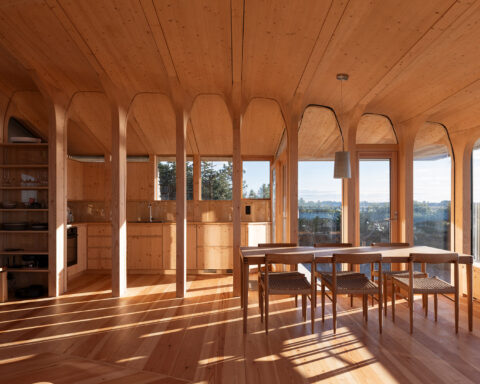
The ceilings of the main rooms are always as high as possible and made of wood, offering a stark contrast to the smaller complementary spaces—carved out from the masonry, entirely mineral in character.
The central space is the most communal, most essential part of the house. It’s a double-height atrium on the ground and first floors, topped by a cloister-like space on the second. Two archetypes with strong, simple geometries stacked upon each other, from which the distribution of the house is organized.


The atrium, the tallest space in the house, is marked by four central pillars that free up the inner courtyard and define a virtual void at the heart of the home—home to the living room.
The upper cloister mirrors the atrium’s proportions—airy and light-filled—but lacks its centrality. Here, instead of occupying the center, the activity moves to the perimeter. The core is left to light and ventilation, expanding the circulation areas and merging with the adjacent rooms. It’s a shared extension of the private spaces—a collective realm.


Project: Casa 1736.
Architects: H Arquitectes. David Lorente, Josep Ricart, Xavier Ros y Roger Tudó.
Location: Barcelona.
Years: 2020-2023.
Built area: 631 m2.
Collaborators: Miquel Arias, Maya Torres, Maria Ferré, Albert Ferraz.
Team: DSM arquitectes (estructura), M7 Enginyers (instalaciones), Carles Bou (arquitecto técnico)
Photography: Adrià Goula.
Text: H Arquitectes
Award: Premi FAD d’Arquitectura 2024 (ex-aequo).

Photo: José A. Santos
H Arquitectes
Founded in 2000 by David Lorente, Josep Ricart, Xavier Ros, and Roger Tudó, H Arquitectes is a Barcelona-based architecture studio that combines professional practice with academic work. They teach at the School of Architecture of the Polytechnic University of Catalonia (ETSAV and ETSAB), at the Swiss Federal Institute of Technology in Zurich (ETHZ), and at Harvard Graduate School of Design.
Their work has also been shared at institutions such as the Porto Academy, the Architectural Association in London, the University of Texas at Austin, the Pontificia Universidad Católica de Chile, the École d’Architecture Paris-Villemin, and Umeå School of Architecture, among others.
Over the years, they have received numerous national and international awards—including the 2024 FAD Architecture Prize. Their work has been widely published and exhibited.
Project by H Arquitectes