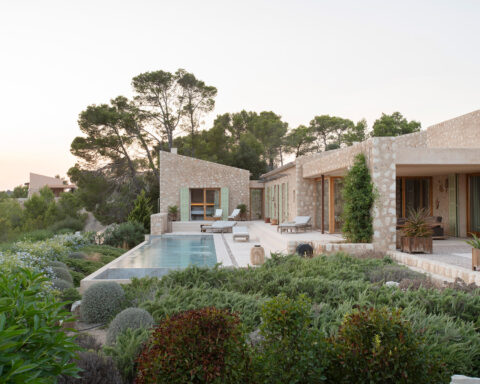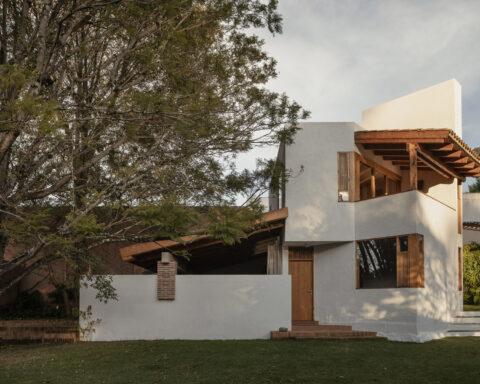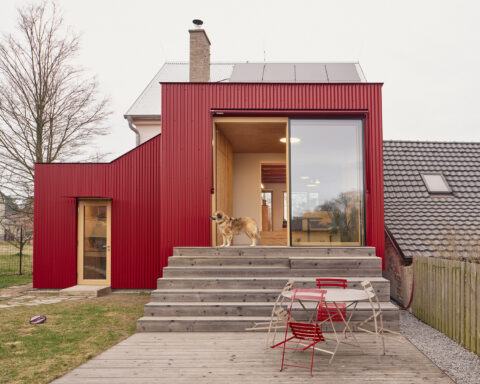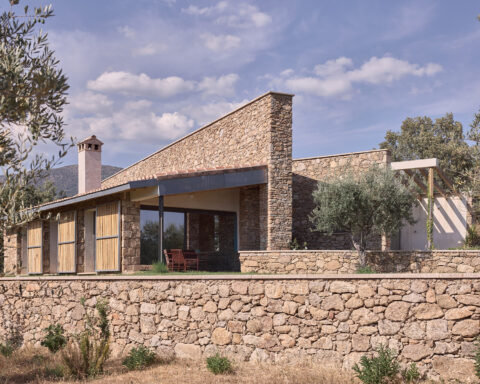


To live among the treetops of a dense pine forest and glimpse the sea in the distance is a rare privilege—one achieved in a small town on the coast of Tarragona by the owners of Casa CLO. They were looking for a second home where they could enjoy the calm of the forest alongside the proximity of the Mediterranean. Familiar with the philosophy of Alventosa Morell Arquitectes, they entrusted the studio with the project, granting them complete freedom to define both the strategy and the material language of the design and construction.
The plot is characterised by a steep slope, rocky ground, and a single access point from its lowest level. The sea is only visible from the upper part of the site. This dual condition—forest and horizon—structures the entire proposal. Casa CLO rests lightly on the terrain, developing a way of inhabiting that remains in equilibrium with the place, where architecture is organised from the landscape outward.
The architectural response is built upon the acceptance of limits. Any earthworks would have been complex and costly, leading the programme to be fragmented into three volumes arranged at different levels and concentrated in the highest part of the plot in order to capture the views. The layout is neither geometric nor rigid: the volumes adapt to the position of the existing trees, avoiding their removal and introducing a subtle rotation in plan that gives the ensemble an organic configuration, intrinsically linked to the site it occupies.


The timber structure is one of the project’s defining gestures. The entire weight of the house rests on ten pillars, significantly reducing the intervention on the ground. This solution not only limits the impact on the soil but also echoes the verticality of the forest itself, visually and constructively extending the rhythm of the trunks into the domestic scale. The house touches the land lightly and rises among the trees that surround it.
Planning regulations require excavation along the street line, an operation that the project takes advantage of to locate the parking area. From here, a staircase runs along the side of the plot and choreographs the arrival sequence: first the swimming pool, then the terrace, and finally the entrance to the house. The route is not direct or immediate; it follows the natural slope of the terrain and prepares the transition into the home through an outdoor sequence.
The interior is organised around a central double-height space that houses the dining area and kitchen. From this core, a continuous visual relationship is established between the shared spaces of the three volumes, reinforcing a sense of unity despite the programme’s fragmentation. A metal staircase connects the different levels: the intermediate floor contains a double-height study and a bedroom, while the upper level accommodates two additional bedrooms.
Casa CLO is an exercise in precision. Every decision—the fragmentation of the volume, the lightweight structure, the adaptation to the slope, the preservation of the trees—responds to a careful reading of the site and to an understanding of architecture as a mediation between landscape, regulations, and ways of living. There are no superfluous gestures or forced solutions. Only an architecture that allows itself to be permeated by the landscape, guided by the owners’ desire for peace and tranquillity.


Project: Casa CLO.
Location: Costa de Tarragona.
Completed: 2025
Surface area: 140 m2
Authors: Alventosa Morell Arquitectes (Marc Alventosa, Xavier Morell)
Team: Néstor Morro (arquitecto), DMS Arquitectes (calculista), Iñaki González de Mendiguchia (arquitecto técnico)
Photography: José Hevia.
Source: Alventosa Morell Arquitectes.

Alventosa Morell Arquitectes
In the landscape of contemporary architecture—where technical innovation coexists with environmental urgency—the studio Alventosa Morell Arquitectes stands out with clarity. Founded in 2012 by Marc Alventosa Zaidín and Xavier Morell Jané, and based in Barcelona and Lleida, the practice has made sustainability a fundamental principle—the true DNA of the way it conceives architecture.
Their architectural practice is grounded in a firm conviction: architecture must respond to climate, landscape and people with solutions that, through sensibility and beauty, ensure comfort, efficiency and environmental respect. This is not about adding a “green” layer to construction, but about designing projects that are born already integrated into a natural balance.
A methodology that listens to place
Each project begins with a gesture of attention: observing the territory, reading the topography, studying the sun, the wind, the shadows. From this initial dialogue emerges a design that combines passive strategies, noble materials and responsible construction systems. Handmade ceramic brick, certified timber or natural insulation coexist with technical innovations that make it possible to reduce energy consumption by more than 70% compared to a conventional dwelling.
Intermediate spaces—porches, courtyards, pergolas—become true climatic refuges, places of transition where architecture reveals its ability to soften the seasons and celebrate everyday life.
Projects that become manifestos
From their hands have emerged homes that are almost manifestos of a new way of inhabiting. Casa GJ in Matadepera (Barcelona) unfolds through nine south-facing structural modules that connect interior and exterior. MM House in Valldoreix (Barcelona) recovers and transforms a 1947 home, combining thermal mass and natural light in a dialogue between memory and future. LA House in Llinars del Vallès (Barcelona) explores the honesty of traditional materials to achieve low energy consumption standards. And Casa CG in Creixell (Tarragona) distils their philosophy into two words: resource optimisation.
Each project reaffirms their commitment to an architecture in which excess has no place—only precision, restraint and environmental generosity.
Their work has been recognised with national and international awards such as the 2025 Architizer AA+Awards, 2024 DNA Paris, 2024 Architizer Awards, 2024 ArchDaily Awards, 2023 4 Future Awards, 2023 Dezeen Awards, the 2022 Mapei Award for Sustainable Architecture and the 2019 BUILD Architecture Award. These distinctions underline that their approach resonates not only with clients and users, but also with specialised critics.
Marc Alventosa, the son of an architect, grew up among drawings and construction sites, learning to observe spaces with the patience of someone who knows how to listen. His sensitivity leads him to reflect on nearly zero-energy buildings as an urgent necessity in the face of climate change.
Xavier Morell, whose career has been shaped by both public and private projects, contributes a broad vision that integrates rehabilitation, industrialisation and research into materials as part of the natural evolution of contemporary architecture.
Together they form a balanced partnership, in which creativity and technique complement one another to give life to a studio whose work is recognised above all for its ethical commitment.
Alventosa Morell Arquitectes
Carrer Rocafort 67-69
08015, Barcelona
+34 93 182 07 80
arquitectes@alventosamorell.com
www.alventosamorell.com
@alventosamorell
Project by Alventosa Morell Arquitectes