
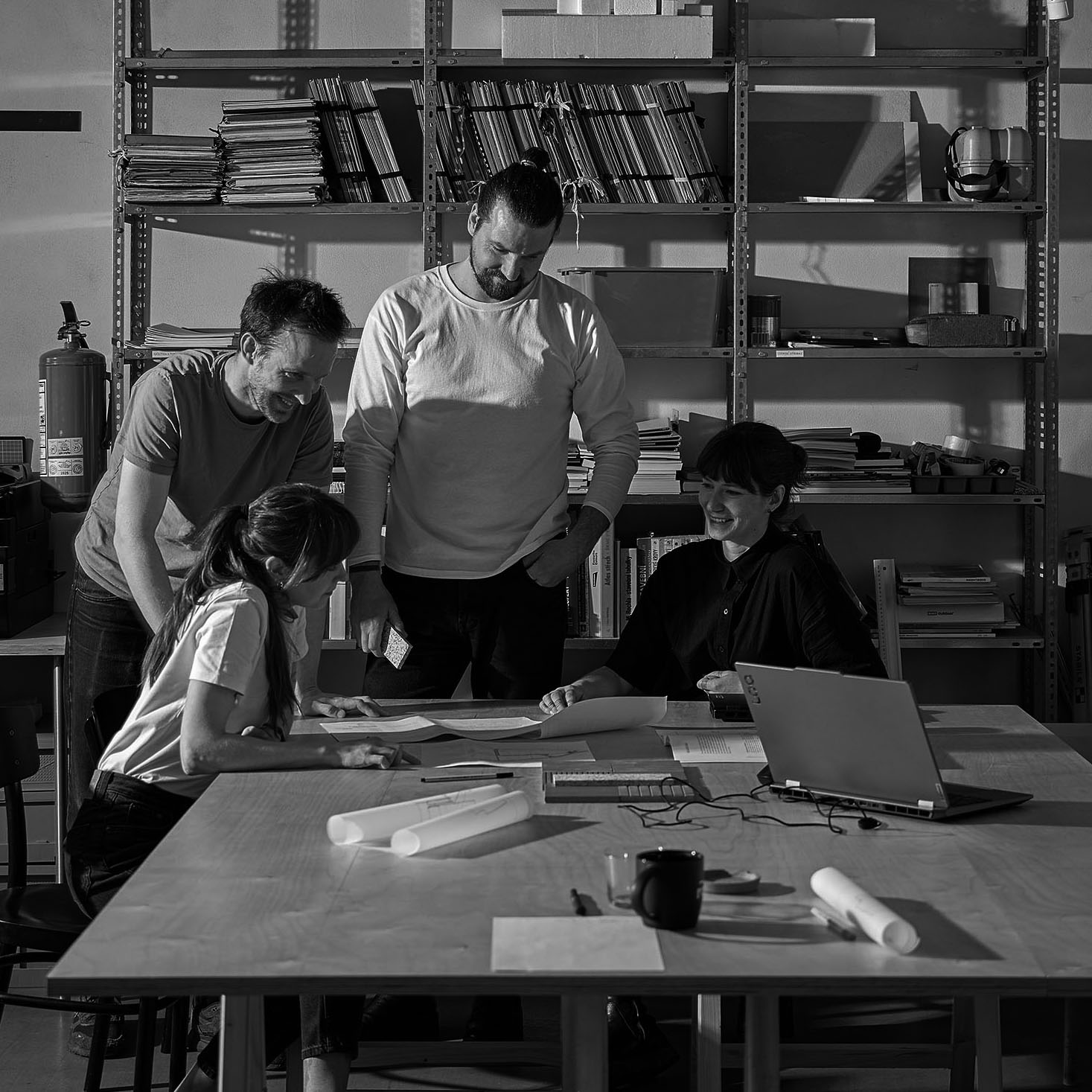
Facha architekti is an architecture studio founded in Prague in 2018 by Jana Fischerová, Martin Chlanda and Matěj Nepustil, joined in 2020 by the artist and designer Andrea Sobotková, completing the current team. They work from a studio in an inner courtyard in the Smíchov district, and the name already announces a way of understanding the craft, in colloquial Czech, facha is work, toil. The founders met at the Faculty of Architecture of the Czech Technical University (ČVUT), and part of their roots lies in the Povětroň studio, where they began to share a common outlook on Czech rural architecture and the search for its character.
Each arrived by a path of their own. Martin trained at a school of arts and crafts in Český Krumlov specialising in the restoration of historic buildings. He later spent three years in the interdisciplinary studio of the Academy of Fine Arts in Prague, an experience that dismantled the prejudices of his earlier training and brought him closer to the contemporary art of Gordon Matta-Clark, Pierre Huyghe or Francis Alÿs. Matěj grew up observing the evolution of contemporary architecture through his father, also an architect, while Jana, the daughter of an architect, sat the faculty’s entrance exams almost as a trial run that ended up becoming a vocation. Andrea’s arrival strengthened an inclination present from the outset, the dialogue with art, which the studio also cultivates in installations for public space made with artist friends.
Their references combine the precision of Peter Zumthor and the Swiss and Austrian tradition with the deliberate rawness of Arno Brandlhuber or Jan De Vylder, but their closest source lies in their own territory. The vernacular architecture and anonymous self-building of Czech villages, they consider a heritage as fertile as the international magazines that fill their shelves. Hence their interest in transforming what already exists, from historic buildings to ordinary houses from the second half of the 20th century.
The small scale is a conscious choice. Single-family homes and seasonal retreats offer them creative freedom and, above all, a close and lasting relationship with those who will inhabit them. Within the team, sensibilities complement one another: Martin and Jana have the ability to imprint the character of its owners on each house, while Matěj leans towards more general solutions, attentive above all to the surroundings. Martin sums up this ethic in the idea that a well-designed house is an imprint of the person who lives in it, and he borrows from Joseph Beuys the notion of “social sculpture”: beyond the built form, each work should cultivate relationships with the client and with those who work on it, and end in friendship.
The building site is the studio’s other natural habitat. Its members alternate between the computer and construction, convinced that combining intellectual and physical work is a healthy way of thinking about architecture, and that contact with the landscape and with people outside their own circle enriches the project. That early aspiration to carry out at least one work a year with their own hands has become an established part of their practice, especially in small projects whose unconventional details are difficult to entrust to others. Works such as the house in Kořenov, between the Jizera Mountains and the Krkonoše, or The Box in the Barn, a seasonal retreat inserted into a barn in eastern Bohemia, have brought them international exposure, and the renovation of an apartment next to Prague’s Old Town Square was nominated in 2025 for the Czech Grand Design awards. With an eye also on public space, small urban ensembles and models of collective housing such as Baugruppen, Facha architekti holds that the generosity of a building is independent of its size, that intuition and passion often weigh more than exact parameters, and that in every building form, structure and material coexist with the people and stories that sustain it.