
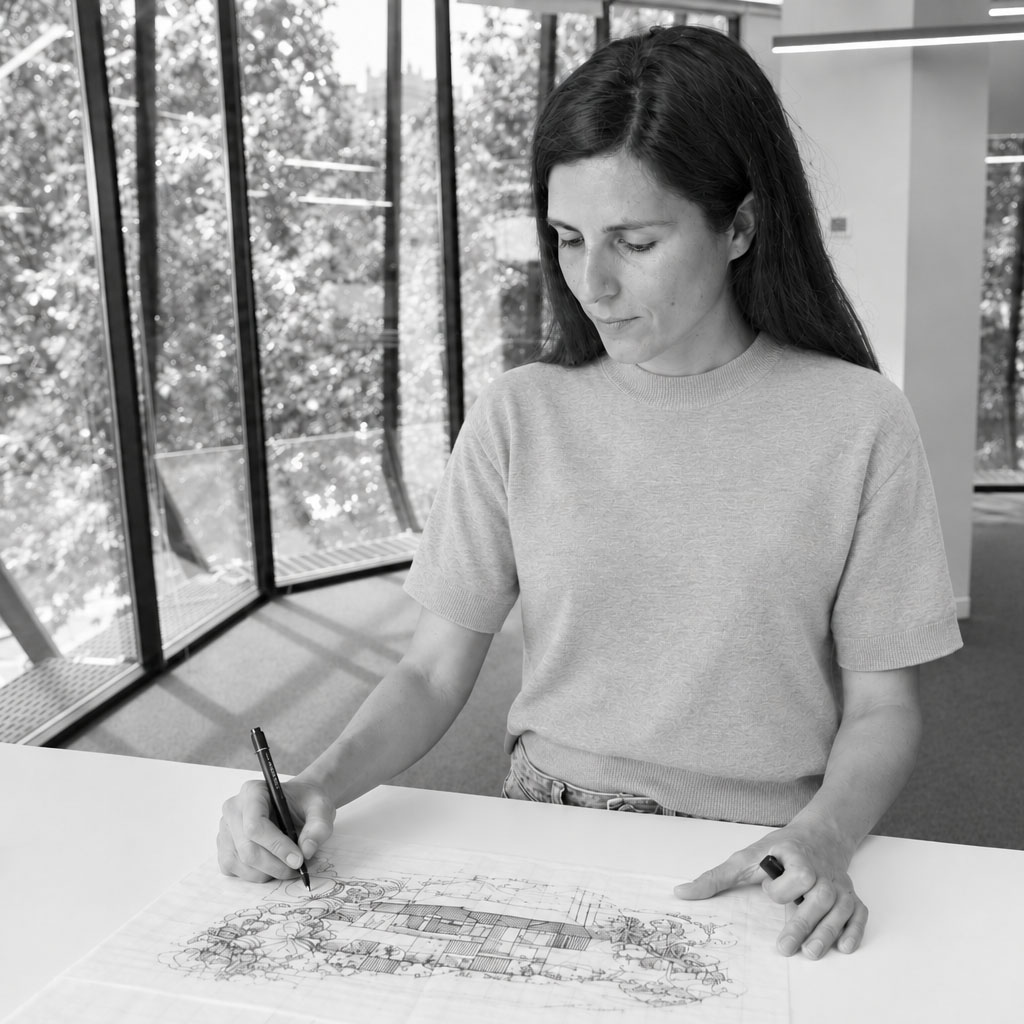
Berenice Moran trained as an architect at the Madrid School of Architecture (ETSAM, 2009). Her early years in practice took her through some of the most demanding studios on the international scene: she worked at Nieto Sobejano Arquitectos in Madrid, and then in Copenhagen, first at MORE (model research) and later at OMA. In 2017 she founded her own studio, working mainly in Mallorca and in various parts of mainland Spain. Between 2018 and 2022 she was also co-founder of MOYO Architects in Palma. Her projects have won awards in architecture competitions and have been published in specialised media. Her current work includes the Génova Sociocultural Centre in Palma, a first-prize competition entry now under construction.
Her method begins with listening: to the client and their way of living, but also to the place, its landscape, its culture and its memory. Each work grows from a generating idea, with a poetic dimension rooted in its context. From the earliest stages of design she seeks unity between space, material, structure and construction system, so that formal expression, function and constructive logic answer to a single line of thought. Light, spatiality and materiality shape her language. Light models volumes and builds atmospheres, while proportion and the tension between weight and lightness give the work a timeless quality, removed from styles and trends. “Architecture must not only be understood; it must also be felt”, she says.
Her interest in structures led her to specialise in timber construction at the School of Forestry Engineering in Madrid (ETSI Montes). She sees technique as part of the creative process, and materials as decisions that shape the design from the outset. Timber, a living material, brings warmth and a sensory dimension to her spaces, in service of buildings that are functional, technically rigorous and made to last. The result is an essential architecture that reinterprets the values of traditional building from a contemporary perspective. In it, each work finds its own identity in the balance between the poetics of space, constructive rationality and a sense of belonging to its place.