

With a fishing tradition, Moraira is a small town on the Costa Blanca featuring historic buildings, a fortified church, a castle, and walls that coexist with abundant sandy and stony beaches, along with a generous nature perfect for enjoying long walks by the Mediterranean Sea.
Can Bau, designed by Paloma Bau in collaboration with Viraje Arquitectura, is a summer residence in Moraira for three families (her family), ready to stop the clock and let themselves be enveloped by the endless summer. It is a place to forget the noise and hustle and bustle, to surrender to the passage of time, enjoying calm and tranquility at any time of the year.
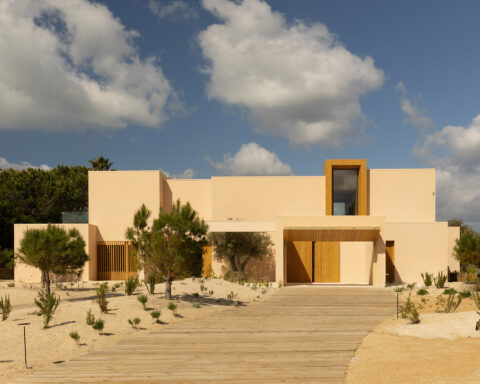
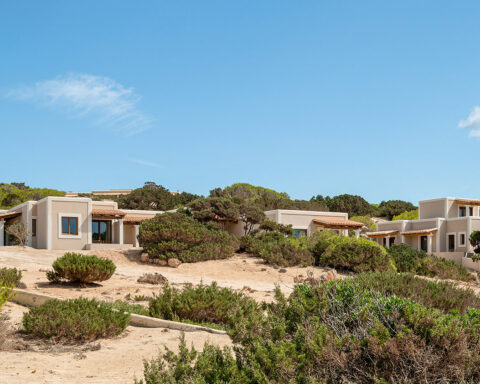
The architecture, developed in the traditional way, using manual means and with only four materials—continuous troweled concrete paving, lime mortar cladding (also continuous), stone, and ceramics—builds a house that is integrated into a privileged place of great beauty, in which the white of the lime and the reddish color of the stone coexist with the green of the abundant vegetation and the scent of the breeze from the nearby sea. “We wanted to make a very Mediterranean house, in the traditional architectural style of the area: reddish stone walls, lime cladding, curved edges, and sloping roofs,” says Paloma Bau.


Exterior and interior merge into one space
Can Bau offers an open architecture where interior and exterior merge into a single space in which the continuous paving throughout the house becomes a common thread and invites you to embark on a journey through a house without hierarchies, where everything is shared.
The house adapts to the plot, which has complex topography and a significant difference in height, generating three platforms separated by just two steps that differentiate the main areas: night area, day area, and swimming pool.
The furniture in the wet areas, kitchen, barbecue, and outdoor areas is resolved with masonry elements, appearing as annexed volumes that emanate from the floor and walls, clad in the same materials.
Outside, a large porch in front of the swimming pool and garden is the favorite summer space, a place for family gatherings and endless after-dinner conversations to enjoy the Mediterranean atmosphere of an ever-present summer on this Costa Blanca.


Inside the house, built on a single floor, there are two distinct areas: the day area designed as a large space with a high ceiling and sloping roof, featuring an open kitchen with built-in furniture, an island with views of the swimming pool, a dining room, and a relaxation area with a sofa nearly 5 meters long in front of the wood-burning fireplace.


The sleeping area includes three double bedrooms, two bathrooms and a children’s bedroom.


Craft and furniture restoration
The interior and exterior furnishings combine handcrafted elements, such as the esparto grass lamps from a local basket maker, the kitchen lamps designed by Adriana Cabello, the wooden chairs in the dining room made from natural fibers, and the esparto grass mats on the porch, with restored antique pieces, such as the dining table, an old family table made from solid wood, and custom-made furniture made from out-of-context materials, such as the 4-meter-long outdoor table made from the same material as the swimming pool.
All the textiles in the house have been chosen in neutral tones, with linen predominating. And the metalwork and accessories stand out in black against the neutral palette of the house, giving a more contemporary character to the whole.
Project: Can Bau.
Architecture: Paloma Bau Studio, Viraje Arquitectura.
Location: Moraira (Alicante).
Surface: Plot of 800m2. House 180m2.
Finished: 2023.
Photography: David Zarzoso.
Video: Santiago Gómez Portillo.

Paloma Bau
He studied Technical Architecture at the Universitat Politècnica de València (IPV) and Interior Design at the IED Barcelona. She defines her work as “Architecture that travels to interior design or interior design impregnated with architecture“. Obsessed with attention to detail and finding the differentiation and transmitting the essence of each space, she accepts the great challenge of turning spaces into inspiring places, convinced that “there are no impossible places“.
Source: Paloma Bau Studio.
Paloma Bau Studio
Sornells 21
46006 Valencia
+34 699 876 227
hola@palomabau.com
palomabau.com
Viraje Arquitectura
Pérez Pujol 3
46002 Valencia
692 179 835 | 963 513 128
info@viraje.es
viraje.es
Project by Paloma Bau