

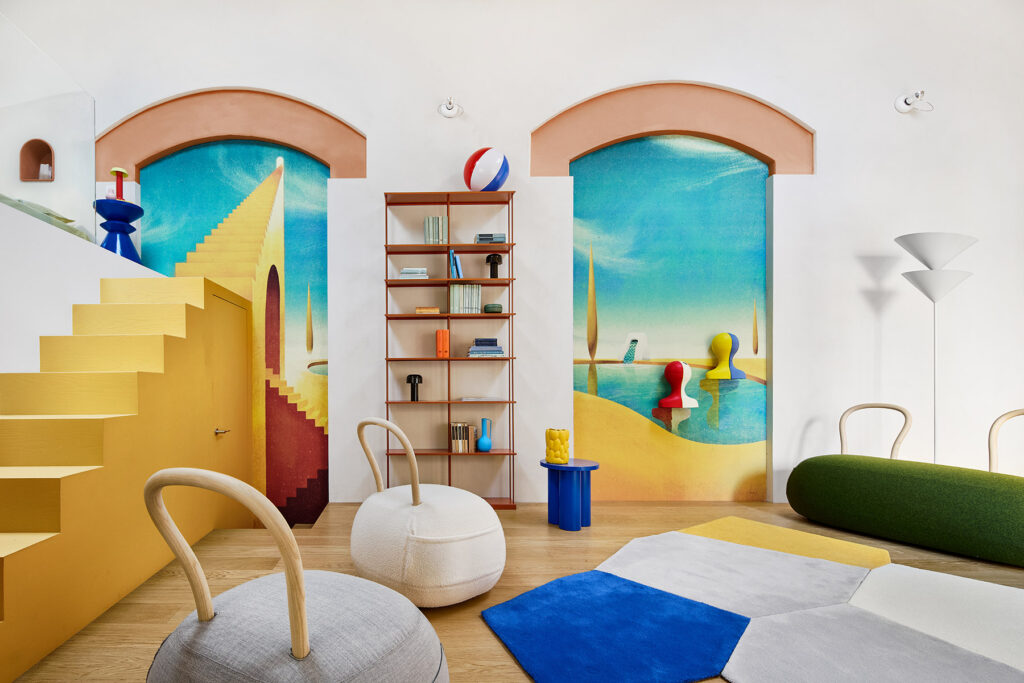
Speaking of celestial bodies, and since we do not believe in chance, we were not surprised to discover that our client, Athos, was a professor of astrophysics close to retirement, with a great interest in philosophy and metaphysics. At our first meeting he told us that for some time he had wanted to renovate a small building he owned and used as a storehouse. The idea was to turn it into a small loft and then let it as a B&B, but for a series of reasons he had always put off starting the work, partly because, since losing his wife, he found it hard to undertake any project on his own. It was, as he put it, a genuine psychological block. He knew he had to overcome it, but in the meantime time went by.
Several years had passed and the storehouse lay half empty at the far end of the courtyard, almost forgotten. Inside, a few pieces of furniture and some work tools slept beneath a heavy blanket of grey dust, while outside the moss and ivy gave it the sinister air of an abandoned fortress. This caused Athos deep unease, and he, by now almost unable to react, had resigned himself to leaving it as it was.
That year summer returned, with its burst of light and that festive atmosphere that heralds the start of the holidays, but for Athos it was not a particularly happy time. He would have to say goodbye to his friends, who would soon be leaving the city. Since being left alone, in recent years he had also lost interest in travel and holidays. And he was even less inclined to join in the plans of his friends, who never failed to invite him. Even Elisabetta, a veteran of the Milanese summer, had told him she was leaving for the South: she had some family matters to settle. So, for the first time, Athos would be truly alone in the city. Betta, as he fondly called her, had invited him to dinner to say goodbye before she left. They had known each other all their lives, and to Athos she was almost a sister.
It had been a long time since he had walked through the centre, and he knew that at dusk the hyperkinetic frenzy of the urban jungle would ease a little. So that evening he decided to set out early and walk to her house.
Coming down the stairs of his building, he crossed paths with Lorenzo, the big ginger cat of the courtyard, who scrutinised him closely. That evening his enormous amber eyes seemed exaggeratedly wide: how could they be so big? The two stood motionless, studying each other for a moment; they were so close that Athos could see every shade in the feline’s eyes. They looked like precious stones. He had the feeling of standing before a small lion, before a divinity. That cat was as beautiful as the sun, he thought, and he understood why the priests of old had worshipped its ancestors. That solemn presence carried all the strength of Africa, of the desert. Athos had read somewhere that the first European cats came from the desert, so he was certain he had before him an Egyptian god rising up like a sphinx. It was no coincidence. It was a precise sign; it wanted to convey a message to him, Athos was sure of it. But what tidings would the royal emissary bring him?
All the way there he could not stop thinking about those enormous eyes that pierced him. Athos walked through the streets and squares of the city and felt his steps being watched relentlessly by the great eyes of his idol. As if under a spell, everything around him reflected the amber light of that gaze. Even the sky had taken on the same hue. A sparkling energy ran through his body, like a slight electric charge. It had been a long time since Athos had felt as alive as he did that evening: something was about to happen, he could sense it. The rattle of a distant tram reminded him that he had almost reached his friend’s house.
He had just passed Piazzale Cadorna when, right beneath the porticoes of the Triennale, he had an extraordinary vision. The sun, already very low, painted long shadows between the columns of the Palazzo dell’Arte. All around, the same amber light that had accompanied him there still enveloped everything, but now, against the deep blue of the horizon, it traced a dazzling golden outline over buildings, trees and people, creating a surreal composition. The few passers-by, their faces indistinct, walked in silence, while others seemed motionless, like strange stylised mannequins. Their physicality was diffuse, suspended. The figures in motion seemed to advance in a strange procession, like the characters of some mysterious play. Athos, intoxicated by that magic, closed his eyes, as if he wanted to stop the moment. He no longer had any doubt: he was completely immersed in what must have been a tableau vivant straight out of a De Chirico painting.
The cheerful cries of a flock of swallows wheeling in the cool air brought him back to reality. As he watched them chase each other in play, he noticed that a little further on a crowd had gathered. They were surrounding something or someone, probably a street performer, so he decided to go and see. Just as he arrived, the delicate sound of a flute reached him.
The musician was a boy with thick, shoulder-length hair. While his flute played a famous romantic ballad that seemed the perfect commentary on that sunset, his body swayed with the grace of a classical dancer, his eyes half-closed in concentration. Despite his short stature he had an innate elegance, the fruit of his perfectly proportioned body, sinuous and slender. When he finished, many came forward to congratulate him and drop a few coins into the hat he had placed in front of him; Athos did the same.
Struck by his poise and his talent, he decided to go up and ask him a few questions. The boy smiled but, perhaps out of shyness, answered in a somewhat confused and vague way. He said his name was Ravi and that he came from India, that he was only 19 and had arrived in Milan that very morning after an eventful journey in several stages. Against the light, his velvety skin seemed dusted with gold, and his large hazel eyes stretched dizzyingly over his cheekbones, like the illustrations in the book on the deities of the Hindu pantheon that Athos kept in his library.
Ravi excused himself with a polite bow of the head, as if to thank him, and began to play again. The mood darkened as a slow, melancholy tango seemed to tell of his long journey to Italy. The notes dragged on slowly, laden with that heartbreaking melancholy. Athos felt loneliness devouring him and, as he left the young man behind, he could not help feeling sorry for him too.
Overcome by bewilderment, almost as if he wished to flee the state into which he had fallen, he quickened his pace until he reached Elisabetta’s house. She talked like a river in flood throughout dinner and did not even notice that Athos’s mind was elsewhere. When the monologue was over, the hostess saw her guest to the door. The taxi had already arrived, but Athos preferred to walk home and cancelled the ride.
When he reached the Triennale again, the place was deserted and the atmosphere was very different from the reverie of the evening. Night had fallen and, with it, unease. Ravi was still there, half hidden behind one of the great columns, sitting on the ground with his head buried in his folded arms. As he drew closer, Athos realised he had been crying. He asked him what he was still doing there so late, what had happened, whether he had somewhere to sleep. Ravi replied that he did not, and that all he wanted was to go back home, to his father. With nowhere to go, despair had overwhelmed him: he felt completely alone in a big city. Athos sat down beside him and, trying to comfort him as best he could, put an arm around his shoulders. The darkness enveloped them, and the two talked for what seemed an infinite time. Ravi told him his story.
He was from Jaipur, in the state of Rajasthan, from a family of textile merchants. His mother was a music teacher and had passed the same passion on to him. His father ran the business from a shop not far from the city centre. They belonged to a Sikh community that had settled in the region after the partition of India in 1947. So Ravi had grown up with rigour and discipline, according to the iron teachings of the Sikh religion.
The clashes with his father, a stern man little given to dialogue, had been countless. The boy described him as cold and distant. He had never managed to truly communicate with him, and whenever he tried to express his opinion, his father lashed out and opposed him violently. The harder his father showed himself to be, the more Ravi grew into a gentle, empathetic character. Of one thing he was certain: he wanted to be the opposite of what his father was. Music had always helped him through dark times and allowed him to express his feelings.
Until one day Ravi came home a little later than usual after a night out with friends, and his father lost his temper. For seemingly inexplicable reasons, he threw him out of the house and told him never to return. The truth was that his father did not accept his son, probably for other reasons. The next day, after spending the night at the home of his friend Ayan, Ravi went back home. His mother, in tears, embraced him and confirmed that his father would not change his mind. It was a blow for the boy. An only child and without work, he felt the world collapsing around him. Ayan’s parents were very kind to him and took him in as a second son. Soon after, Ayan persuaded him to go with him to Leicester, where some relatives of his lived. They would be their guests for as long as it took to settle in and find work. His dream of seeing Europe could come true. For Ravi, sustained by Ayan’s friendship, a new life was opening up. His savings, however, were not enough for the journey, so at first Ayan helped him, and in stages they managed to reach Turkey.
They spent a few weeks in Istanbul and then Ayan vanished. One morning Ravi found a message from him that said: “forgive me, I think it’s better this way”. It was another hard blow for Ravi. How he got from Istanbul to Milan was never known. Athos tried to find out more, but Ravi seemed to have erased that part of his story completely.
Athos had already made up his mind: he would offer him the guest room for the night and the next day help him find a solution. At first Ravi turned down the invitation, but when Athos had already walked a little way off, the boy caught up with him. The next day was Sunday, and Athos showed Ravi the city, almost completely deserted. In the afternoon they returned to the centre and decided to visit the inside of the Triennale building, because Ravi was curious about some colourful figures glimpsed in the garden. They had lunch at the Caffè del Museo and, after walking through the interior, went out into the garden, in front of the famous pool of I bagni misteriosi. Then Ravi stood motionless before the sculptures and, in a very low voice, almost talking to himself, said: “an encounter”. Athos thought of Lorenzo and felt himself watched once more by his deep eyes. Then, for an instant, he thought he heard Ravi’s flute in the distance. The atmosphere regained the same suspension as the previous evening, but this time the sun was high and the heat torrid. The light of the zenith made the white marble of the building and the courtyard dazzling, and created that optical effect whereby sunlit surfaces seem to shimmer and dissolve into the air.
Athos asked him to explain what he meant, but Ravi, with the leap of a panther, ran off to the edge of the pool. Athos watched him from a distance, overwhelmed by the beauty of his harmonious figure. The song of the cicadas was deafening. Ravi took the flute out of his rucksack and played again the melancholy piece of the night before. Athos asked him what that sad music was called, and the boy replied that it was Il Sole Stanco (The Tired Sun), an old Polish tango. It was part of his childhood memories: his maternal grandmother often listened to that record. Ravi explained that the sun, too, could sometimes be tired and sad. It was an idea that struck Athos deeply, because the sun had always been associated with strength and vitality.
As if he wanted to break out of that moment, Athos asked the boy whether he would like to become a real bather. Ravi burst out laughing and asked him what he meant, and Athos replied that, in that unbearable heat, they could cool off in a real swimming pool. Soon afterwards they were in the water, amid the shouts of children. Ravi was overjoyed and kept diving and swimming underwater. Athos watched him, amused. The boy came up to him and, looking him in the eyes, asked whether he would help him. In a choked voice he said: “I want to go home, to my father”. He spoke these words with a disarming fragility and delicacy. Ravi wanted to be reconciled with his father and was sure he would succeed. Athos decided to help him and, without hesitation, that very night arranged the journey to accompany Ravi back to his home in India.
For Athos it would also be a chance to see the famous astronomical observatory of Jantar Mantar, which stood in Ravi’s own city, Jaipur. Built by Jai Singh II in the 18th century, it was a sophisticated ensemble of architectures that functioned as astronomical instruments, commissioned by the enlightened maharaja to observe the stars. It had always fascinated Athos and, in his imagination, being a mythical place, the visit would be a kind of almost mystical pilgrimage. The opportunity had arrived. He would return Ravi to his father and together they would visit the observatory.
They left the following day. Throughout the journey to India, Ravi never stopped asking Athos about the positions of the constellations or the distance between one planet and another. Athos was happy to teach him and, at the same time, impatient to visit Jantar Mantar. An enormous trust had already grown between the two.
In Jaipur they slept in a hotel not far from Ravi’s home. The next morning they said goodbye. Athos wished the boy luck, and he, visibly moved, thanked him with a tight embrace. Athos was alone once more and decided not to waste any time: everything had been fulfilled, and all that remained was to set out on the long-awaited pilgrimage, the visit to Jantar Mantar. He reached the site just at sunset. The amber sky had the same hue as the architectures, which, painted partly in ochre, seemed to reflect it. Everything seemed to be reflected in everything. At that hour no one was left. Athos wandered among those enigmatic structures, his heart suspended with emotion. Then he came to the famous astronomical stairway, built as an enormous sundial to study the sun: a very tall double flight of stone steps that ended in the sky. At the top, in fact, a small pavilion served as a gateway to the firmament. Scholars used it to measure the position of the sun precisely. For its time it was an extraordinarily advanced instrument of observation. That extraordinary architecture, which Athos had known from books since he was a boy, was now there, right in front of him.
Athos closed his eyes: he knew he was standing before a stargate, a point of no return. He felt that climbing that stairway would mean a change of life for him, a spiritual ascent. For too long he had let himself drift, had allowed sadness and melancholy to consume him, but now he felt ready to change. He did not yet know what or how, but he felt within him the fire of a new life about to be born. Each step was a stage of reflection for him. Who was he? What had he done until then?
When he reached the last step, his emotion was overwhelming. He opened his arms to receive the sun, by now a great red sphere above the horizon; then he turned his head and saw his body cast a gigantic shadow down every step, all the way to the base of the structure.
Suddenly a gust of wind reached him, and he thought he recognised the scent of patchouli and rose from Ravi’s hair. At that moment he saw, in the distance, a small figure running across the esplanade at the foot of the ramp. It was Ravi, who climbed the stairway in an instant and reached Athos. The boy burst into tears and there was no need to explain anything. His father had rejected him again. He was inconsolable and sobbing so hard that he seemed about to choke. Athos held him close and, little by little, Ravi calmed down.
When his breathing had steadied, he raised his face towards Athos. At that instant, a ray of sunlight crossed his profile and lit up his face. His eyes, still veiled with tears, shone like gems, like golden crystals. He rested his head on Athos’s chest and, seeking refuge in his embrace, called him “father”.
Project by Studio Paradisiartificiali