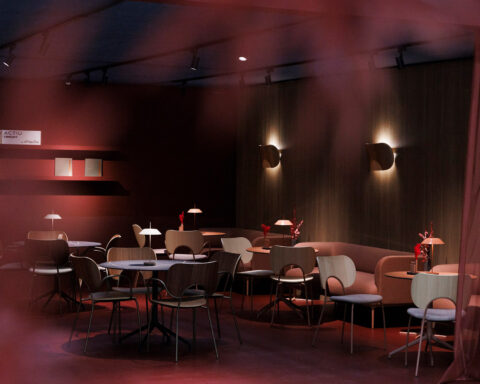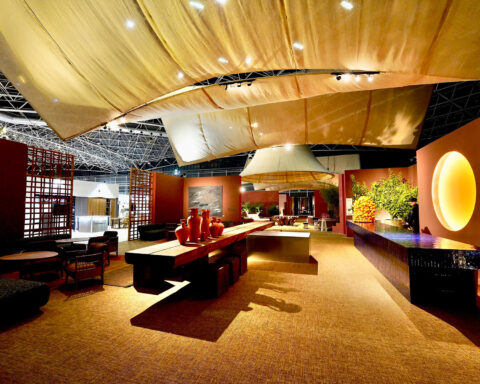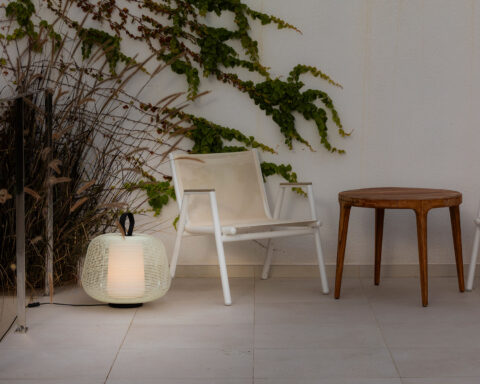

Te were thinking of dedicating a special page to Héctor Serrano, to his career and his designs. Tachy Mora has provided us with the Exhibition Héctor Serrano: El viaje entremedias. 25 años conectando, which he has curated, with such success, with the support of DIMAD, in the environment of the Madrid Design Festival 25 and which can be seen at the Central de Diseño Matadero Madrid, until 30 March..
Tachy Mora explains that “the exhibition seeks to transmit what Héctor Serrano’s approach and design processes consist of, in which the journey he makes between the starting point and the result is of great relevance, and where what he calls the unexpected ingredientoften intervenes : that spark that characterises his proposals and that can appeal to the user in a fun and creative way immediately, or manifest itself in a not so obvious way at the level of innovation, research or sustainability“.


The exhibition is designed by Héctor Serrano and brings together for the first time almost a hundred of his works, produced for brands and entities such as A-Emotional Light, Ezpeleta, Faro Barcelona, Fontana Arte, Fundación La Caixa, Fundación Telefónica, Gandia Blasco Group, Kikkerland, Lékué, Lexon, Möwee, Muji, Nagami, Porcelanosa, Roca and Seletti, among others.
To facilitate the understanding of his universe of projects, Tachy Mora “has grouped them along an imaginary path according to their most relevant quality (although all of them usually occur simultaneously): innovation, memory, intuition, emotion, creativity and immersion, which in the first three cases function as a starting point and in the last three as a destination“.
From innovation
“Innovation, although a transversal value in Héctor Serrano’s work, is specifically the starting point in some projects. Sometimes, at a material level, when working with novel materials in which he explores their formal and manufacturing possibilities; but it can also act in a silent way, through a complex manufacturing process or a design with painstaking details that may not be appreciated vehemently at first glance. It can also stem from a social or sustainable requirement or need. Sometimes even all three cases occur at the same time” explains Tachy Mora.
Designs in this area
Land, Sea and Air lamps designed for Faro Barcelona that we already commented on in this article. Then we were able to enjoy the video in which Héctor explained this contemporary and at the same time inspiring design of the future. We republish it here. We hope you enjoy listening to it as much as we did.


The Dégradé lamps, a 2020 design for Nagami explores how to achieve a gradient effect with 3D printing technology, adding colour as the piece is printed with a robotic arm.


The Xaloc outdoor furniture collection. An innovative 2020 design for Möwee with extremely slender, organic and fluid shapes, made by combining different elements of cast, injected and extruded aluminium. Pure 21st century modernism.

Welcome Back, the redesign of London’s Routemaster, which won second place in Transport for London’s 2008 design competition.


Horizonte Madrid, winner of the competition organised by the EMT of Madrid in 2023, with its disruptive proposal on electromobility.


From memory
“In the same way that Héctor Serrano innovates from scratch, he also innovates from the memory we have of objects and the collective imagination. Héctor Serrano is a true genius in establishing associations between existing elements that come from different worlds to create a new design. But he also has a special penchant for revisiting designs and improving them: objects that perhaps don’t work as well as they could or new products for everyday needs that he identifies. Because everything in this world is designed, but not all designs are good” says Tachy Mora.
Designs in this area
The V collection of luminaires, created for A-Emotional Light in 2007, whose formal inspiration comes from the curious geometry of the elastic zigzag diadems.


The botijo La Siesta, created in 1999 in collaboration with Alberto and Raky Martínez, currently marketed by Gandia Blasco. A piece born from the union of a botijo and a plastic bottle that has gone beyond its function, becoming an icon of Spanish design.

The Noon chair created for Ezpeleta in 2023. A contemporary reinterpretation of bentwood seating with a rattan grid, made in monobloc, transferred to a more durable material that performs better in public and outdoor spaces.


The Amelia ceiling fans, created in 2023 for Faro Barcelona, in which it addresses the shortcomings in lighting that this type of fans usually have when they also function as lamps, providing them with an ambient light and another direct light.


From intuition
“One of Héctor Serrano’s main concerns during his creative process is that the user is able to understand his designs in an intuitive way, understanding them and quickly connecting with their form and usability” explains Tachy Mora.
Designs in this area
The Porrónpompero, designed for Koala in 2010. A glass utensil that attaches to wine bottles and makes it possible to drink from them as if they were a porrón.


The Inout alarm clock designed for Lexon in 2016, which solves the recurring night-time worry of not remembering whether the alarm has been set, by means of a simple button that rises up and protrudes from the alarm clock when it is set, displaying the set time.

The Alhambra chair, designed in 2022 in collaboration with Inma Bermúdez and Andreu Carulla, as a representative exercise in synthesis. It incorporates in its backrest and sides the Arabic graphics inspired by the Alhambra present in the image of the beer brand. A very durable design, made from 100% recycled and recyclable plastic material, which is immediately associated with the brewery.


From emotion
“Industrial design is a highly technical discipline, in which the importance of meticulously fulfilling function is sometimes magnified. However, Héctor Serrano belongs to a generation in which design began to address the emotional aspects of our objectual world. In this sense, he has always designed from emotion, whether appealing to our sense of humour, to fun or to the mental shock of recontextualisation, but also seeking complicity with the environment in which his designs would be used” says Tachy Mora.
Designs in this area
The Superpatata, marketed by Droog Design in the year 2000, a true manifesto of its style. A luminous and soft object made of latex, it can function as a lamp, but also as a pillow, an anti-stress object or to warm the bed. With this fun, versatile, innovative and unique design, he won the Peugeot Design Award right after graduating from the Royal College of Art.


The Waterproof aquatic lamp, created for Metalarte in 2003. A design with which Héctor Serrano did not create a new lamp, but a new lighting context.

The Isabelle luminaires, created for Faro Barcelona in 2010 with a design that is more complicit with the environment, which stands out for its soft, warm light, filtered by the play of light and shadow generated by its undulating texture.

The Woods collection, designed in 2011 for A-Emotional Light, manages to reproduce with a very Japanese sensibility that magical and special light that filters through the trees in a forest, through a composition of square wooden pieces placed at different heights.

From creativity
“Encouraging the personal creative development of both children and adults has been an important activity in Héctor Serrano’s career. It is something he also does as a teacher, training future designers in creativity” says Tachy Mora.
Designs in this area
Kits to encourage play and creativity, to acquire skills and knowledge or to learn how to make handicrafts, many of them for the Dutch company Kikkerland, with whom he has a long-standing relationship.


From immersion
Héctor Serrano’s studio also carries out important work in the field of ephemeral installations and the curating and design of exhibitions, which it does under the name Borealis.
The exhibition includes audiovisuals of the work he has done for organisations such as the Coachella festival, ICEX, La Caixa Foundation, Mercabarna, Miradors de l’horta, Noken- Porcelanosa, Roca and World Design Capital Valencia 2022.
Solidarity Project
In addition, Héctor Serrano has developed, ex profeso for this exhibition, the solidarity project Raíces, destined to raise funds for the victims of the dana that on 29 October 2024 devastated 85 municipalities in Valencia, leaving the beaches completely overcrowded with trees, trunks, roots, reeds and plant debris that transmit in an overwhelming way the force that the water carried. This project, in turn, reveals the poetics with which the Valencian designer also approaches his designs on certain occasions. The funds will go to Cerai, a non-profit association in Catarroja.


Exhibition: Héctor Serrano: El viaje entremedias. 25 años conectando.
Exhibition design: Héctor Serrano.
Commissioner: Tachy Mora.
Promotes: Dimad.
Dates: Del 27 de febrero al 30 de marzo.
Place: Central de Diseño, Matadero Madrid. Paseo de la Chopera, 14.
Timetable: Tuesday to Friday from 16.00 to 21.00 h. Saturdays and Sundays: from 11.00 to 21.00 h.

Héctor Serrano
Héctor Serrano trained in Industrial Design at the UCH CEU University in Valencia and later moved to London to specialise in Product Design at the Royal College of Art, an institution that created a school among young designers in the late 90s for its disruptive teaching. This experience helped him to understand and build his creative process, laying the foundations for his distinctive style as a designer.
After completing his training, he stayed in London and founded his own studio in 2000, which quickly became famous for its innovative approach to turning everyday products on their head, attracting the attention of the then well-known Dutch collective Droog Design, which marketed his first design: the Superpatata latex lamp.
He was based in the British capital for more than a decade before moving back to Valencia, from where he now works internationally for major brands such as A-Emotional Light, Ezpeleta, Faro Barcelona, Fontana Arte, Fundación La Caixa, Fundación Telefónica, Gandia Blasco Group, Kikkerland, Lékué, Lexon, Möwee, Muji, Nagami, Porcelanosa, Roca and Seletti, among many others.
Héctor Serrano’s work is of great value both creatively and technically. In addition to dealing with versatility in multiple fields of industrial design, Héctor Serrano also creates ephemeral installations and exhibitions under the name Borealis. This other medium, more linked to spatiality and the creation of an experience, allows him to investigate, test and reflect on new materials, technologies or contemporary currents of thought.
Héctor Serrano’s honesty as an industrial designer lies in the combination of putting the user at the centre, designing designs that connect with them through emotions, and proposing innovative products that represent progress. Not in vain, his designs have been exhibited in important museums such as the V&A in London or the Cooper Hewitt in New York and he is regularly awarded international design prizes.

Tachy Mora
Tachy Mora is a journalist and exhibition curator specialising in design and architecture. She has worked as a cultural journalist since 1998, specialising in design, architecture and its interaction with other disciplines. She is a regular contributor to the Sunday magazine of the newspaper El País and Icon Design. She has written regularly for media such as Neo2, Diario Design, Arquitectura, Elle Decoration, Visual, Citizen K or the Magazine of the newspaper El Mundo, among others.
In 2011 he published the book Artesanía Española de Vanguardia (Lunwerg) with the support of EOI-Fundesarte, which he later turned into an exhibition that toured Spain, the USA, Peru, Mexico and Colombia between 2013 and 2016.
She also curated, together with Javier Abio, the exhibition Madtastic! Fresh Design From Madrid, which could be seen in 2013 at the Cervantes Institute in Milan, as well as the small exhibition Autoexpresiones for the Joya 2020 show in Barcelona, which brought together eight designers, artisans and artists with very personal pieces.
His most recent curatorial project was Escenarios de un Futuro Cercano, a prospective on the design of the domestic environment, which was on view from 23 November 2022 to 19 March 2023 at the Centre del Carme Cultura Contemporània, and which formed part of the programme of World Design Capital Valencia 2022.
On the occasion of this exhibition, he published his second book under the same title which, beyond functioning as a catalogue of the exhibition, explores and reflects on the possible changes that housing and its equipment could undergo in the coming years.
Sources: Héctor Serrano y Tachy Mora.
Héctor Serrano
González Martí 1
46008, Valencia
+34 960 213 460
info@hectorserrano.com
hectorserrano.com
@hectorserranostudio
Tachy Mora
tachymora@gmail.com
tachymora.com
@thisismadtastic