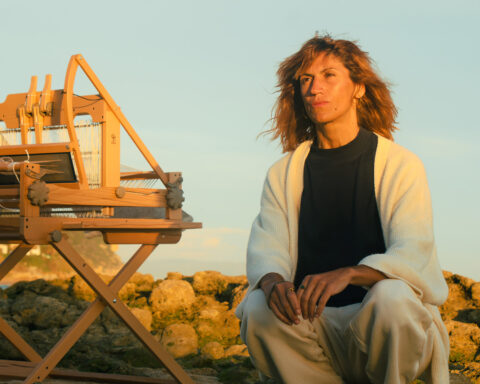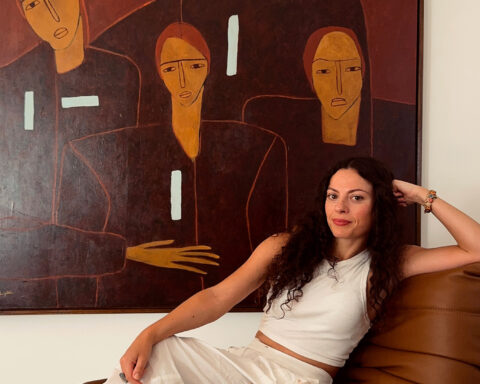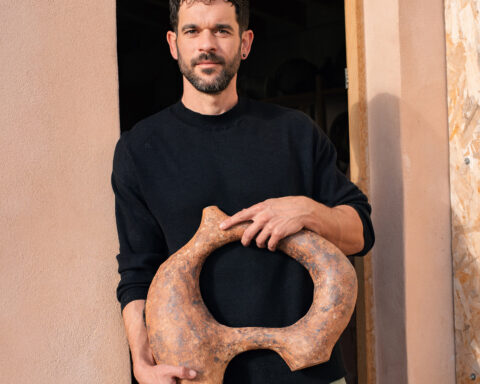


Presenting this book, Lavacedario, is a great personal joy, as it gives me the chance to introduce the three key figures behind this project. Fernando Berenjeno. His photographs of Lavacedario are both surprising and evocative—an urgent call to those of us who love nature to take real responsibility for its care, beyond words, fully aware of the harm we continually inflict. Fernando Beltrán, a dear friend across the distance. His poems have given me a deep emotional jolt, for which I am immensely grateful—something we increasingly value at our age. Pep Carrió, a remarkable artist and designer, who has gifted us the beautifully crafted edition of this book—an authentic work of art, like everything he touches. His long dedication to the craft of design, so often underestimated, is truly admirable. I hope you enjoy this beautiful Lavacedario as much as I have.
Andrés Moratinos.
The memory of the volcano
There’s something awe-inspiring about discovering the alphabet of memory while walking through El Confital, in Las Palmas de Gran Canaria. If one pays close attention, a language of symbols begins to speak: circles, faces, lines, shapes as clear as fossils, or others as vague as fleeting geometries. Traces that the sea, with the chisel of its waves, has patiently carved—allowing us, like a jealous sculptor, to observe them only once a day. Every twelve hours, the tide withdraws and this ancestral alphabet is revealed.
These are mysterious vestiges where forms, sometimes anthropomorphic, suggest faces, gazes, silhouettes that long ago shed the ferocity of fire. Time and the gentle friction of seawater have softened their edges. Now, their improbable hollows shelter sea snails, seagrass, and sea urchins. Living beings!
They are the distant relatives of those who once bore witness to the volcano’s explosive force. These petrified traces speak to us of the past. How many words might this language contain? An infinite number.
Sunlight, too, claims authorship in the reading of these ancient signs. With whimsical skill, it weaves a dazzling magic, dressing the volcano’s marks in ever-shifting meanings. An oval, a triangle, or a face may appear if low tide coincides with dawn. Or not. Or yes. It may be the noonday sun that unveils a different reading of these hidden messages. Or the dusk light. Or perhaps not. Or perhaps yes. Light, like water, is fickle in revealing millenary codes. It undermines certainties and births new mysteries.

hat revealing light always yields to the pull of night, to the will of the moon—sovereign of the tides. The sun’s mighty rays are useless if the full tide’s liquid veil floods this volcanic ground.
On many afternoons and countless mornings, seizing the moment of low tide, I have stepped onto the sandstone slabs of El Confital—only to find that the light, the shadows, the water or the confitales obscured the volcanic vestiges. At times it was difficult to rediscover markings I had already photographed. When I did find them, they seemed altered in shape or dimension.
Sometimes, they seemed to shift places. At dawn, the triangle appeared beside the double circle. Or was it a single circle embedded in a vague triangle at dusk? These are shifting puzzles of the mind—or perhaps mischievous games played by the volcano’s memory.
These images form a personal, incomplete compendium of an alphabet that was named by the clarity of the poet Fernando Beltrán: Lavacedario. The first photograph of this project was taken in 2018 on the beach of El Confital, in Las Palmas de Gran Canaria. Since then, many steps have danced with the ebb and flow of the tide. In May 2023, I walked with the poet through the nerves and natural seams of El Confital, and from the mind of the namer came the word: Lavacedario.
It was the poet who invented the word, giving meaning to images that had filled an archive with purpose, yet no name. Until then, everything had flowed at the rhythm set by the tides. Since then, the project has unfolded as a constant dialogue between word and image—the latest photographs captured in 2024. Only three images fall outside this volcanic territory.
Finally, I am deeply grateful to Pep Carrió, who brought cadence and harmony to this book. His wisdom and generosity shaped this magical, dreamlike Lavacedario—a book that speaks of a beautiful geography we must listen to, read, and protect.
Fernando Berenjeno


Lavacedario
Los poetas son islas,
sólo crecen con lava derramada,
sólo crecen con sangre derramada
que gana tierra al mar,
al mar de su intemperie, sus otoños,
sus cajones del frío, su belleza,
sus peces de colores
tan grises como el ala de esta noche
a la orilla de un dios extraño y cierto
——
Piedras, sombras, estrellas
y un silencio de mar.
El más difícil.
Entre un batir de ola y el siguiente
habla el mar lo que calla.
Me doy miedo


Tiéndete en esa playa.
Pon tu oído en sus piedras.
Escucharás el fuego
—
Bostezo del volcán,
dormido aún
con su boca muy abierta
—
Me quema la garganta.
Me atormenta la lengua.
Quizás sea el principio
de un poema


Nos atrae el volcán
porque soñamos fuegos.
Nos asusta el volcán
porque apagamos fuegos.
Amamos el volcán
porque vivimos dentro
—
Forjar es trabajar
con el fuego y el agua…
oí decir un día al escultor.
Lanzó después al aire su cincel,
como lanza su cinta la gimnasta,
y al caer ya se había convertido
la bailarina en hierro
—
Los poetas arañan.
Desnudan la mirada.
Iluminan con sombras.
Escupen piedras negras


Arte que nunca alcanza
Fuego que espía al fuego
Fuego que engaña al fuego
—
Acercarme despacio.
Acariciar la puerta.
Despertar al volcán.
Saberte ahí.
Si no piedra contra otra
no existiría el fuego
—
Como arrojan sus piedras los volcanes,
como escupen ahogados las mareas,
con los ojos muy abiertos
—
El escorpión del mar
clavándome su queja
ola a ola


Agua incendiada.
Ese hierro que tienen las palabras,
como lenguas de lava,
cuando llegan de un grito
cuerpo adentro
—
Milagro de la piedra,
hija del fuego,
arde inquieta
—
Negro esencial.
La belleza, esa oscura
realidad que tan sólo
uno mismo ilumina
—
La piedra no es la piedra
La piedra es nuestra forma
de escuchar la piedra


De pronto una pregunta
caminando mis dedos.
Qué buscan las hormigas
a la orilla del mar.
El ser más diminuto
frente al inmenso océano
—
Misterios del poema,
escribir de repente
frente al mar:
El mar siempre está lejos
—
Amamos el volcán
porque vivimos dentro
Fernando Beltrán


The book: Lavacedario.
Poems: Fernando Beltrán.
On loan for this edition of Exágono magazine.
Photographs: Fernando Berenjeno.
On loan for this edition of Exágono magazine.
Design: Pep Carrió Studio.
Printing: Truyol Digital.
88 pages.


Fernando Berenjeno
Photographer. Journalist. Publicist. He’s still unsure in which order. A lover of good literature. Curious by nature. A traveller. A lifelong learner, master of almost nothing. He has been connected to the Canary Islands for over forty years—more than half his life. The Atlantic mesmerises him, and El Confital holds him captive. Since happiness may not truly exist, he finds joy in gathering with family and friends around a table, sharing wine and words. He admires wit, irony and conversation. He is outraged by intolerance and blatant lies.

Fernando Beltrán, the poet who names the world
Born in Oviedo in 1956 and based in Madrid, Fernando Beltrán has forged one of the most unique and radiant paths in contemporary Spanish poetry. His verses—translated into more than a dozen languages—have always emerged in dialogue with life, his life, aware that the journey of a poem inevitably leads elsewhere. Among his most celebrated collections are El Gallo de Bagdad, Amor Ciego, La Semana Fantástica, El Corazón renace, Sólo el que ama está sólo, and Hotel Vivir.
If his poetic voice has moved readers, his other vocation—that of naming—has helped transform the landscape of our everyday lives. As founder of the studio El Nombre de las Cosas, he has named spaces, companies, products and projects that have become part of the collective imagination: Amena, Faunia, OpenCor, La Casa Encendida, and Yoigo, among many others. His poetic approach to verbal identity has made him a benchmark in the field of Spanish-language naming. It is no coincidence that his gift for naming is born from poetry: for Fernando, every good name holds a resonance, an emotion, a truth that pulses beneath the surface, waiting to be revealed.
In addition to his work as a poet and namer, he has been a university professor, columnist, lecturer, and cultural activist. He directed the poetry magazine El hombre de la calle and has taught at the European Institute of Design, the Higher School of Architecture, and the Fundación Contemporánea in Madrid. He has twice received the Critics’ Award, along with other honours such as the Gold Medal of the European Forum and the Asturias Prize for Literature.
Above all, Fernando Beltrán is an exceptional human being. Those who know him speak of his generosity, his open smile, his ability to listen without haste, and to look with depth and tenderness. His friendship—like his poetry—is a celebration of life, of what is essential in life.
Project by Fernando Berenjeno