

In the heart of Almagro, a city steeped in baroque and Cervantine spirit, where theatre has long taken root, the old museum is gently transformed into a space consecrated to stage memory. The National Museum of Performing Arts, until now hidden behind the walls of a noble yet dormant building, awakens to a new era thanks to the sensitive and precise intervention by Donaire Milans Arquitectos.
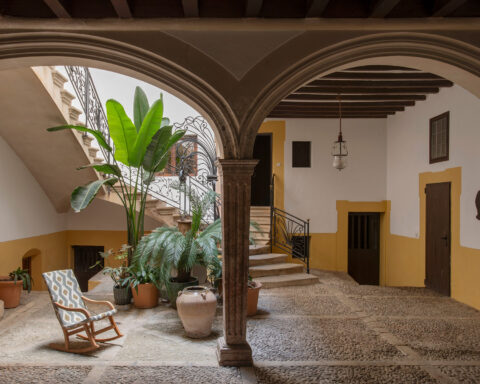
The project is founded on a clear premise: this is not about imposing contemporary architecture, but about listening to what is already there. The dialogue between time and material becomes the guiding principle. Original elements, rammed-earth walls, colonnaded courtyards, wooden beams, terracotta floors, are not only preserved, but made present, brought into the present without erasing their historical density.


Donaire Milans understands architecture as an act of mediation: between past and future, between function and emotion, between what is revealed and what is merely suggested. The new museum, in addition to housing a valuable collection of stage designs, costumes, documents and theatrical objects, is conceived as a living space, where exhibition and performance coexist, each room can, if desired, become a small stage.
Faithful to their commitment to sustainability and contextual architecture, the architects work with local materials, traditional techniques, and carefully orchestrated light. The result is a hushed, welcoming atmosphere, where each object finds its place and each visitor can imagine the whisper of rehearsals, the tremble of a curtain about to rise, the thrill of a first line spoken aloud.
The National Museum of Performing Arts in Almagro is not just a container of memory, it is a declaration of principles on how to inhabit heritage and how to build architecture that lives up to the culture it preserves. In Almagro, theatre has always had a home. Now, thanks to Donaire Milans Arquitectos, that home also has a renewed voice: serene, profound, and ready to accompany the future scenes of memory.


Minimum resources, maximum impact
The commission to rehabilitate the National Museum of Performing Arts in Almagro has been, for Donaire Milans, an exercise in narrative precision: to intervene with delicacy, generating coherence between architecture and museography. Guided by the motto “minimum resources, maximum impact,” they reorganised entrances, routes and circulation flows, removing peripheral staircases to create vertical visual dialogues and a more fluid, integrated spatial perception.
Natural light acts as the main narrator: entering through skylights above a central stone cube, it envelops the rooms and corridors in a luminous geometry that reinterprets the historic building.

Architecture and museography: a dialogue between silence and narrative
Museographic design was developed in parallel with the architecture, generating dynamic routes and layered views between levels thanks to the open arrangement of display cases and the visual connections between spaces. The integration of a large LED screen at the start of the tour merges the memory of the past with contemporary digital languages, building a bridge between history and present.
The graphic identity, designed by Inés Atienza, and the curatorial work of Ángel Martínez Roger build a coherent exhibition narrative, giving the museum a serene atmosphere where heritage and the contemporary coexist naturally.
A museum with a renewed voice
The result is a luminous, open and sensitive space, a stage for scenic memory that breathes and performs. Donaire Milans’ architecture allows the theatre to emerge from the history embedded in every wall and every object.
Through this intervention, the National Museum of Performing Arts in Almagro, and the city itself, recovers not only its theatrical past, but also the ability to host the scenes of the future, from a sanctuary of light, silence, and rediscovered emotion.


Technical aspects: noble materials and sustainable solutions
The renovation of the National Museum of Performing Arts in Almagro by Donaire Milans Arquitectos is an exercise in constructive minimalism with significant technical depth. Their commitment to sustainability and heritage conservation is reflected in material choices that deliver coherence, durability, and environmental sensitivity.
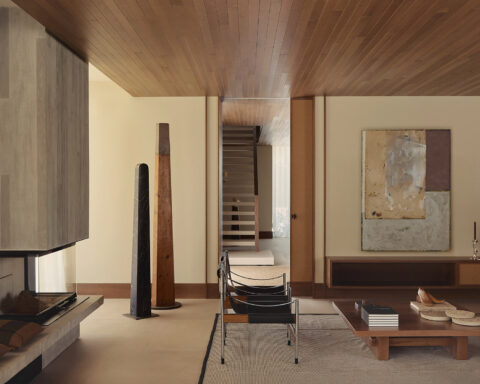
Noble materials: Local stone was used for the central cube, wood and steel for the restored lightweight structures, and glass for the visual connection elements. This elemental palette provides a “blank canvas” that allows scenic objects to breathe without distraction.
Reduced construction resources: True to the “minimum resources, maximum impact” philosophy, the architects avoided heavy-handed interventions. Openings were strategically introduced, existing floors and carpentry were reused, and staircases were modified without extensive demolition.
Use of natural light: A key feature of passive sustainability, natural light enters through carefully sized new skylights, enveloping the stone cube and significantly reducing the need for artificial lighting.
New theatrical systems: Prominent figures from Spain’s stage scene collaborated on the museum’s new discourse. A soundscape by Luis Miguel Cobo, stage machinery by Miguel Ángel Coso, and a technical lighting system by National Award winner Juan Gómez Cornejo create an atmosphere with scenographic lighting that highlights objects and textures while optimising energy efficiency.
Technological integration: A large low-emission LED screen at the main entrance and audiovisual panels throughout enrich the visitor experience. All systems are managed through a monitored energy system.
Respect for the original structure: The intervention avoids overloading the medieval building and instead accompanies it. Rammed-earth walls, timber ceilings and domes are preserved and subtly reinforced using compatible materials to prevent issues with humidity or thermal expansion.
Sustainable architecture: Although the project does not cite specific certifications like LEED or Passivhaus, it follows a low-impact philosophy: the use of durable, local materials; efficient management of light and energy; and passive design principles that favour comfort without relying on complex systems.
These solutions shape a museographic space that enters into dialogue with heritage, without dissonance. This renovation is not just about beauty—it also reduces consumption, supports future adaptability, and prolongs the building’s lifespan. In the words of the architects: “to create a blank canvas for the works,” with the dignity of essentials, the strength of authenticity, and a gaze that looks ahead.
Project: Renovation of the National Museum of Performing Arts in Almagro.
Architecture: Donaire Milans Arquitectos.
Location: Almagro (Ciudad Real).
Completion: 2025.
Photography: Montse Zamorano.
Graphic Design: Inés Atienza.
Curatorship: Ángel Martínez Roger.

Donaire Milans Arquitectos
Donaire Milans Arquitectos was founded in Madrid in 2020, shaped by the rigorous sensibility of Jesús Donaire and the evocative architectural vision of María Milans del Bosch. Their practice is rooted in a careful balance between research, context and adaptation, always in service of memory and the identity of place.
With a compact and inquisitive team, the studio develops architecture committed to sustainability, timelessness and adaptability, undertaking both public and private projects across Spain, France, Italy and the United States. Their work ranges from exhibition design at MoMA in New York to the transformation of cultural spaces in Bilbao and Rome, reflecting a deep ethical and aesthetic engagement with each setting.
View full studio biography.
Sources: Donaire Milans Arquitectos, Museo Nacional de Artes Escénicas e Idónea Comunicación.
Donaire Milans Arquitectos
+34 914676091
info@donairemilans.com
donairemilans.com
@donairemilans
Project by Donaire Milans Arquitectos