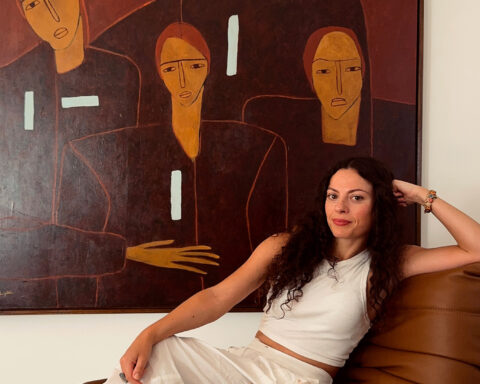


In the baroque heart of Noto, in southern Sicily, there rises a pink house, luminous and serene, where painting merges with music and the scent of bougainvillea. This is where Júlia Martins Miranda lives and works, a Brazilian artist who has found, in the depth of time and the Mediterranean light, a new place to belong. In her house-studio, a former monastery restored with patience, love, and local hands, Júlia has shaped an intimate and radiant universe that is at once a refuge, a workshop, and a poetic manifesto.
Born in Belo Horizonte, Brazil, Júlia trained as a photographer and musician before surrendering to painting with passion. The visual rhythm of her canvases reveals this fusion: there is cadence, harmony, and deep silence in them. Her training took her through cities such as São Paulo, Milan, and New York, where she absorbed new perspectives and languages, yet never lost touch with the pulse of her homeland, which persists in her work like a quiet melody. In her art, the Brazilian spirit is not a theme, but an echo, an atmosphere, a memory filtered through distance.


Pindorama: a series born of memory, nostalgia, and desire
Her latest series of paintings is titled Pindorama, the Tupi-Guarani word meaning “land of the palm trees”, the ancestral name of Brazil before colonisation. In these works, Júlia paints from memory, nostalgia, and desire. Her palette bursts with warm tones, orange, red, yellow, that seem to ripen on the canvas, while organic forms float like islands in an emotional geography. Each painting is an intimate map of her childhood, a scene from an invented paradise where the poetry of Adélia Prado, the music of Tom Jobim, and the sensuality of the tropics converge.
“Painting is a way of returning,” says the artist. Not to a specific place, but to a slower state of consciousness, one that is closer to what is essential. Pindorama does not depict the jungle or folklore, but an inner forest, where feelings of belonging, uprootedness, and reconciliation bloom.


Her house studio, a restored monastery
The story of this series cannot be separated from the place where it was created. Júlia’s home is a former monastery in Noto’s historic centre, which she restored alongside her couple, designer Mimmo Calcagno, with the collaboration of local artisans. Respect for the soul of the building guided every decision: they preserved the irregular walls, high ceilings, and stone floors, removing modern partitions to allow the light to enter like an honoured guest.
The furnishings, minimal and essential, were crafted to measure by local carpenters, reflecting a dialogue between tradition and contemporary simplicity. The kitchen opens onto a patio lush with tropical vegetation. The shower, without walls or doors, becomes a creative ritual: “It’s where I think through my paintings, where everything begins,” the artist confesses. In this home, every corner and every object is not part of a set, but part of an emotional atmosphere.


Sicily: an island where time slows down
The choice of Sicily was no coincidence. On the island, Júlia found the slow time and constant light that her work requires. Life here unfolds at a gentler pace, as if each gesture could be contemplated before it happens. That slowness is also a form of resistance, against digital haste, urban noise, and emotional disconnection. Her house studio stands as a manifesto against the speed of contemporary life.
During the summer, Júlia opens her doors to share her work and hosts evenings of conversation, live music, and local cuisine, which she calls “tropical soirées.” Her exhibitions, like the one held at Iuta Farm, an artistic retreat nestled among olive trees and the sea, embody her way of inhabiting art through intimacy.
In Júlia Martins Miranda, the artist and the emotional architect converge. Her home is not a backdrop, but an extension of her painting. Her works do not depict landscapes, they create them. Every gesture, every colour, every texture constructs an enveloping atmosphere that invites reflection, celebration, and contemplation. Rarely is the fusion between life and work, between space and thought, so clearly expressed.
In Noto, the brazilian artist has built a tropical heart, a place that does not belong to a specific time, but to a sensibility, one that reminds us, like her work, that it is still possible to inhabit the world with beauty, roots and soul.


Source: Júlia Martins Miranda.
Photographs provided by Júlia Martins Miranda.
Júlia Martins Miranda
ciao@juliamartinsmiranda.com
www.juliamartinsmiranda.com
@julia.martins.miranda
Project by Júlia Martins Miranda