
In the heart of the Italian region of Apulia, between Bari, Brindisi and Taranto, stretches the Valle d’Itria, a landscape where architecture and nature have built a silent and enduring relationship over centuries. Fields of ancient olive trees unfold across reddish soil which, under the intense Mediterranean light, transforms the territory into a succession of warm tones and gentle contrasts..
This rural landscape is marked by the presence of the trulli, small dry-stone constructions that have given the region its identity and that still appear scattered among the cultivated fields and rolling hills. Towns such as Alberobello, or nearby villages like Locorotondo and Cisternino, preserve a singular atmosphere where whitewashed houses, vegetation and the domestic scale of the streets compose an image deeply rooted in the territory.
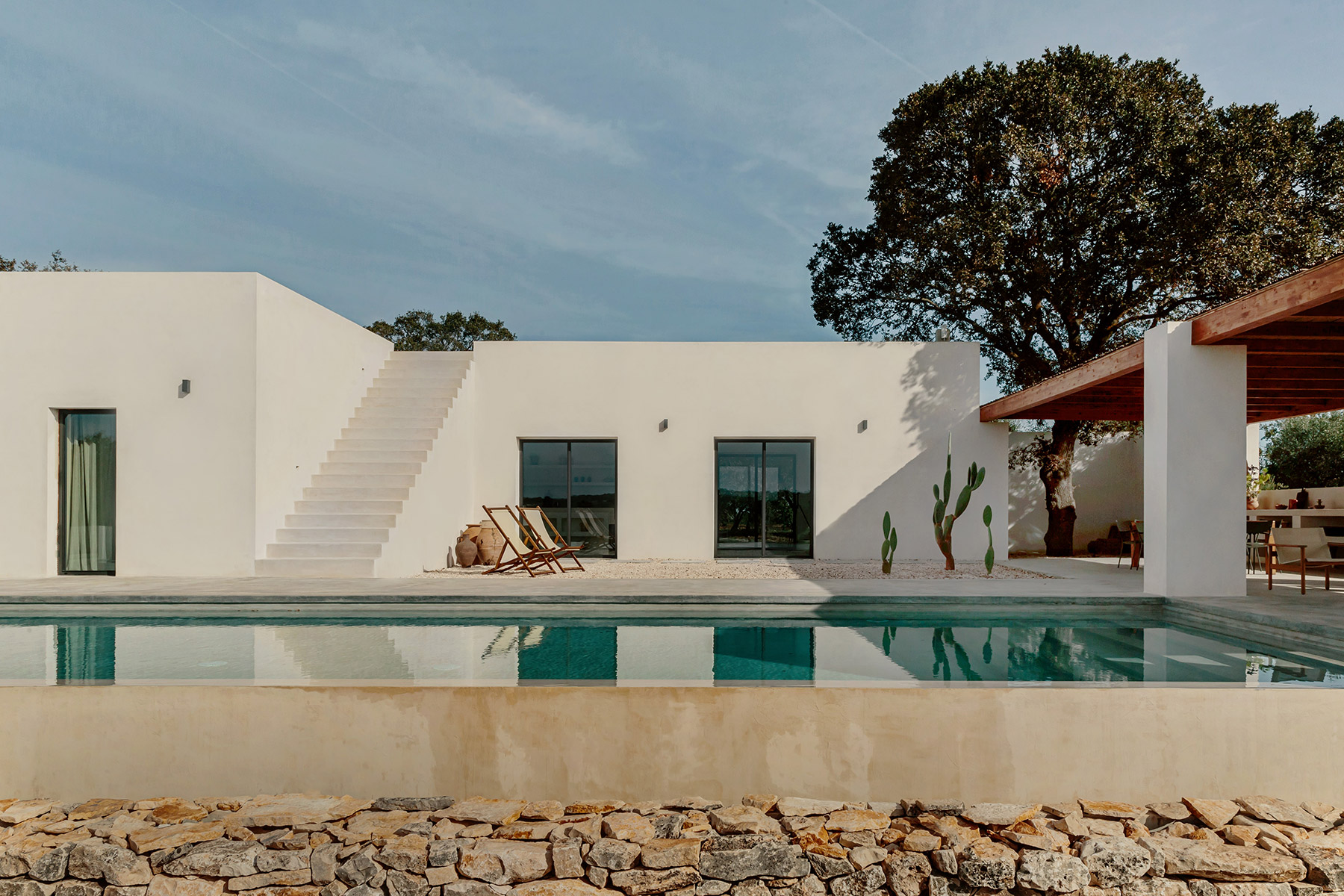
Within this context, where landscape and tradition remain part of the same cultural continuity, stands Casa Roverella, the house designed by Italian architect Andrea Vergati. A project that begins with the attentive observation of the site and finds in a large existing oak tree the origin around which the entire architecture is organised.


A century-old oak tree as visual and spatial reference
The house develops around this tree, incorporating it as an essential part of the domestic experience. The oak acts as a visual and spatial reference point around which the rooms and perspectives are arranged. In this way, the architecture unfolds around it, establishing a constant relationship between interior and exterior.
The plan adopts a C-shaped configuration, a gesture that symbolically evokes the idea of an embrace. This arrangement generates a protected outdoor space, domestic in scale, opening towards the swimming pool and the rolling hills that characterise this region of southern Italy. The infinity pool visually extends the terrain, dissolving the boundary between water and land, while an exterior pergola provides shade and hosts outdoor dining and living areas, extending everyday life beyond the walls of the house.

The exterior staircase, a sculptural element
Outside, a compact and geometric staircase appears as a sculptural element connecting the pool to the roof. Its presence introduces a vertical gesture within the horizontal composition of the house and offers a small lookout point from which to contemplate the landscape of the Valle d’Itria, especially at sunset, when the warm summer light travels across the hills.
The project is built upon a carefully measured spatial continuity. Inside, the curved vaults and the soft transition between walls and ceilings create a play of shadows that changes throughout the day as the light enters the house. Openings are positioned to establish precise visual alignments that reveal, from different points in the home, the key elements of the project: the garden, the pool, the exterior staircase and, always, the presence of the large oak tree.


The kitchen as an architectural piece
One of the central spaces of the house is the kitchen, conceived as an architectural element rather than simply a functional feature. A large continuous concrete counter directs the gaze towards the arched opening that frames the exterior patio and the tree. This element connects the kitchen area with the dining table, generating a continuous solution that combines material solidity with a contemporary reading of domestic space.
The architecture maintains a deliberately restrained language. The pure forms of the building are accompanied by materials that, without renouncing a certain rustic character, establish a direct relationship with the Mediterranean context. Continuous cement flooring unifies the interior spaces, while the walls and vaults are finished with ivory lime paint that amplifies natural light. Custom furniture in stained oak wood introduces warmth, balancing the austerity of the mineral materials.
The interior design was developed in collaboration with designer Jared Green, responsible for the selection of furniture, decorative elements and vegetation. The intervention embraces a minimalism that accepts the imperfections of natural materials and engages with the rustic character of the local environment, reinforcing the serene and domestic atmosphere of the house.
In Casa Roverella, Andrea Vergati proposes an architecture that does not seek prominence but relationship. A house conceived as a gesture of closeness to the landscape, where each space opens towards the exterior and where everyday life unfolds in continuity with the surrounding nature.


Project: Casa Roverella.
Location: Ostuni (BR), Puglia (Italia).
Completion: 2024.
Area: 115 m2.
Architecture: Arquitecto Andrea Vergati. Vergati Creative Studio.
Interior design: Andrea Vergati. Vergati Creative Studio + Jared Green Interior Designer.
Photography: Alex Reyto.
Source: Vergati Creative Studio.

Andrea Vergati
Italian architect Andrea Vergati belongs to a generation of professionals who have shaped their vision through travel, cultural exchange and the exploration of different ways of inhabiting space. His trajectory combines architectural practice, sensitivity to place and a constant search for balance between tradition and contemporaneity.
Initially trained at the Politecnico di Milano, where he obtained his degree in Architectural Sciences in 2013, he later continued his studies in Lisbon, graduating in Architecture from the Universidade Autónoma in 2016. Years later, he expanded his academic path with a Master’s degree in Bioconstruction Project Management at Universidad Nebrija, deepening his knowledge of sustainable building strategies and the conscious use of materials.
From the beginning of his career, Vergati has understood architecture as an open and transversal discipline. His professional experience has developed across different cultural contexts —Italy, Portugal, Mexico, Peru, Greece, Sweden and England— an itinerant path that has enriched his way of interpreting space and landscape.
This diversity of experiences is now reflected in his work: an architecture that carefully observes the conditions of place, local building traditions and the relationship between people and their environment. For Vergati, designing means listening to the territory and reinterpreting it through a contemporary perspective capable of generating harmonious, serene and deeply inhabitable spaces.
In 2020 he founded his architecture studio, Vergati Creative Studio, in the heart of the Italian region of Apulia, with the intention of offering a personal and critical interpretation of the built environment.
The studio develops projects that span architecture, interior design, rehabilitation and proposals connected to sustainability and the social dimension of architecture. Its philosophy stems from a simple idea: using creativity as a tool to improve people’s lives and to strengthen the relationship between human beings, nature and the cultural memory of places.
In this sense, the studio’s work is characterised by a careful reading of Mediterranean vernacular architectures, reinterpreted through a contemporary language of soft forms, honest materials and spaces open to light and landscape. Each project is conceived as a process of transformation in which the conventional is critically reconsidered, always seeking a balanced response between functionality, beauty and emotion.
With roots deeply connected to the territory of Apulia and an international experience nourished by different cultures, Vergati Creative Studio currently develops residential projects, rehabilitations and experimental proposals that explore new ways of inhabiting the Mediterranean landscape.
Vergati Creative Studio
Via Fratelli A. G. Vincenti n.8
72017, Ostuni (Italia)
www.vergaticreativestudio.com
@architettovergati
Project by Andrea Vergati