
Só é possível chegar a Formentera por mar. The smallest and southernmost island of the Balearic archipelago has no airport, and that absence, far from being a lack, has operated for decades as the most effective filter against the mass tourism that has transformed other corners of the Mediterranean. One arrives in Formentera slowly, by boat, and that manner of arrival already predisposes a different rhythm..
The landscape that greets the traveller is flat, dotted with pine groves and centuries-old sabinas, and crossed by kilometres of dry-stone walls that for generations marked out plots and protected crops from the salt-laden wind, a craft the island’s artisans continue to practise and that today is claimed even in contemporary construction as a mark of identity. Alongside that stonework, whitewashed farmhouses, with thick walls designed to insulate against the damp cold of winter and the heat of summer, define a vernacular architecture as functional as it is austere, free of any ostentation.
The last Mediterranean paradise
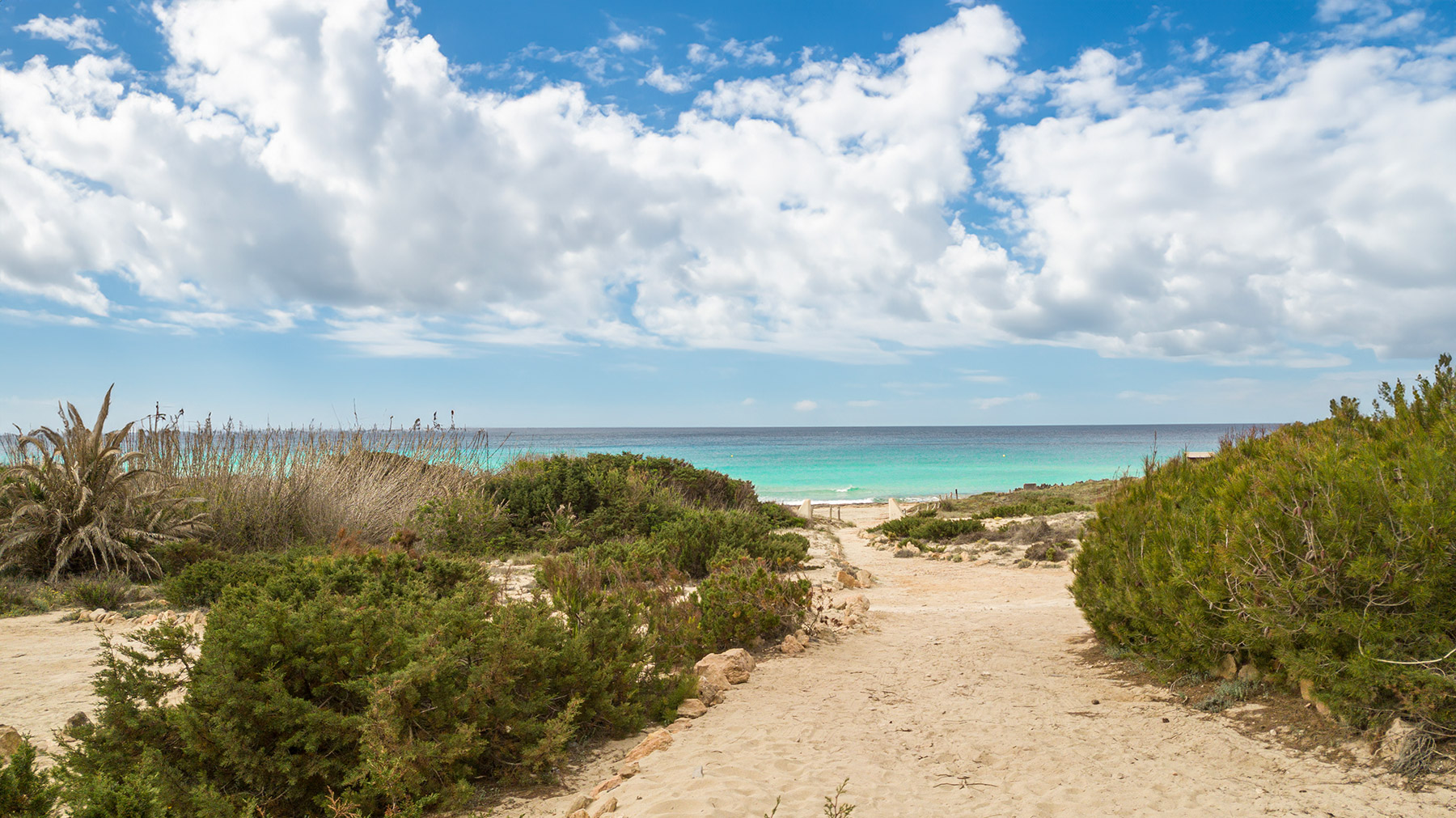
But it is the coastline that has given Formentera its reputation as the last Mediterranean paradise. Extremely fine sands and waters ranging from turquoise to emerald green, a transparency owed in large part to the extensive Posidonia oceanica meadows carpeting its seabed, a plant that acts as the sea’s lungs and natural filter and that Unesco has declared a World Heritage site. Migjorn beach, the island’s longest, stretches for more than six kilometres along the entire southern coast, alternating open sandy stretches with more secluded coves, in a landscape that favours direct contact with nature over any aggressive development.
Formentera also retains a bohemian memory that goes back to the sixties and seventies, when the island became one of the most iconic places of hippie culture and free spirit, a refuge for artists, musicians and travellers in search of freedom who arrived from all over the world; that legacy lives on in the craft markets of El Pilar de la Mola and Sant Ferran, and in a way of life that favours the slow and the essential. It is on that substrate —an island filtered by the sea, architecture of stone and lime, a protected landscape, a memory of freedom— that architect Antonio Obrador’s studio has built Dunas de Formentera, a very special 45-room hotel designed to dissolve into and merge with that landscape.
A cluster of independent buildings
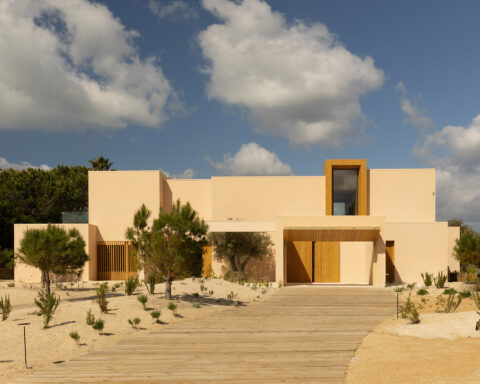
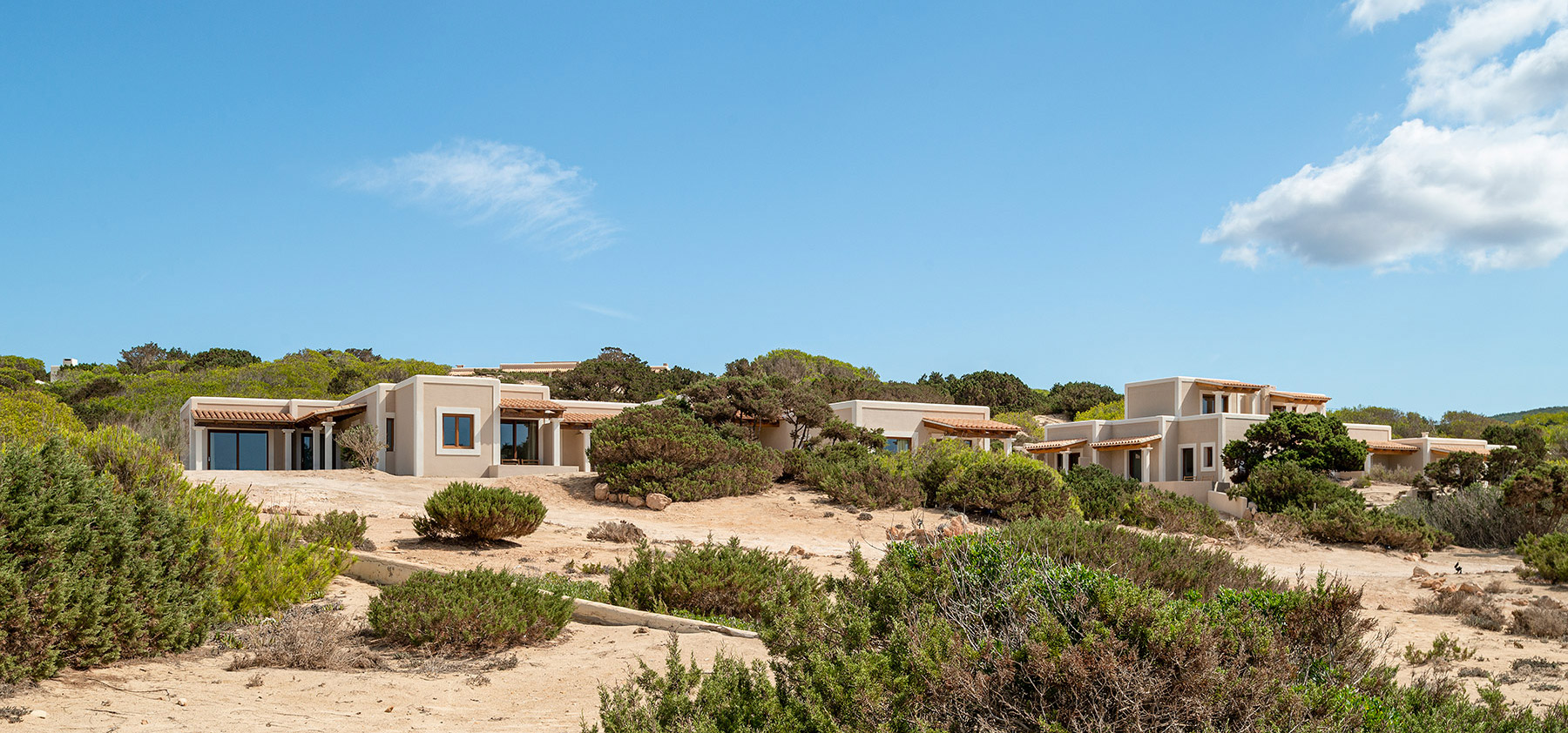
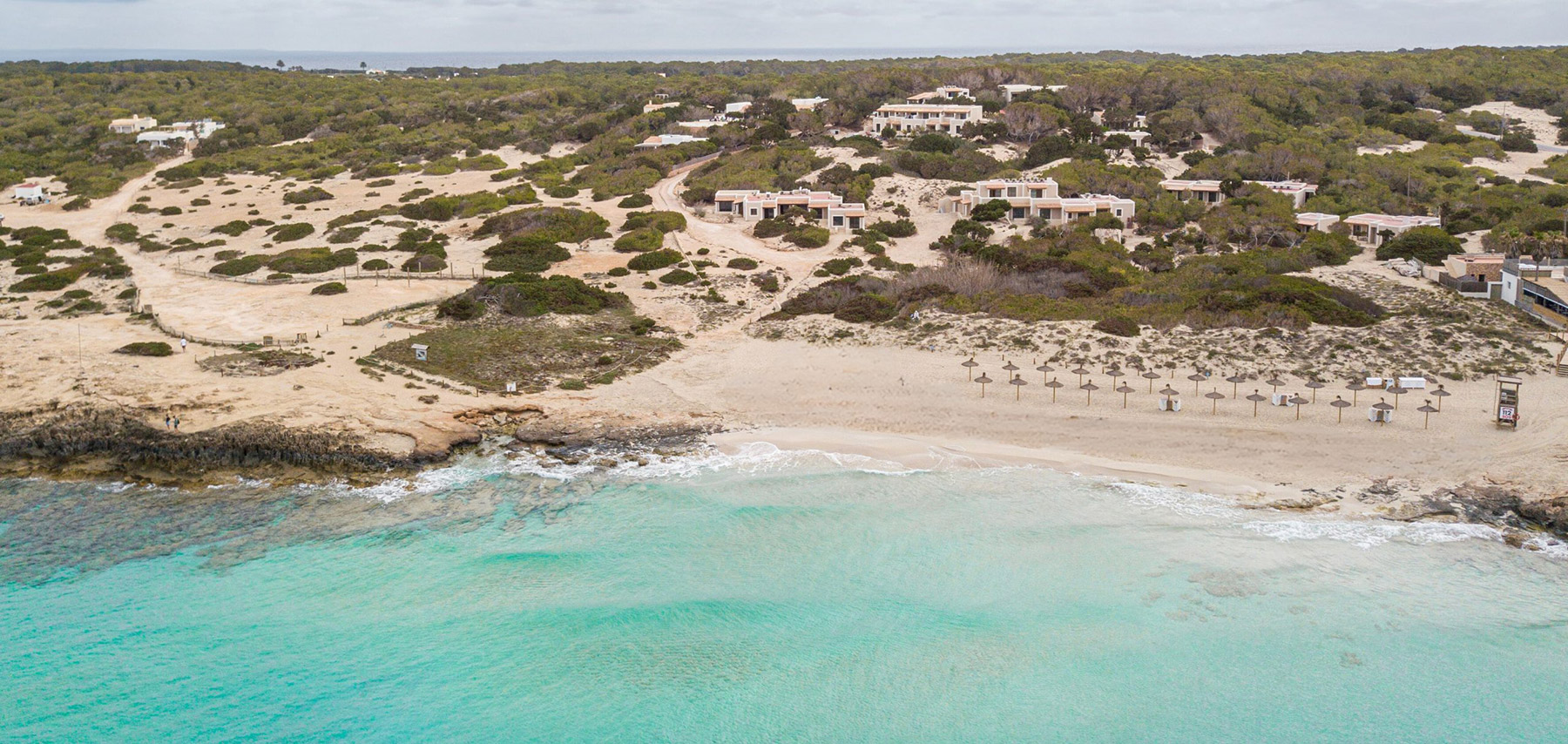
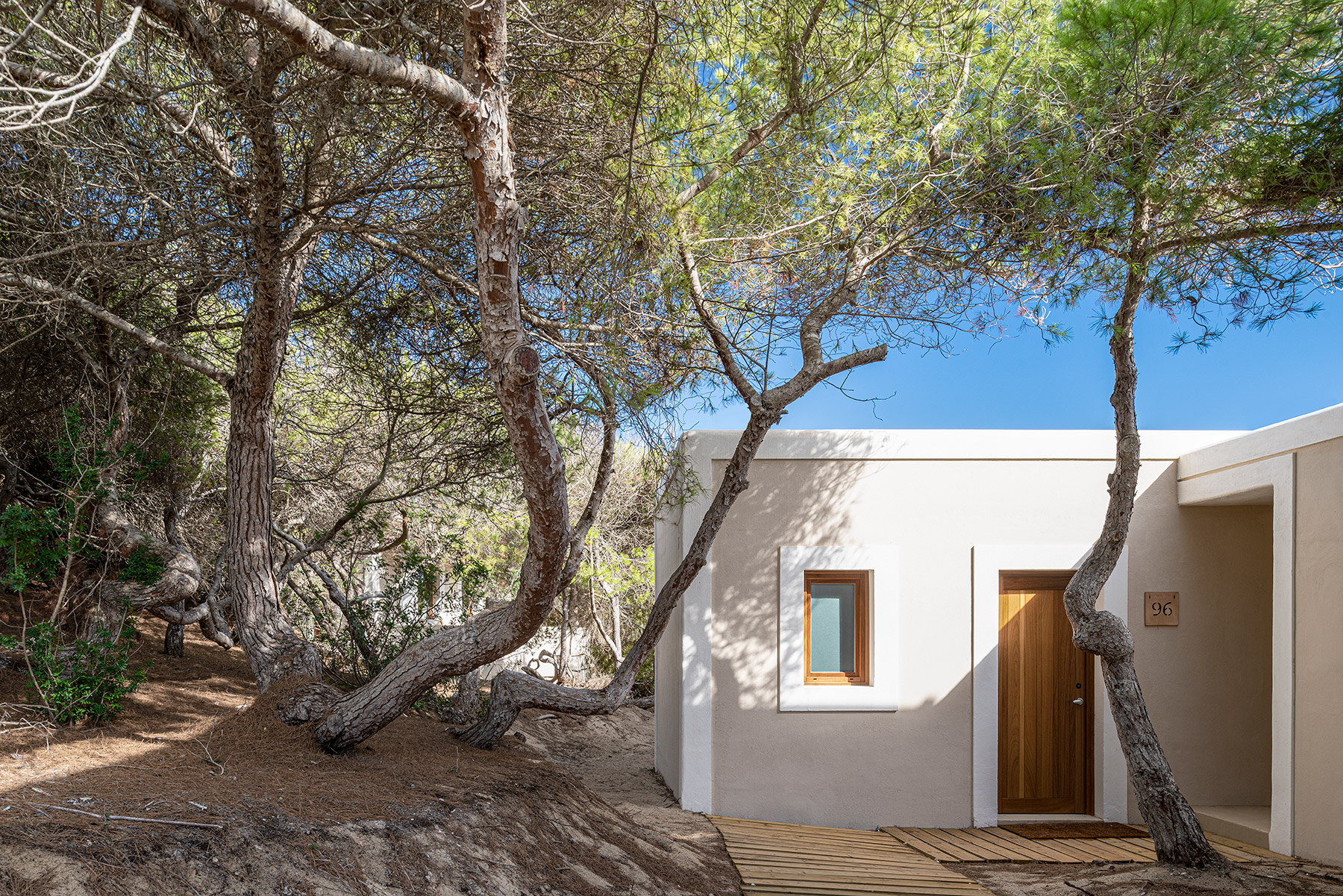
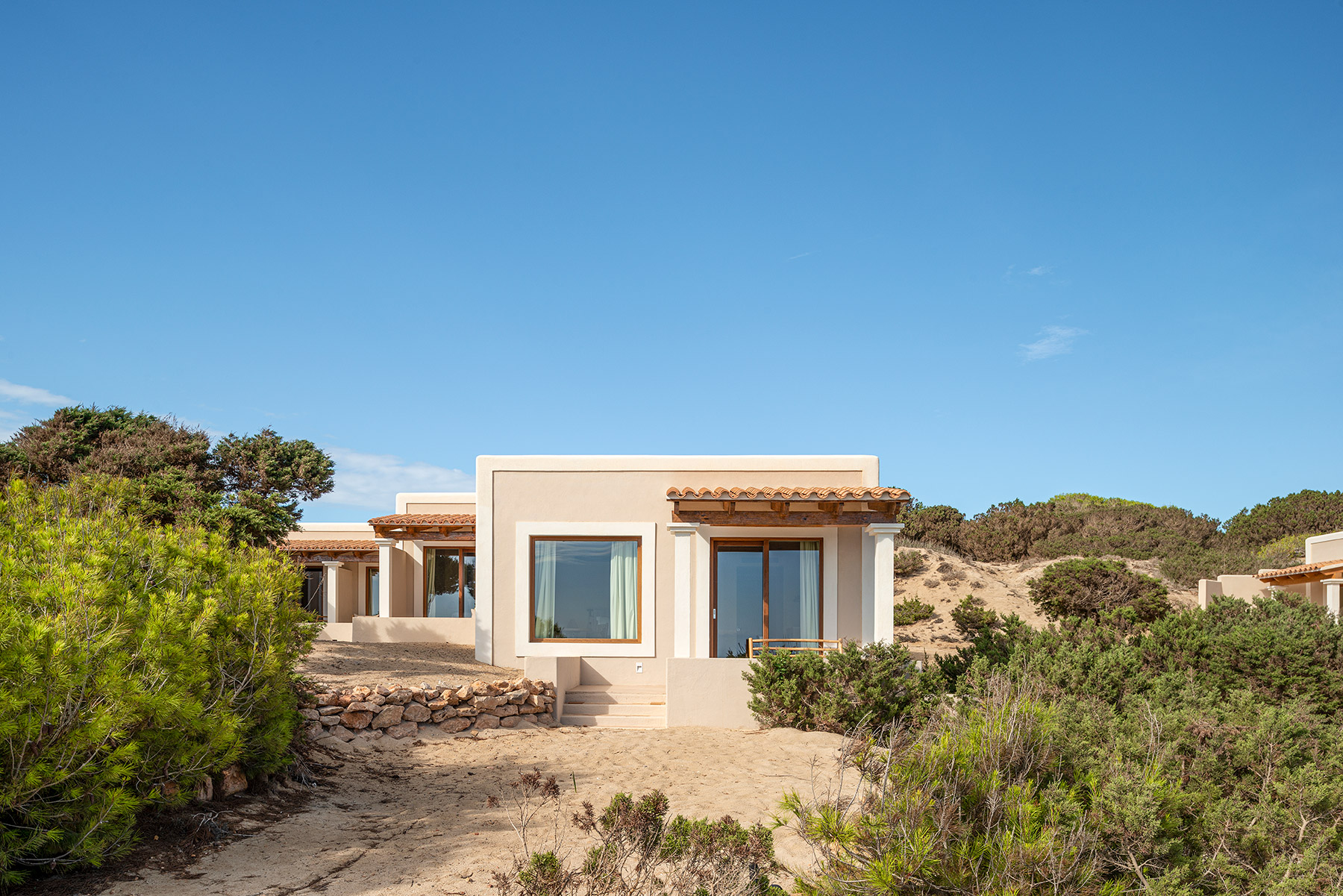
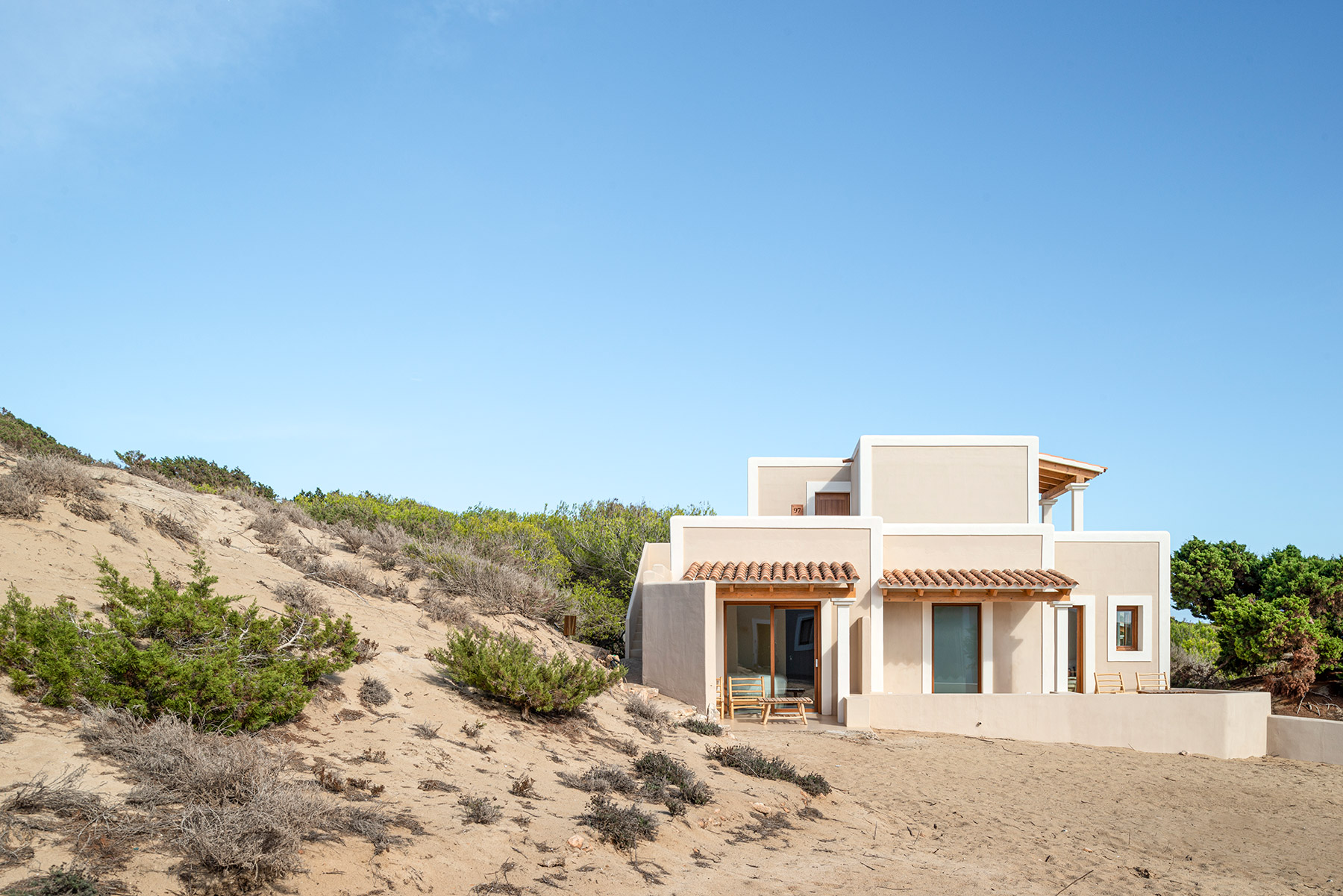
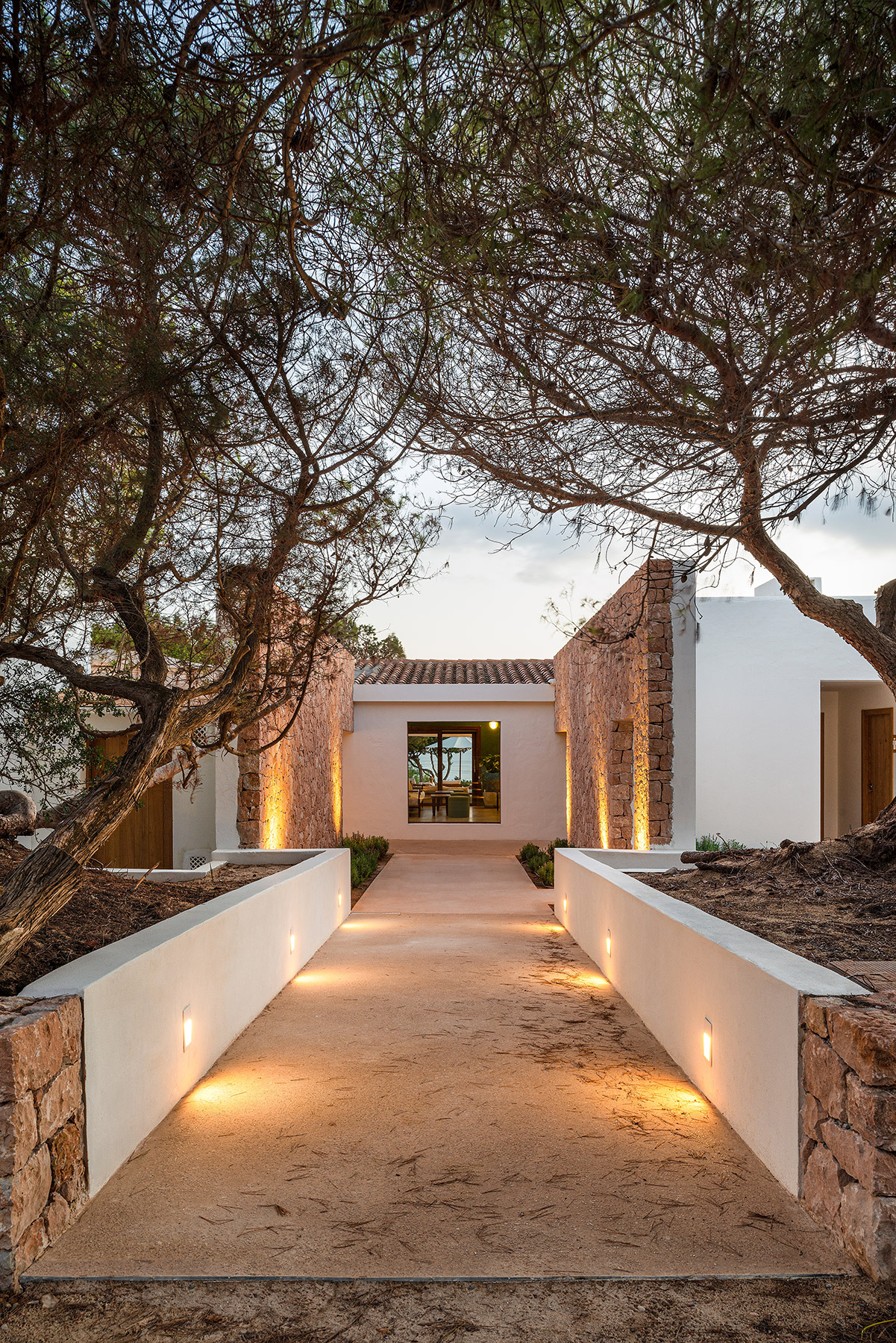
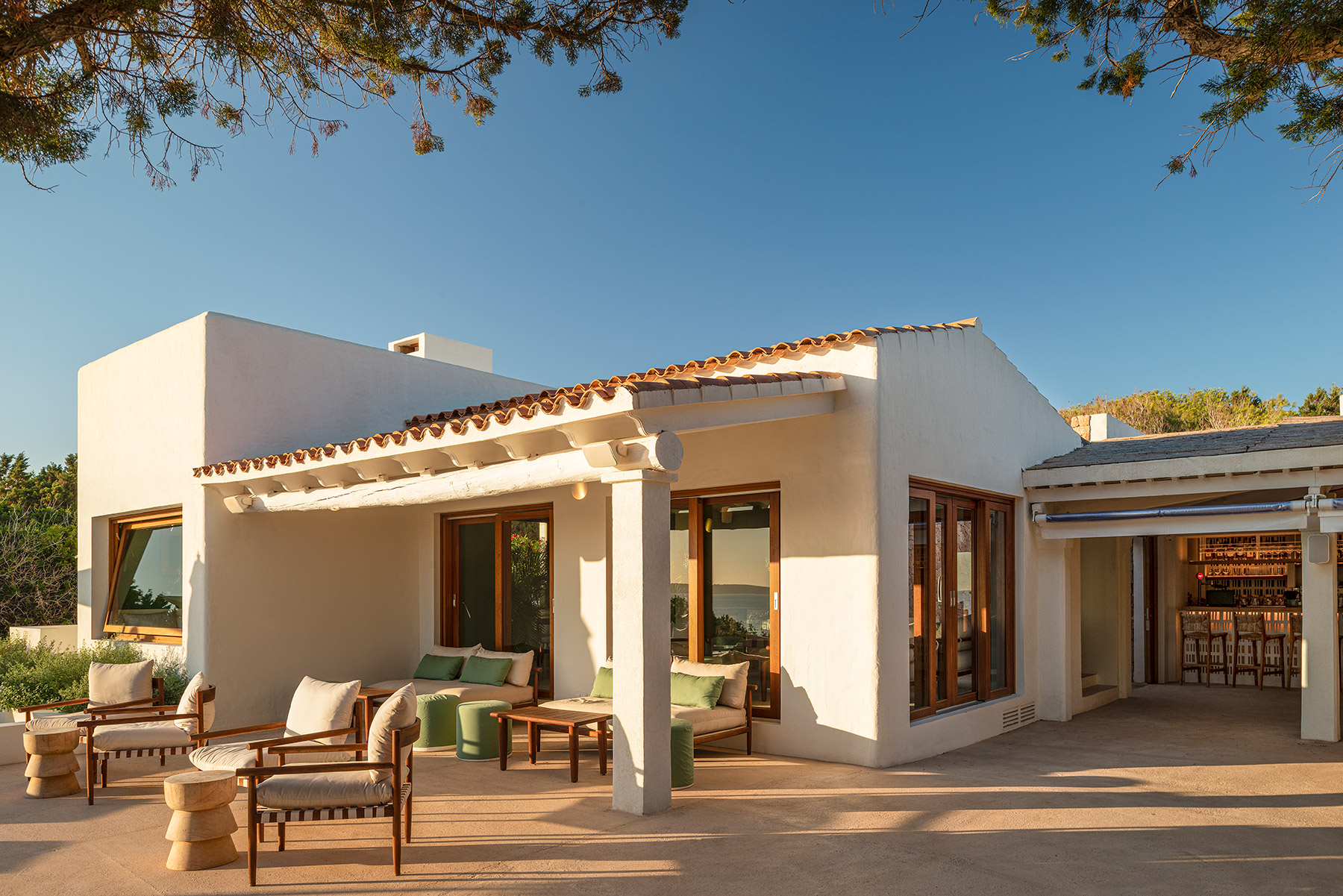
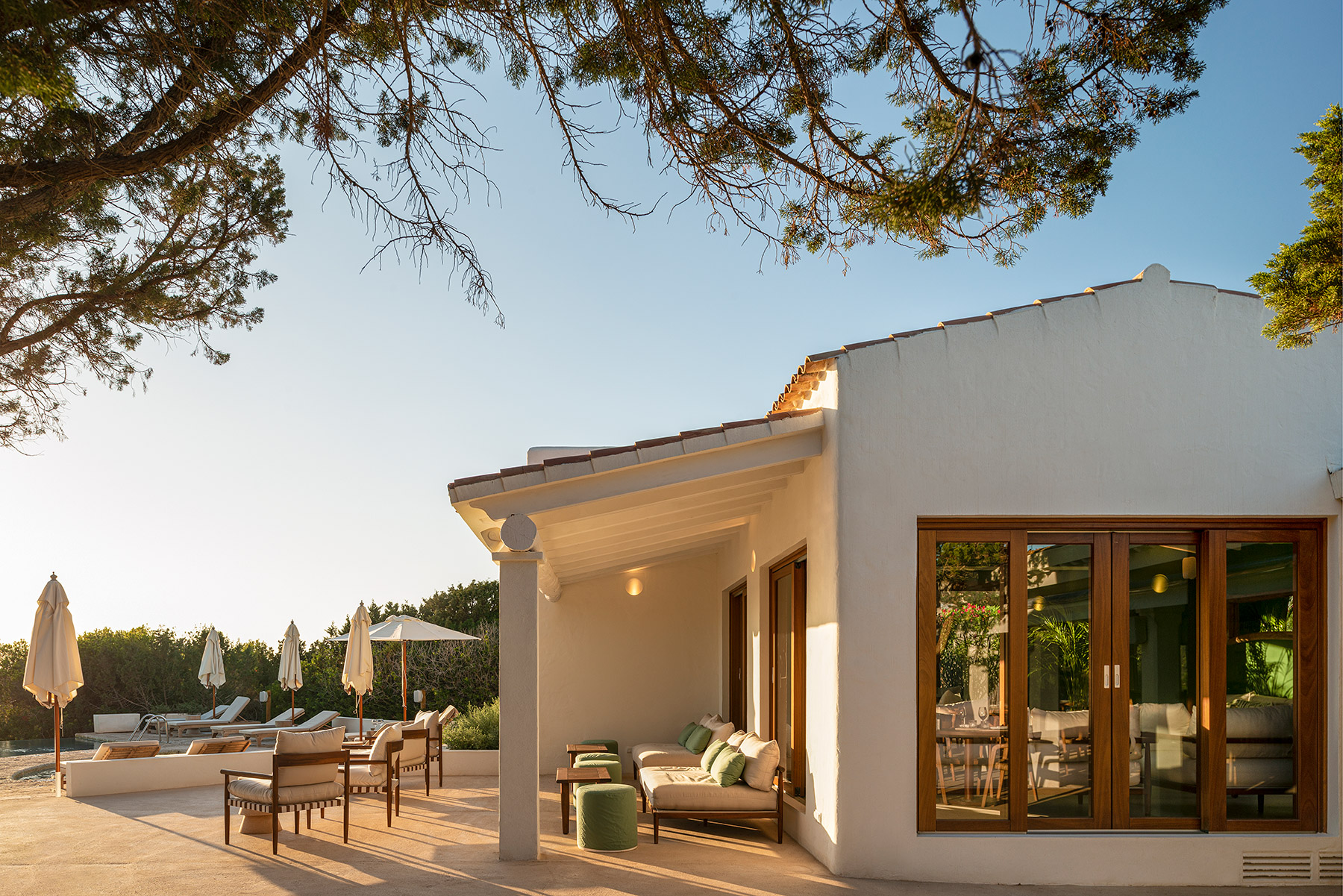
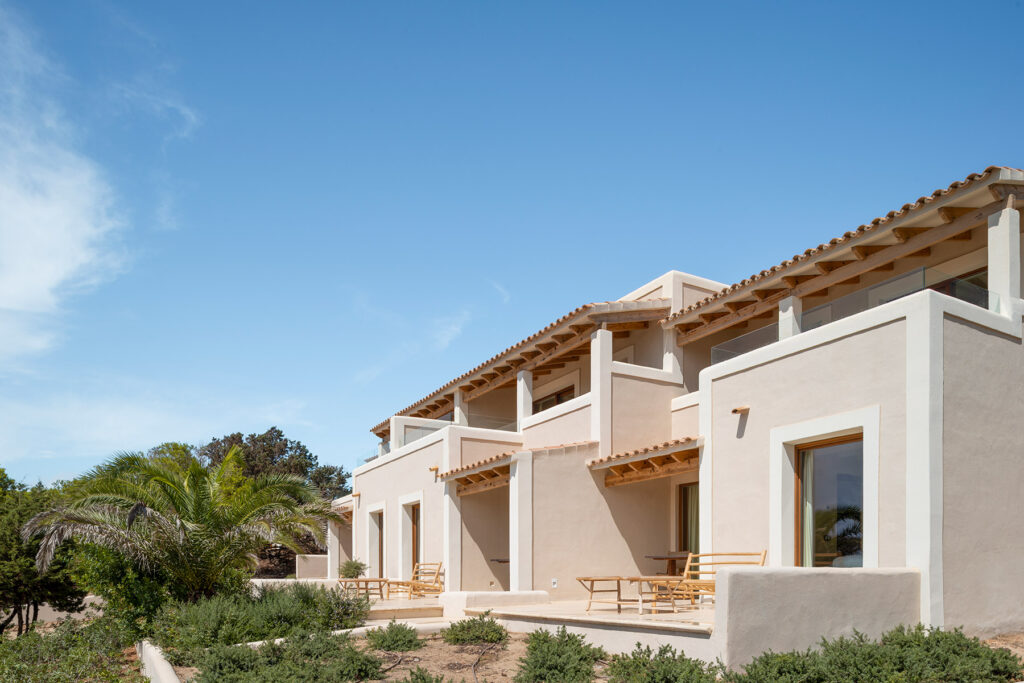
The chosen site is the dune itself, within the natural surroundings of Migjorn beach, and from there stems both the project’s name and its internal logic. Rather than a single hotel volume, Antonio Obrador chose to fragment the programme into a cluster of independent buildings —ranging from 100 to 535 square metres each— distributed among the native vegetation and the undulations of sand, more like a small village than a single building. The result is a circuit that alternates interior and exterior without a clear boundary between the two. Light, sand and Mediterranean scrub enter the rooms as much as the visitor steps out into them.
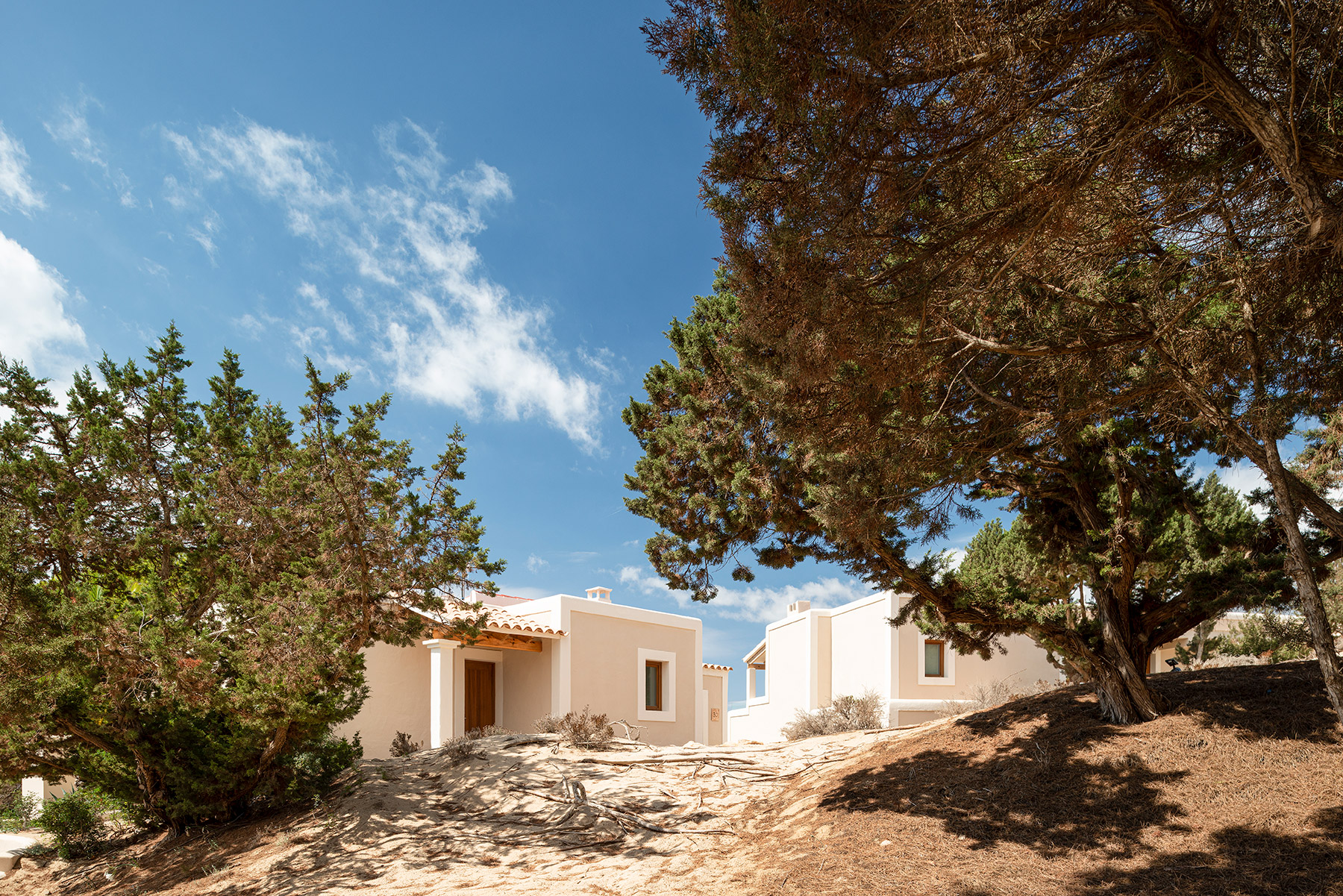
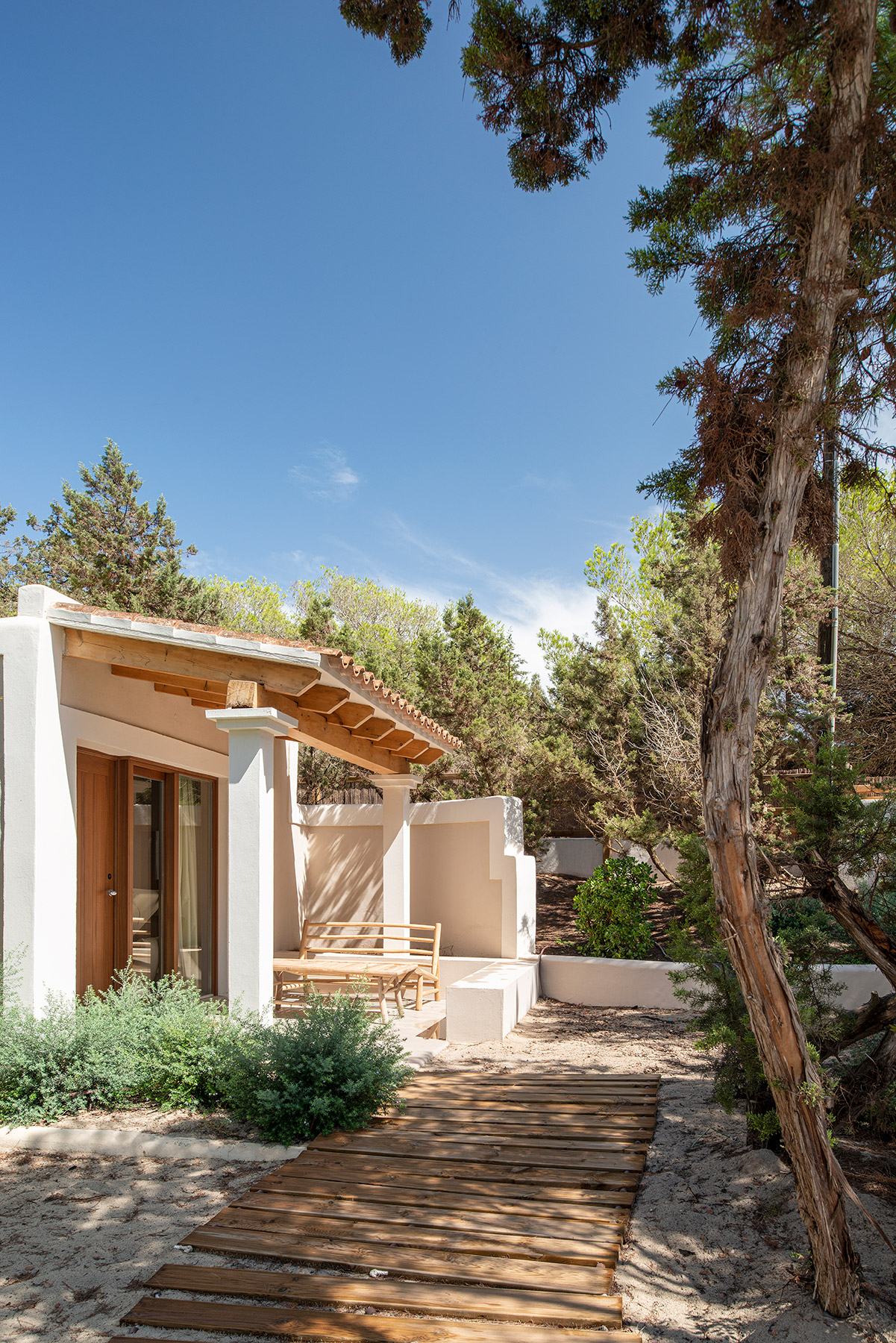
Each whitewashed volume evokes the island’s vernacular architecture, with breathable lime walls, Arabic-tile roofs sheltered by exposed timber pergolas, and some blocks that rise to a second floor topped by a terrace for the larger suites. The palette adheres almost entirely to sand tones, a colour that, more than an aesthetic choice, is part of the integration strategy. The same shade that covers the rooms’ façades recurs in the restaurant, the pool and the solarium, all of them conceived as extensions of the landscape rather than as pieces built upon it.
A network of pedestrian paths connects every space
This project, it should be underlined, is a rehabilitation rather than an entirely new work. The studio intervened on a pre-existing hotel complex on that same site, and one of its most significant decisions was almost urbanistic in nature. The old road network that connected the hotel’s various buildings has disappeared entirely, replaced by a network of pedestrian paths resolved with wooden boards laid directly on the sand, unpaved. It is the same system the Consell Insular applies in the island’s protected dune areas, and its adoption sums up well the studio’s attitude toward the site: leaning on the landscape rather than imposing itself upon it. From the complex itself, one reaches the sand of Migjorn on foot, with no road or visible car park in between.
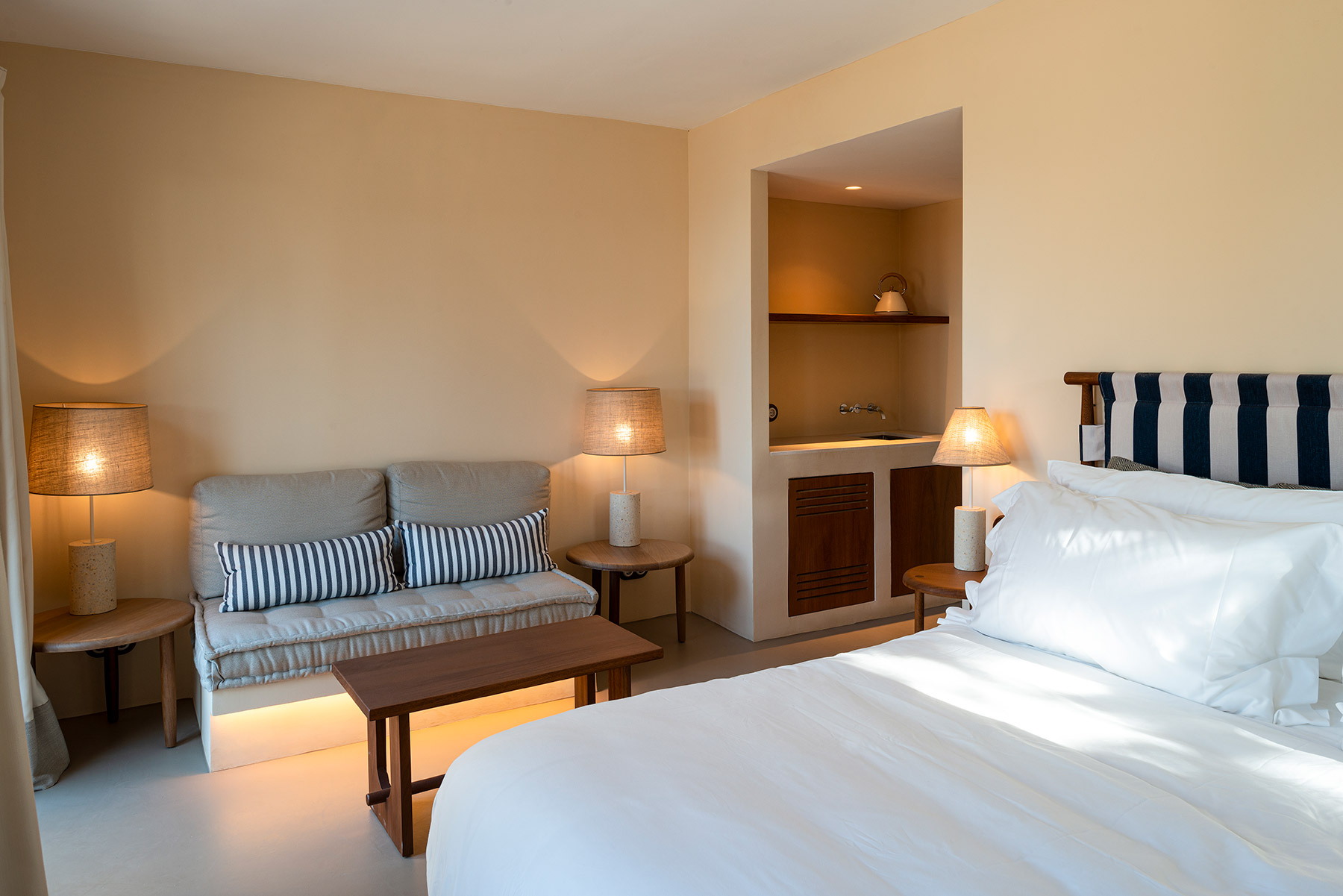
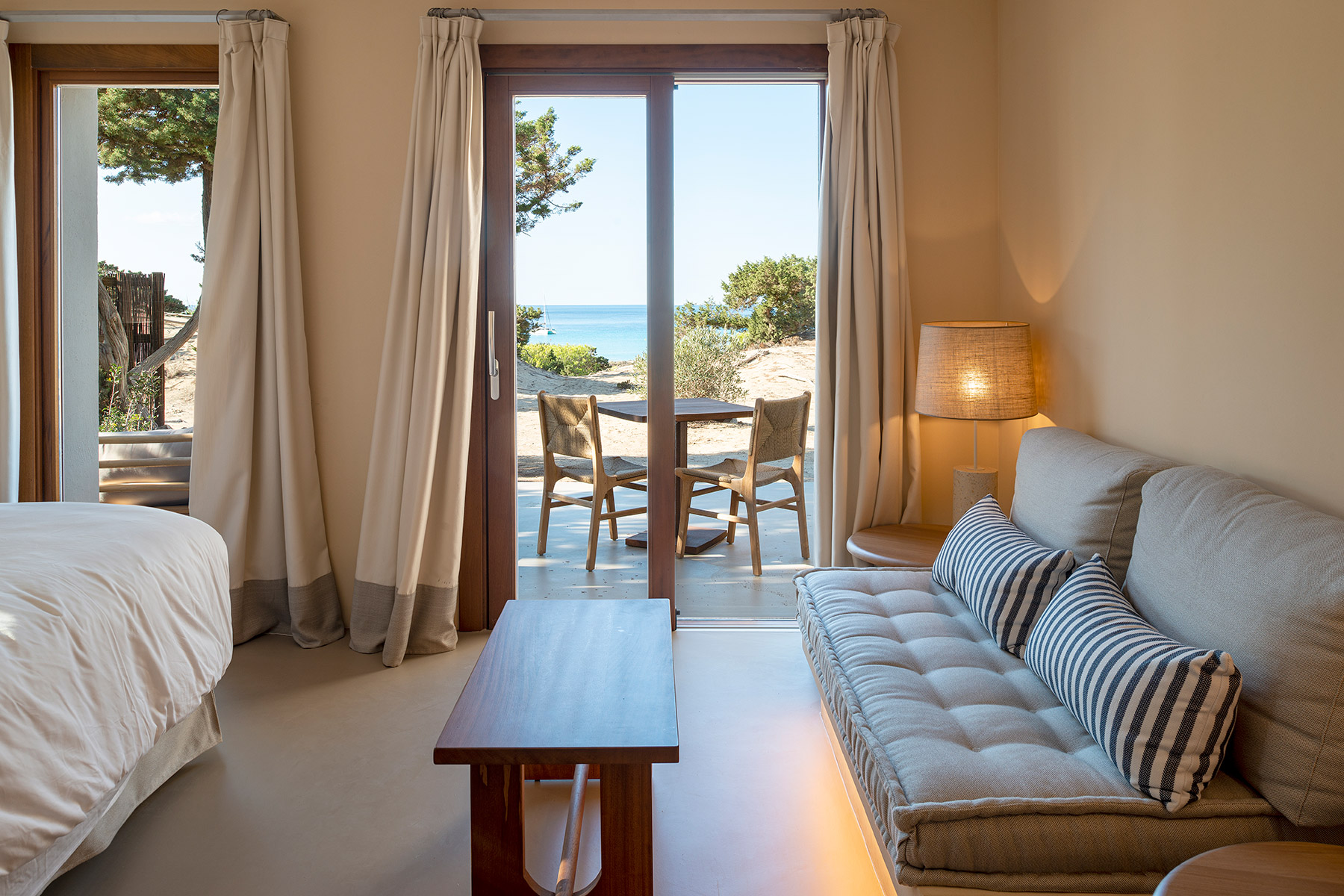
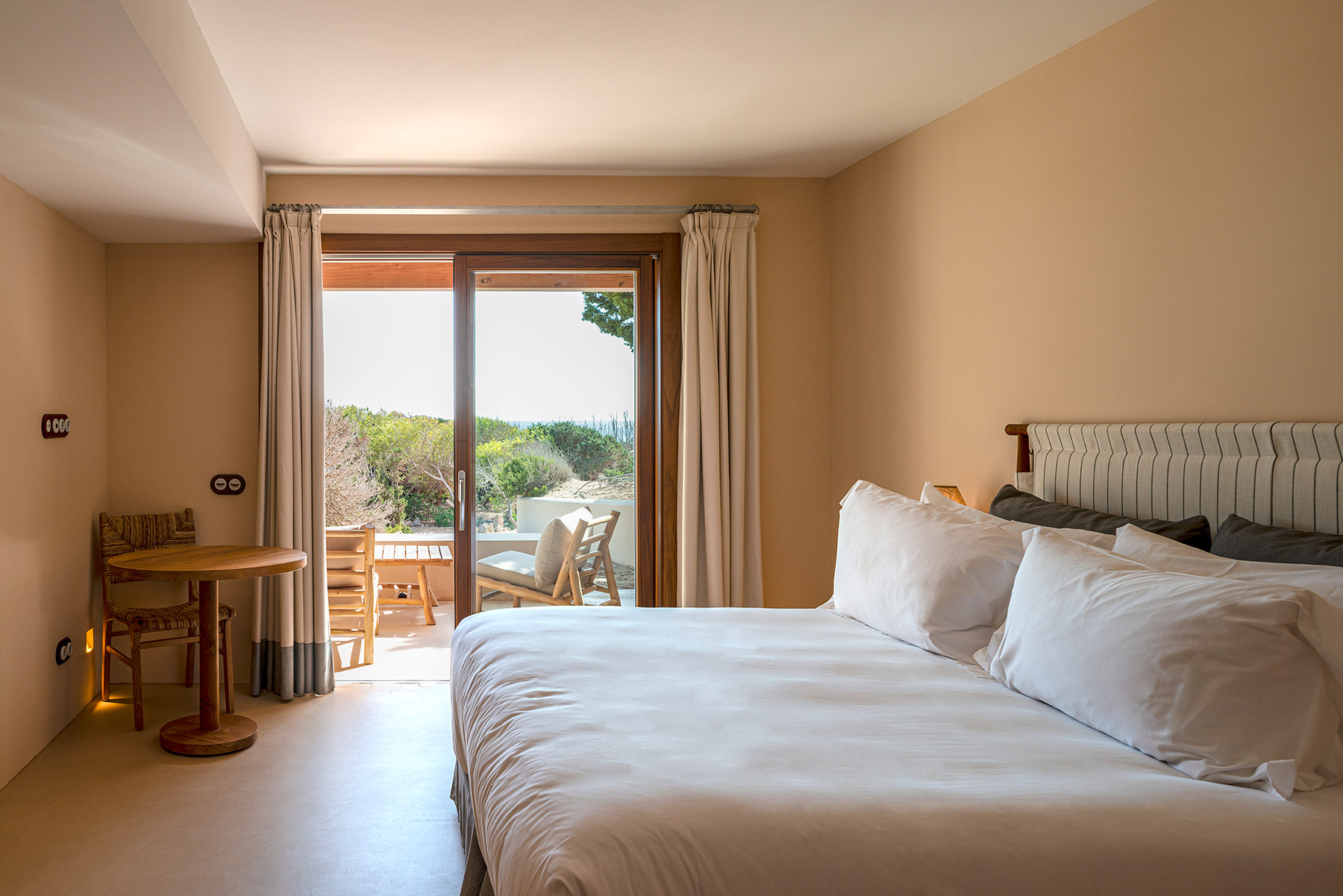
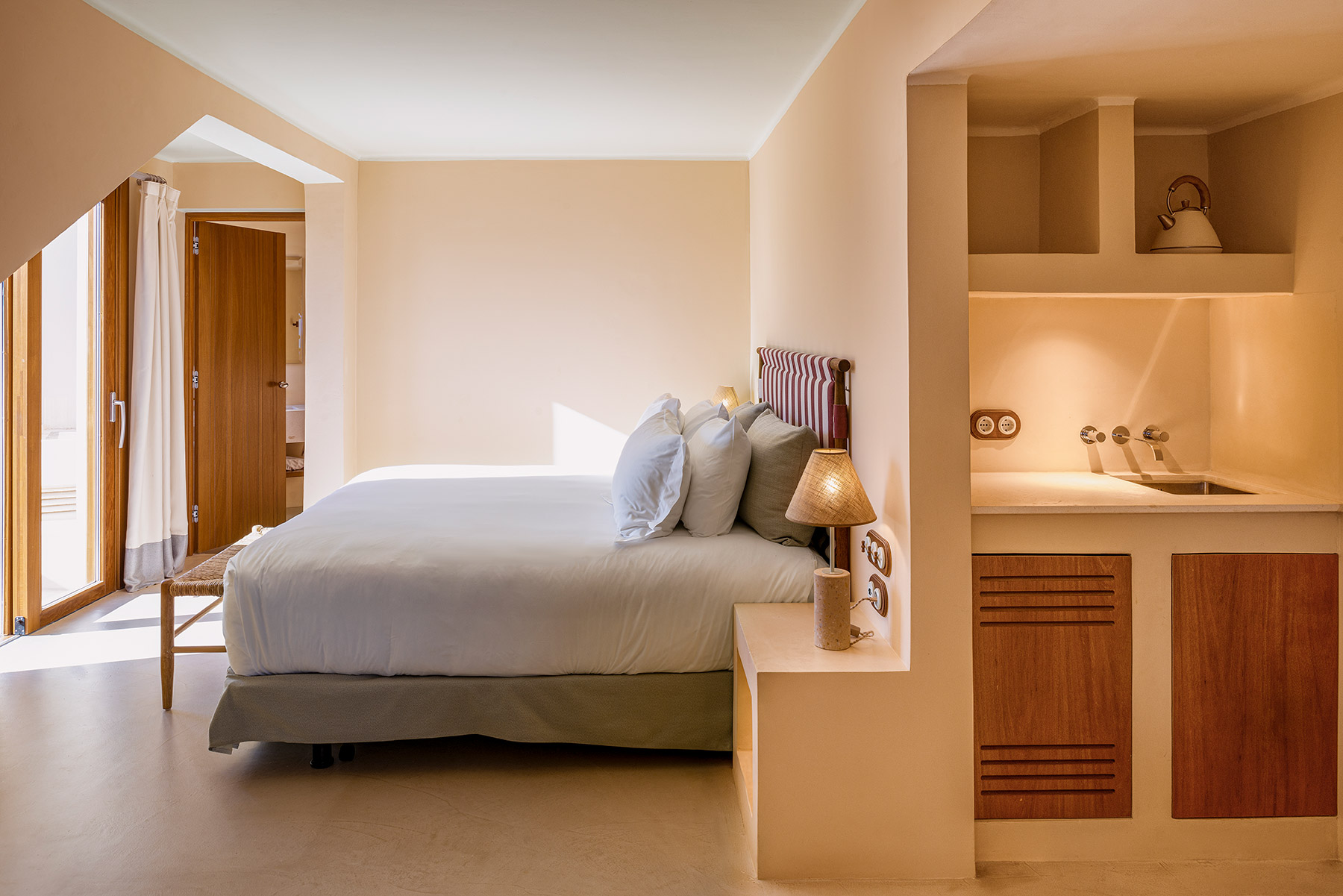
Tradition and modernity, craftsmanship and contemporary functionality
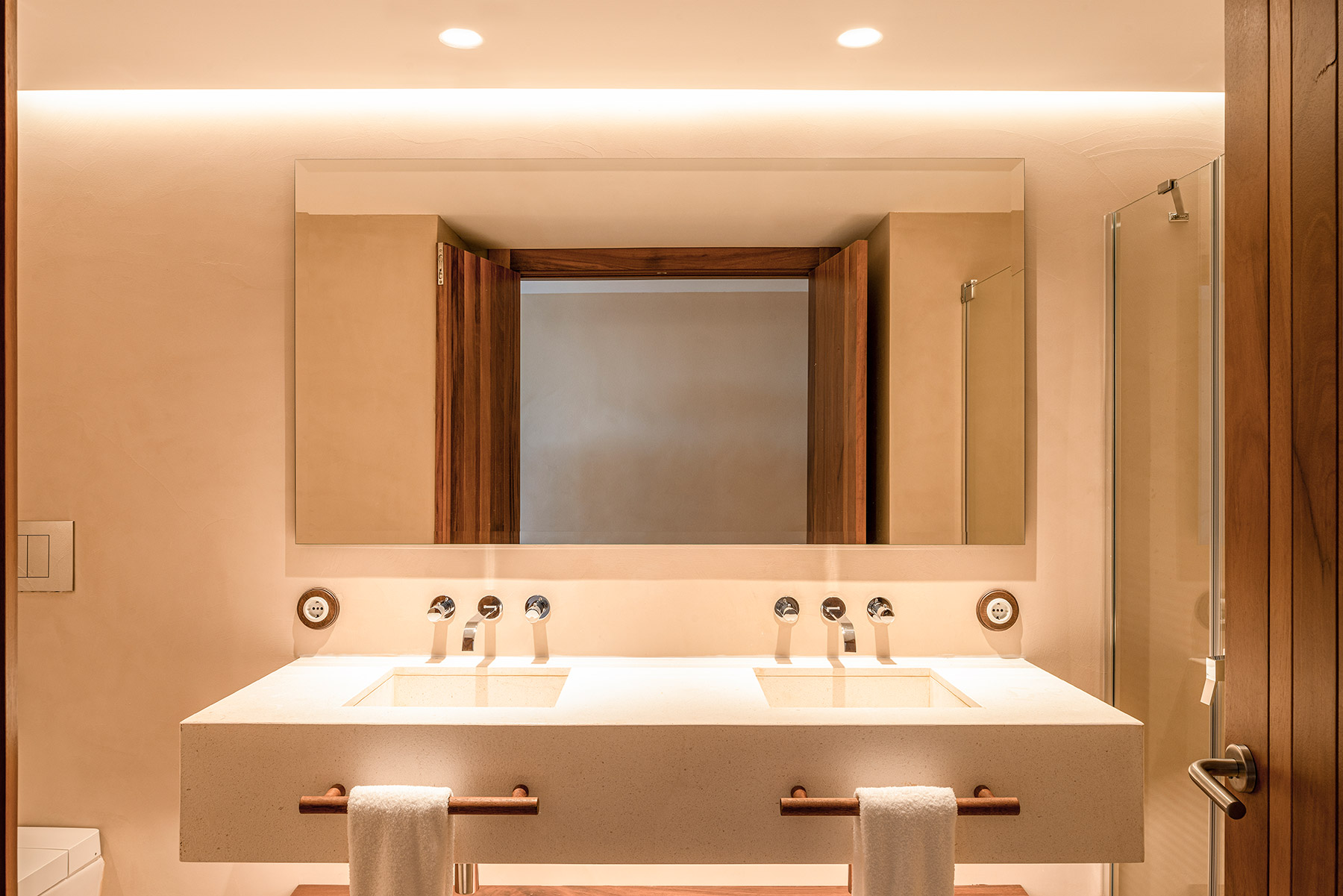
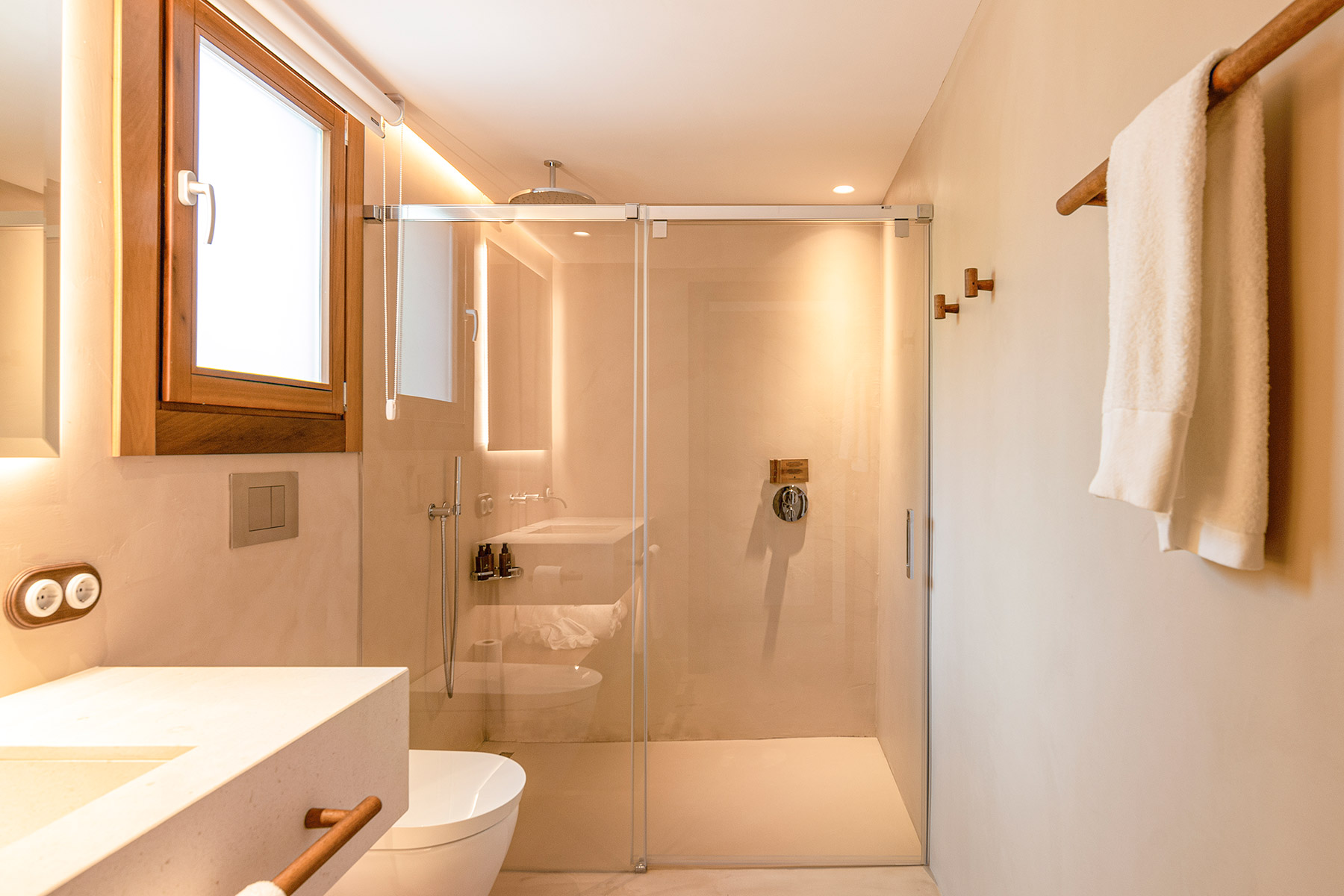
The interior design, developed entirely by Antonio Obrador’s team, insists on the same restraint: bespoke furniture, natural fibres, organic textures, a serene atmosphere that avoids any decorative stridency. It is the same duality —tradition and modernity, craftsmanship and contemporary functionality— that Antonio Obrador has upheld throughout his entire career, applied here at a domestic, horizontal scale, very different from the monumentality of a fortress like Cap Rocat, but faithful to the same principle: “renovation is always conceived from respect for what already existed on the site.”
The complex’s regenerative character is not limited to the layout of the ensemble. The walls are finished with lime-based paint, a material that allows the envelope to breathe, naturally prevents damp from appearing and improves thermal insulation without resorting to industrial solutions. Energy self-sufficiency relies on photovoltaic panels, and a greywater recovery and treatment system allows domestic water to be reused for garden irrigation. These are pieces of a single circular-economy mechanism that reduces the hotel’s carbon footprint and that responds, ultimately, to the fragility of the environment that hosts it: dunes and posidonia meadows that demand more caution than ambition from the architect.
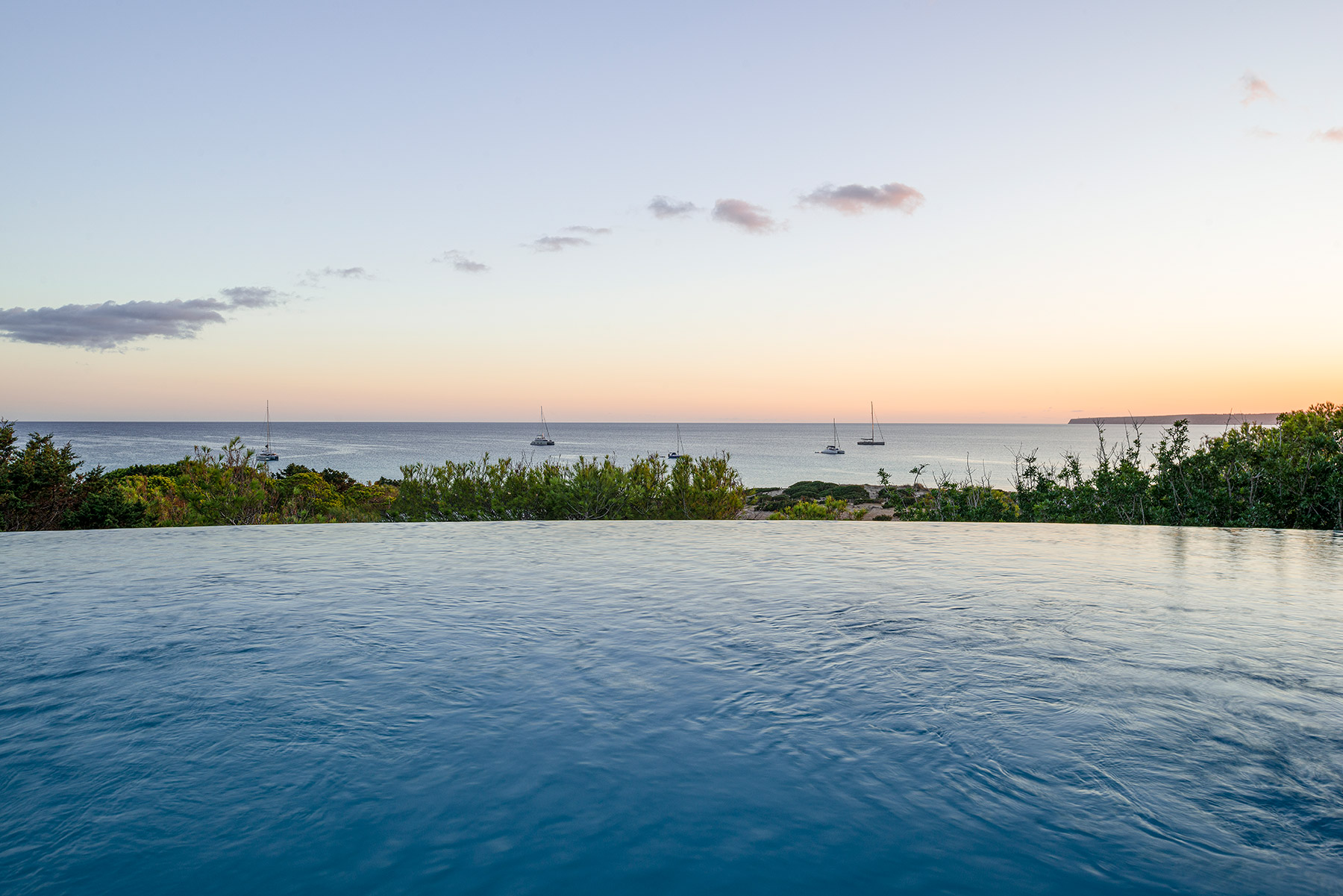
A habitable Mediterranean landscape
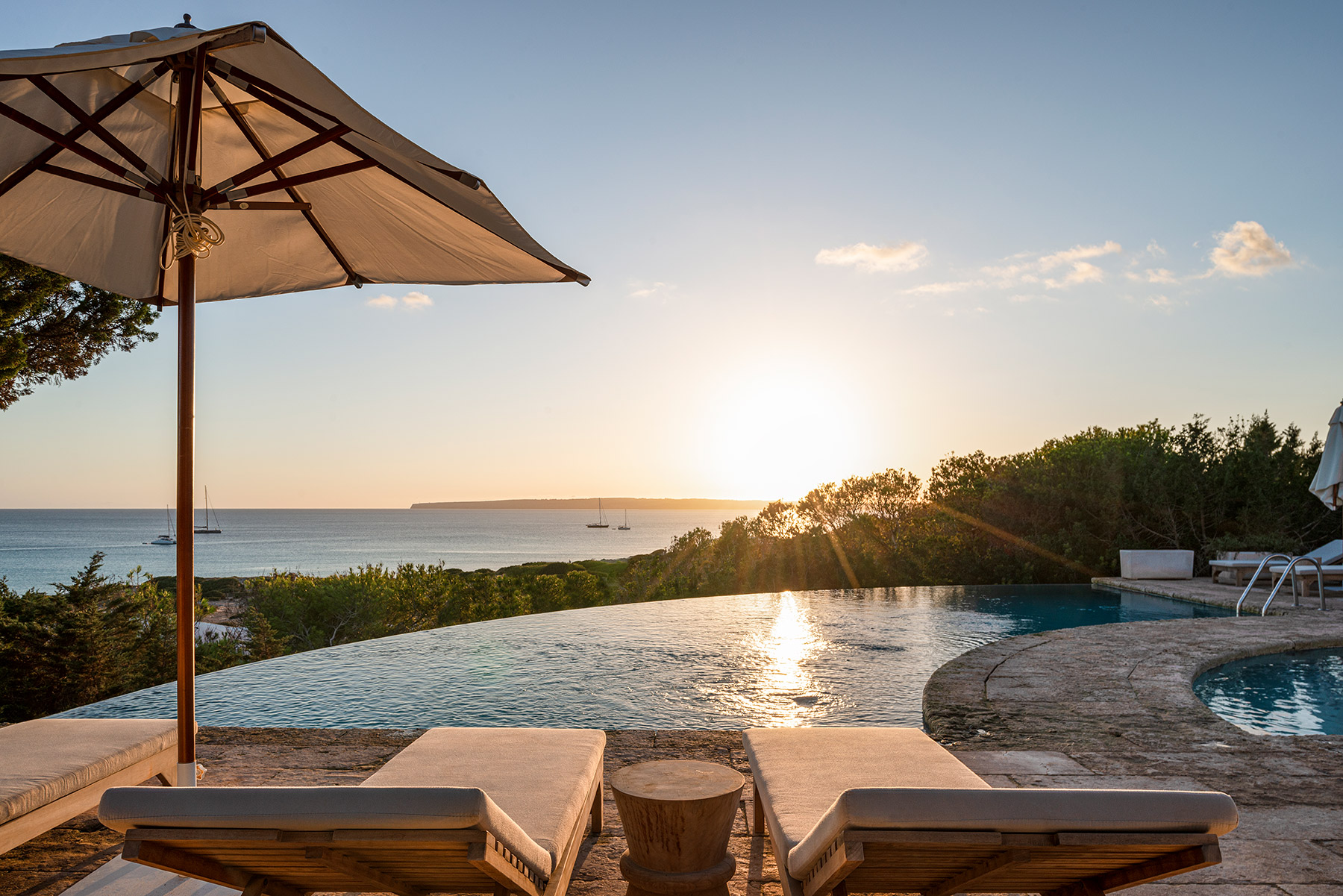
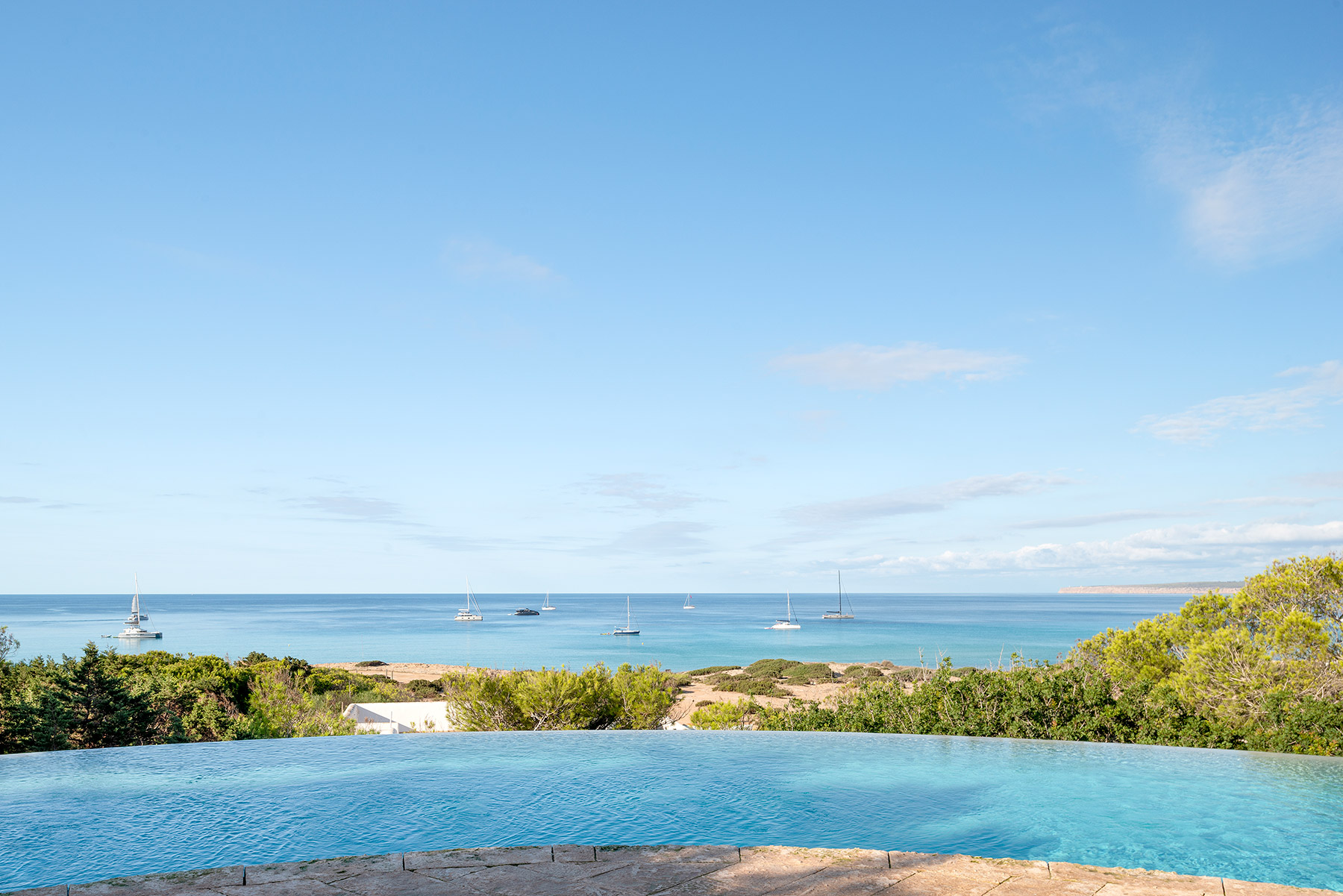
Whoever stays at Dunas de Formentera walks barefoot for most of the day, wrapped in the intermittent sound of wind through the pines and in a sand that replaces any pavement or road. It is, at bottom, the experience Antonio Obrador wanted to build, and one he sums up in a phrase that could well serve as the project’s manifesto: “an architecture is proposed that transcends the idea of a hotel to become a habitable landscape, where simplicity, light and nature build a new way of inhabiting the Mediterranean from respect, calm and authenticity.” That phrase, far from the advertising rhetoric usual in this kind of statement, precisely describes what takes place among this set of rooms, where each one maintains its own relationship with the dune and none repeats exactly the same view.
Formentera can only be reached by sea, as we said at the outset, and that slowness imposed by geography finds in Dunas de Formentera its architectural translation: a hotel that does not interrupt the landscape one crosses to reach it, but rather extends it. It is the same conviction Antonio Obrador has upheld across four decades of hotel restoration, from the fortress of Cap Rocat to the Gran Hotel Son Net: that the most accomplished architecture is, almost always, the architecture that is least noticed.
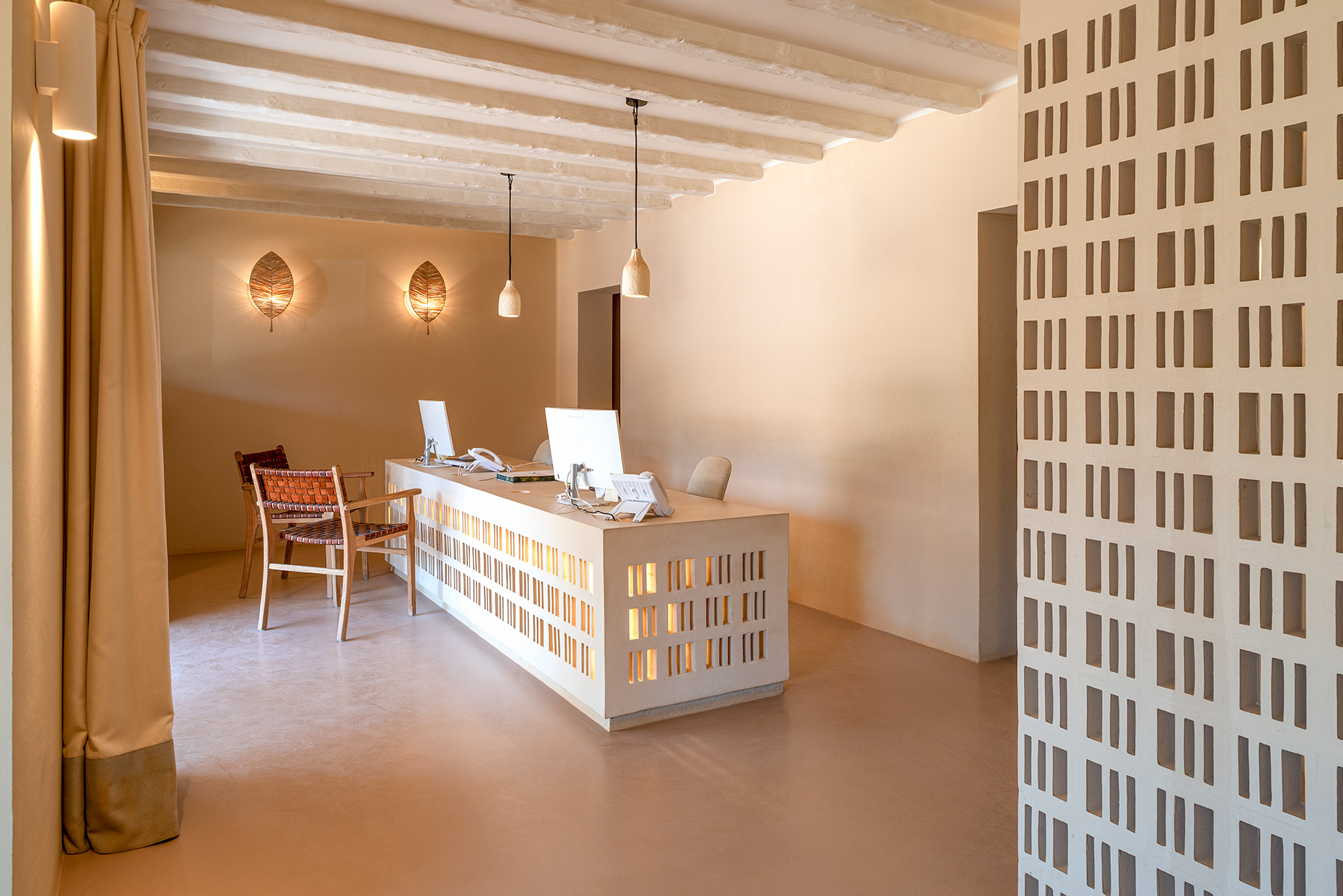
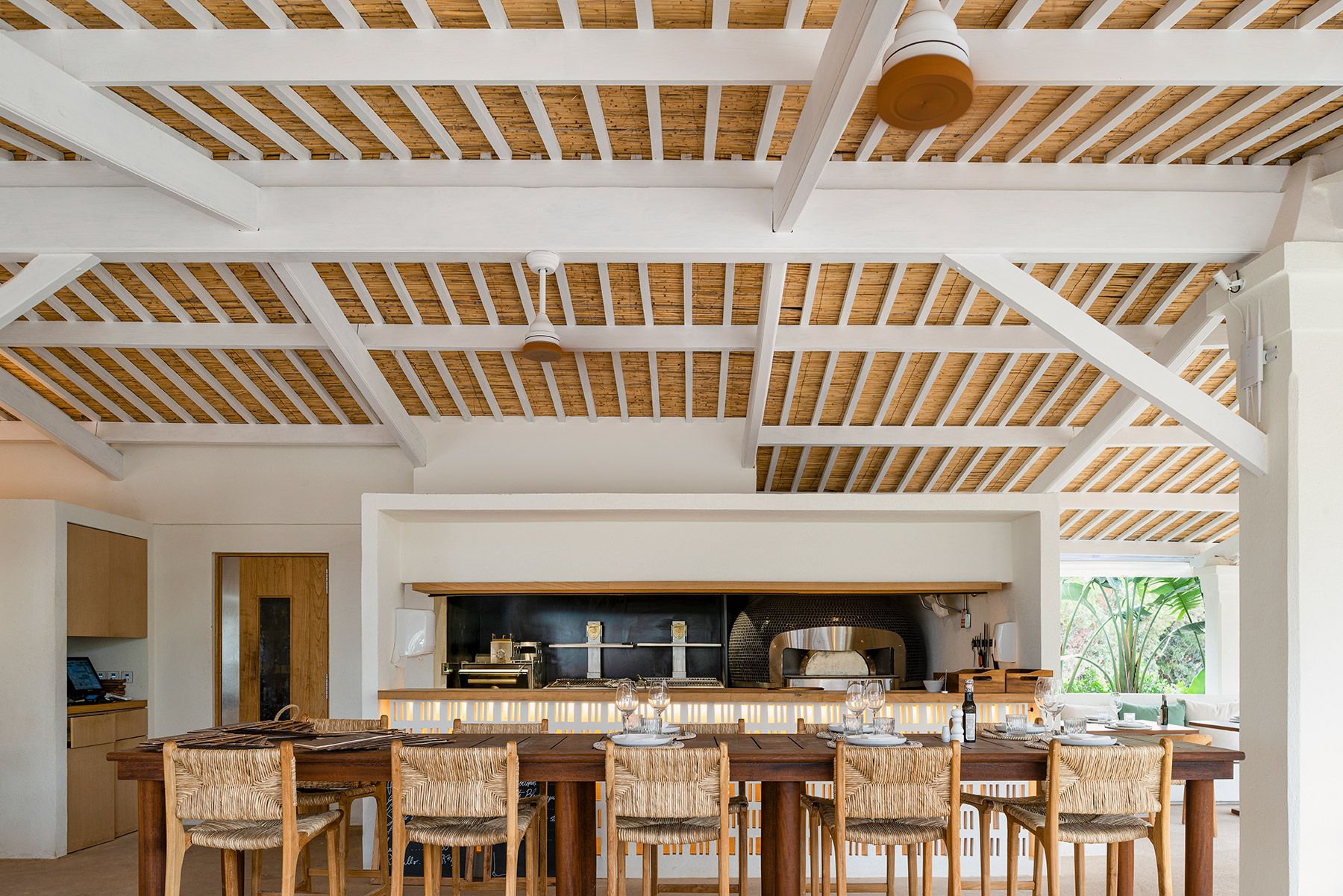
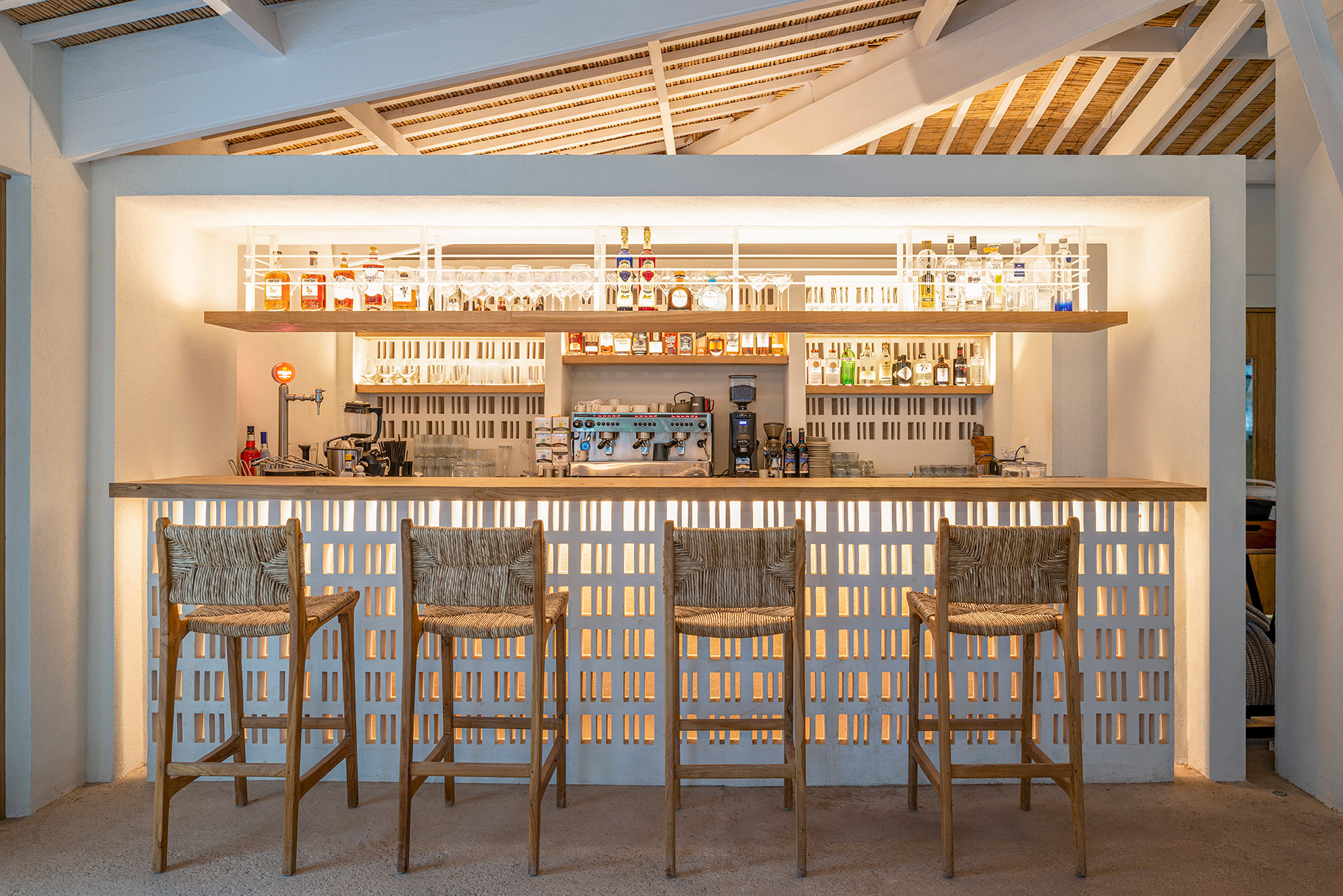
Project: Dunas de Formentera.
Location: playa de Migjorn, Formentera.
Completion: 2025.
Developer: Marugal.
Architecture, interior design and landscaping: Estudio Antonio Obrador.
Project team: Antonio Obrador, Adriana Méndez, Jordi Muñoz, Lluis Bort.
Built area: 3,078 m², in volumes of 100 to 535 m².
Rooms and suites: 45.
Photography: Lluís Bort.
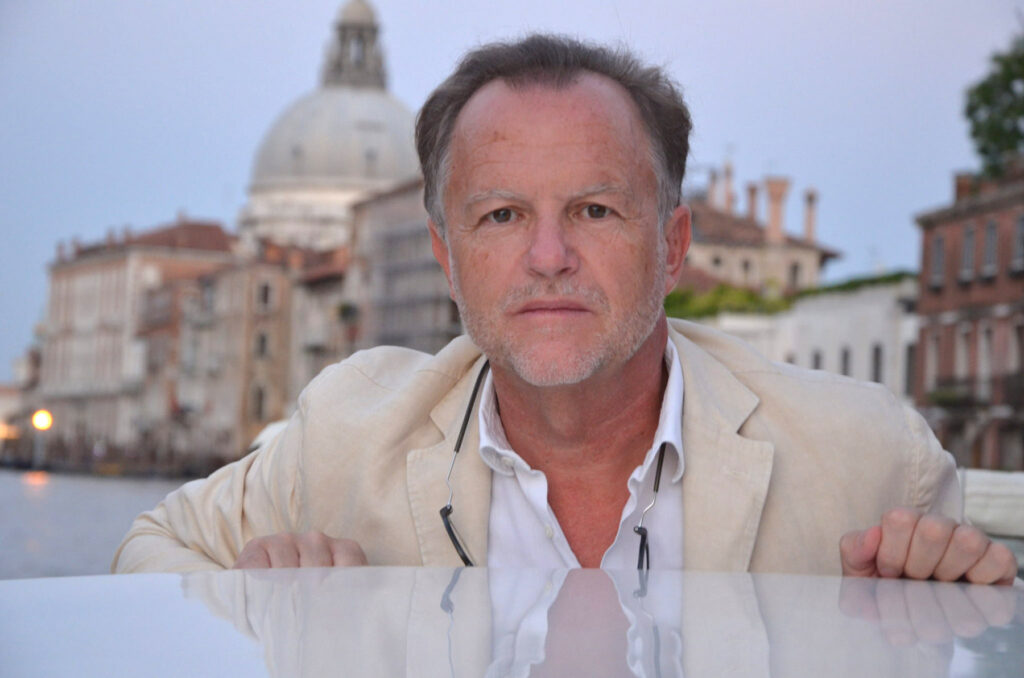
Antonio Obrador
Antonio Obrador (Palma de Mallorca, 1956) found his vocation long before he had a name for it. As a child he was fascinated by the pillars without bases or capitals of La Lonja de Palma, the Gothic building that Guillem Sagrera raised in the fifteenth century. That early fascination held firm against family pressures pointing him toward other paths, and in time confirmed what Obrador understands as a certainty: “vocation is something innate that one carries within.”
In 1980 he founded in Mallorca the studio that today bears his name. More than four decades later, that trajectory has translated into a catalogue of architecture, interior design, decoration and landscaping that spans the private home as much as, most notably, the hotel sector, the terrain on which Obrador has built much of his reputation and in which he has signed some of the most celebrated heritage restorations of recent decades in Spain.
The studio’s work rests on a constant dialogue between tradition and modernity, terms Obrador refuses to consider contradictory. Tradition is expressed in the respect for noble materials —stone, wood, iron— and in the assertion of craftsmanship, of the expert hand that works them; modernity, in the will to reinterpret, to respond to the needs of the present without appealing to nostalgia. Faced with an old building, the studio approaches restoration from a position of respect and of bringing out the value of its original author’s work; faced with an empty plot, new construction frees itself of those constraints in search of a singular result. In both cases the declared objective is the same: a contemporary extension of Vitruvian firmitas that Obrador understands as “enduring design,” set apart from other approaches that dominate much of construction today.
That principle has found its most recognised expression in hotel restoration. Hotel Cap Rocat, installed in the former fortress of Cap Enderrocat, in Llucmajor, is for the architect himself the most difficult project and also the most acclaimed: it received the European Union Prize for Cultural Heritage (Europa Nostra) from the hands of Queen Sofía in 2018, the highest distinction that exists in the field of heritage conservation. The Gran Hotel Son Net, in Puigpunyent, came into the studio’s hands in a state of ruin and today ranks among the twenty-five best hotel restorations in the world according to Condé Nast. To these are added the Hotel Majestic and the Gran Hotel Florida, in Barcelona; the Urso Hotel & Spa, in Madrid; the Palacio Solecio, an eighteenth-century Andalusian palace in Málaga; and, on the islands, interventions such as those of La Residencia de Deià, the Castillo Hotel Son Vida and the Gecko Hotel & Beach Club in Formentera.
At the head of the studio, based in the Casc Antic of Palma, Obrador works today alongside María Chocarro, director architect and partner at AO Estudio, with a team of fifteen in-house architects and a network of external collaborators —engineers, landscapers, interior designers and decorators— completed by craftsmen working in stone, iron and wood. With more than forty years of trajectory behind it, the studio has chosen to keep growing rather than withdraw: the fruit of that review of its own archive is Hotels (Ediciones El Viso, 2025), the first volume of a collection the studio intends to complete with dedicated books on new construction and landscaping.
Recognition for this trajectory includes, among others, the Ramón Llull Award for Professional Career from the Balearic Government (2005) and the Ciutat de Palma Prize for Rehabilitation for Ca’n Nadal, a seventeenth-century casal in Palma’s old town with which he opened his list of honours in 1985. Four decades later, Obrador continues to describe his craft in terms of search rather than achievement: “Perfection does not exist, but the search for perfection does. Only through self-criticism and nonconformity can one advance along that path.”
Estudio Antonio Obrador
San Felio 17A
07012 Palma de Mallorca
+34 971 726 987
contacto@antonioobrador.com
antonioobrador.com
@antonioobrador.arquitectos
Project by Antonio Obrador