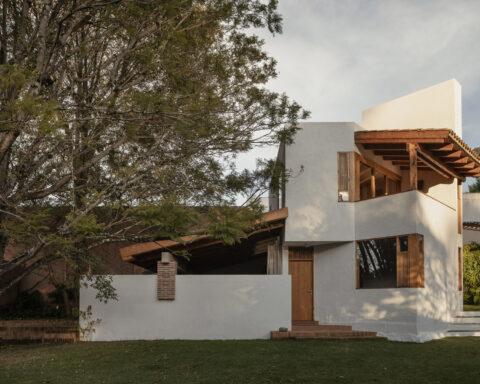


Located in the Tenza Valley, in the central Andes of Colombia, Casa Barro Negro is an exercise in architectural recovery that shifts the focus from the new object towards the value of what already exists. Designed by Cabida Arquitectura, the project begins with an abandoned adobe construction and places it at the centre of a contemporary reflection on rural housing, landscape and time.
At Cabida, contemporary architecture is understood as a discipline that should orient itself towards the reuse of inherited structures, not as a nostalgic gesture, but as a critical response to modern processes of accumulation and their environmental, economic and spatial consequences. In this context, the recovery of constructive memory is not conceived as an idealised reconstruction, but as a conscious continuity of typologies and forms of knowledge that have proven their effectiveness over time. This idea lies at the core of Casa Barro Negro.


Casa Barro Negro takes as its reference the traditional rural architectures of the Andean region, where attached courtyards organise domestic life and naturally regulate ventilation, lighting and thermal comfort. Built with local materials and simple systems, these spaces define a way of inhabiting that is closely linked to climate, use and landscape. The project reinforces these logics, understanding that the architect’s task lies in harmonising existing elements as they are, rather than transforming them through an external logic.
The intervention process is grounded in research into local construction methods and in collaboration with local labour, recovering techniques associated with adobe and traditional building. This decision places the project in a critical position with respect to certain processes of modernisation which, by introducing systems alien to their context, have increased the cost of rural housing while degrading its spatial and environmental qualities. In contrast, Casa Barro Negro advocates for an architecture that is economical in means, yet rich in accumulated knowledge.
The relationship with the landscape is not built through contrast, but through continuity. The materiality of the project enters into dialogue with its immediate surroundings and embraces the passage of time as an essential component of its architecture. Far from seeking a finished or closed image, the house is conceived as a structure open to transformation, where the marks of use and climate become part of its identity.
Casa Barro Negro does not propose a replicable model nor a universal solution. Its value lies precisely in its contextual condition: an architecture that emerges from the territory, recognises memory as a project material, and proposes a way of inhabiting in which landscape, technique and time operate in balance. In a global context marked by homogenisation, this project reminds us that contemporaneity can also be built through recovery, precision and permanence.


Project: Casa Barro Negro.
Location: Valle de Tenza. Colombia.
Completed: 2024.
Architecture: Cabida Arquitectura.
Architects: Oscar González y Diana Lancheros.
Photography: Iván Ortiz Ponce.
Source: Cabida Arquitectura.

Cabida Arquitectura
Founded in Colombia by architects Oscar González and Diana Lancheros, Cabida Arquitectura develops a practice that understands design and architecture as a conscious and responsible act. The studio emerges from a critical position towards architecture produced under market-driven logics, particularly that which reduces space to a commodity and subjects it to processes of repetition, standardisation and obsolescence.
Their work is deliberately situated at a small and medium scale, a field in which the project can sustain a direct relationship with territory, ways of inhabiting and local construction systems. For Cabida, architecture is neither an exercise in style nor a response to trends, but a tool to think time, memory and landscape as active materials of the project. Their practice investigates the essence of materials and their sensory qualities to construct atmospheres that engage in dialogue with people, context and landscape.
The studio approaches residential, commercial and retail projects through a deep understanding of identity, conceived as an emotional and spatial experience at the service of those who inhabit or move through them. Each intervention is developed with strategic rigour, balancing design, functionality and investment, and accompanying the client from architectural definition through to execution.
Cabida integrates the design and development of bespoke furniture as an essential part of the architectural whole and understands construction as the moment when ideas are transformed into reality, carefully attending to timelines, budgets and the final quality of each project.
Cabida Arquitectura
Calle 127a # 7 – 19 Of. 203.
Bogotá, Colombia.
+57 316 306 3367
+57 313 208 6535
taller@cabida.co
cabida.co
@cabida.arquitectura
Project by Cabida Arquitectura