

In Valencia’s Nazaret neighbourhood, far from any grand or ostentatious gesture, a dwelling reopens itself to the city after years of abandonment. This house—named The philosopher’s house by the architect in reference to the profession of its owner—does not stem from an abstract idea or a closed programme, but from the owner’s choice of the pre-existing structure—sealed off, silent, marked by traces of time—and from the dialogue established with architect Jose Costa, with whom there was a strong mutual understanding from the outset. From this exchange emerges an architecture shaped by use, coexistence and time.
The project unfolds as a succession of interconnected interior and exterior spaces, revealed progressively. There are no rigid hierarchies or isolated rooms: the house functions as a continuous system in which each space responds to a specific way of living. A patio conceived as a place for gathering friends brings social life into the heart of the home. A large bookcase organises the space and gives physical form to an extensive book collection, understood as an active part of inhabiting.


The house incorporates a room dedicated to yoga practice, a space for concentration and bodily care, and a study for writing and thinking—intimate yet visually connected to the rest of the home—alongside open areas where the owner’s two dogs can roam freely. A flexible mezzanine can accommodate guests or become a place to play music, while the upper terrace offers a space for rest and light.
Spaces for multiple uses
This logic of multiplicity extends to every element. The bedroom also functions as a cinema; the bathroom becomes a dressing room; the staircase turns into storage. Even the floor participates in the project, allowing natural light to pass through it, descending and connecting different levels. Costa’s architecture does not seek to accumulate functions, but to conceive each space in terms of its capacity to adapt to different situations without losing clarity.
The intervention embraces the building’s history as part of the project. Original hydraulic tiles are recovered and repositioned; existing doors are restored and transformed. Traces of old paint surfaces reappear and are integrated as fragments that narrate the house’s past. Structural reinforcements are not concealed: they are revealed and become part of the ceiling’s language. Exposed brick walls lay bare the construction process and the memory of the place.


A dialogue between old and new
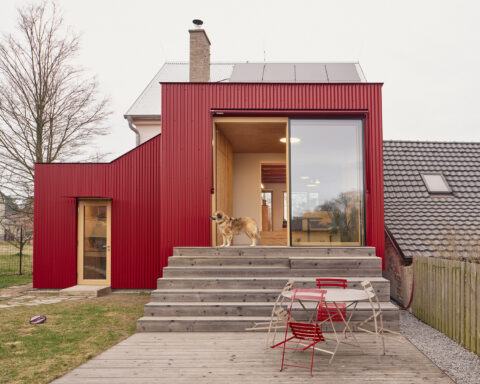
A singular element—the red staircase—introduces a counterpoint within this dialogue between the new and the existing. Over time, the vegetation that accompanies it will transform its presence, softening the initial gesture and reinforcing the idea of a house that does not end when construction is complete, but continues to evolve.
The house is wrapped in a constant natural light, treated as a material of the project. This light unifies the different layers—old and new, domestic and introspective—and allows the dwelling to recover its relationship with the street and the neighbourhood.
The philosopher’s house is, in essence, an architecture built through conversation and attention to detail. A project in which every decision responds to a specific way of living, and in which the past is incorporated into the house to give rise to a new life. Another one.
Project: La casa del filósofo.
Location: Barrio de Nazaret, Valencia.
Completion: 2025.
Architect: Jose Costa.
Team: Ana Aguado, Victoria Recio, Belén de las Heras, Patricia Barber.
Technical architect: Salvador Tomás.
Photography: Mariela Apollonio.

Jose Costa
Jose Costa is an architect and founder of Jose Costa ARQ., an architecture studio based in Valencia that understands architectural practice as an active tool for improving the ways we inhabit space. The studio operates as an open platform, bringing together professionals from different disciplines who share a common ambition: to work with rigour, sensitivity and commitment through architecture.
The practice focuses on residential, cultural and workplace projects, always approached from a critical and analytical perspective. Each commission is conceived as an opportunity to explore the limits of programme and context, combining technical efficiency with creativity, material research and constant attention to the people who will occupy the spaces. Reuse, integration with the surrounding environment and close observation of real patterns of use are essential components of the studio’s working methodology.
Jose Costa was born in Alzira in 1978 and trained as an architect at the Polytechnic University of Valencia, where he graduated in 2004. That same year, winning first prize in the IVVSA National Preliminary Design Competition —for the construction of a 42-unit housing project for young people in Benidorm— marked the beginning of an initial professional phase defined by projects developed within the Spanish context and an early public recognition of his work.
In 2011, Costa moved his practice to Rio de Janeiro, which became the studio’s main base until the end of 2014. During this period, he founded The House, a creative space conceived as a multidisciplinary extension of the studio, from which cross-disciplinary relationships between architecture, art, design and education were explored. This international experience broadened his frame of reference and consolidated an approach to architectural practice that remains open to experimentation and dialogue with other disciplines.
After four years in Brazil, Jose Costa returned to Valencia, where he continues to develop architectural projects, social initiatives and artistic proposals, both through his own studio and as a co-founder of the artistic collective Enredant. Today, José Costa ARQ. maintains a practice that combines reflection and action, with an architecture attentive to context, resources and, above all, to the people who inhabit it.
Jose Costa Arq.
The House
Denia 50
46006 Valencia
+34 617 525 323
estudio@josecosta.es
josecosta.es
Project by José Costa