
On Muntaner 185, one of Barcelona’s most demanding gastronomic arteries, Chambacú opens its doors with an identity-driven proposal that seeks to compete beyond fleeting trends. With a surface area of 220 m², the project structures gastronomy, memory and interior design into a single coherent narrative .At its helm stands the Colombian chef Santiago Sánchez Arango, a professional with a long trajectory in international haute cuisine and experience in Michelin-starred restaurants. Chambacú is his most personal undertaking: a synthesis between contemporary technique and cultural memory. His cuisine departs from pre-Columbian, African and colonial roots, reinterpreted through present-day gastronomic rigor. Product, research and narrative align in a proposal that vindicates mestizaje as a creative foundation.
The name is not incidental. Chambacú was a historic neighborhood in Cartagena de Indias, a symbol of resistance, cultural mixture and social resilience. The restaurant adopts this reference as its conceptual point of departure. The interior design, developed by Rosa Colet, translates that memory into space. The designer approaches the project convinced that the gastronomic experience begins before the first dish arrives. The journey unfolds through three differentiated realms —El Patio, Candela and Memoria— functioning as chapters in a spatial and symbolic sequence.

El Patio: Caribbean exuberance
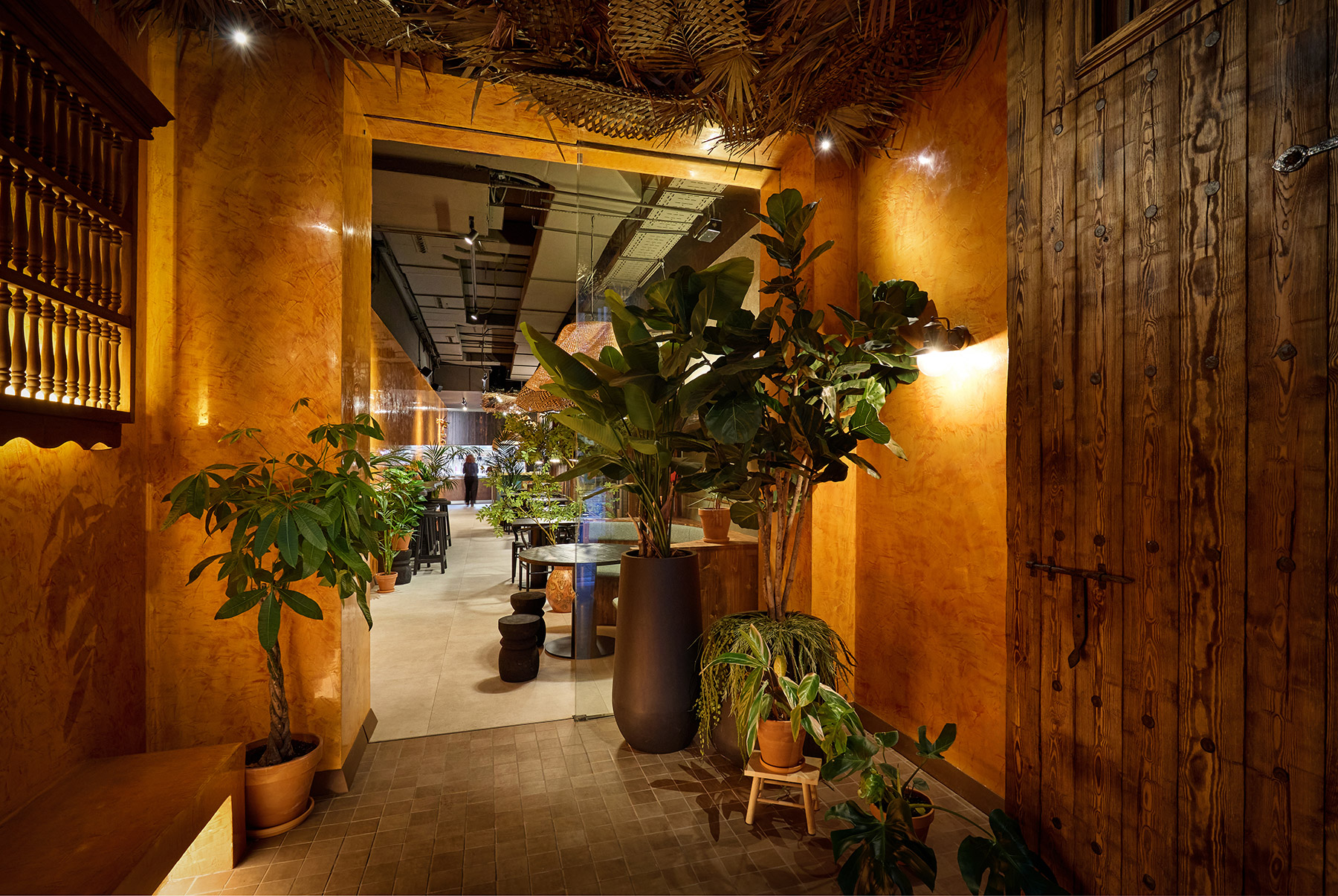
Access takes place through El Patio, a vibrant space that acts as both threshold and meeting point. The Caribbean reference materializes in the presence of vegetation, in the texture of the weathered wooden door and in the reinterpretation of the traditional Colombian window. The aim is to generate an immediate and welcoming atmosphere. Light, warm tones and natural materiality construct a transitional environment that invites enjoyment. From the outset, the design establishes a bond between origin and contemporaneity.

Candela: encounter and cocktails
The route leads to Candela, a zone conceived for informal gathering, cocktails and a flexible gastronomic offering. Here, the language becomes more dynamic. Zigzagging walls clad in recycled wooden pieces filter light and generate depth. The reference recalls the spontaneous constructions of the former Chambacú neighborhood, where homes were erected from fragments of wood and sheet metal. Memory is reinterpreted through a technical solution that transforms recycling into an expressive resource.
Lighting, handwoven by master artisan Philip, incorporates African lamps that reinforce the project’s mestizo dimension. Suspended natural fibers add texture and shadow, modulating the nocturnal experience.

The graphic voice of La Linterna
Between Candela and Memoria appears an exhibition space dedicated to La Linterna, the historic typographic print workshop in Cali that has turned the Colombian popular poster into cultural heritage. Its handcrafted posters, vibrant in color and direct in graphic language, act as a narrative device, embedding context within the spatial journey. Visitors traverse a graphic memory that connects popular tradition and contemporaneity, preparing the transition toward the restaurant’s most introspective setting.


Memoria: the contemporary rite
The sequence culminates in Memoria, the dining room dedicated to the tasting menu. Here, the atmosphere transforms. Calm prevails, light becomes subdued and the ambience grows concentrated. Two large-scale murals by the artist Ivanna Gautier preside over the space: an Indigenous figure and a palenquera, symbolic presences of belonging and origin. Color and scale introduce the ritual dimension that accompanies the rhythm of gastronomic service.
The African lamps woven by Philip reappear, reinforcing material and cultural coherence. The space suggests solemnity through proportion, lighting and chromatic restraint.
Materiality and craftsmanship as strategy
Rosa Colet’s intervention rests on a palette of earthy tones, beiges and energetic chromatic accents that converse with the culinary proposal. The selection of materials responds to a logic of honesty and natural origin: charred wood, vegetal fibers, cane and author ceramics.
Collaboration with Rústic Ceràmica has enabled the development of bespoke pieces —plates, bowls, vases, cutlery supports and lamps— integrated into the overall concept. Tableware forms part of the spatial narrative. Each element reinforces the diner’s tactile and visual experience.
All furniture has been designed specifically for the project and executed through artisanal processes. This decision responds to the developed design concept, with the intention of constructing coherence between cultural discourse and material production.
Gastronomy and interior design: an indivisible experience
Santiago Sánchez Arango’s gastronomic proposal explores Latin American mestizaje through contemporary technique. Native ingredients, reinterpretations of traditional recipes and a current reading of Colombian cuisine unfold in menus that dialogue with the space.
Rosa Colet’s interior design structures the experience of those who share the chef’s proposal. The route, the gradation of light and the transition between atmospheres modulate the diners’ time. Interior architecture and cuisine share a single objective: to transform memory into present experience.


A project with identity in a competitive context
Located in one of Barcelona’s most consolidated gastronomic areas, Chambacú embraces the challenge through cultural and conceptual differentiation. In contrast to proposals competing for immediate impact, the restaurant commits to narrative coherence and identity depth.
In this project, design, gastronomy and history integrate with notable precision. The result is a space where every decision —material, graphic, artistic or luminous— responds to a shared logic. Chambacú does not merely recreate a past; it translates it into a contemporary and emotional experience. Therein lies its singularity.

Project: Restaurante Chambacú.
Location: Muntaner, 185. Barcelona
Author: Rosa Colet.
Creative direction: Rosa Colet.
Client: Santiago Sánchez Arango.
Completion: Setiembre 2025
Site coordinator: Marisa Amorós
Carpentry: Fusteria Miquel.
Lighting: Gaudir Girona.
Photography: Vicenç Prat.
Kitchen equipment: Complet Hotel.
Ceramist: Rut Oliver Valls Rustic.
Textiles: Casamance, Naturtex.
Flowers and plants: Bossvi Deco.
Furniture: Casual Solutions.
Upholstery: Lucky Mora Studio.
Natural fibers: Mas Valls.
Wall coverings: Texdecor.

Rosa Colet
Rosa Colet (Barcelona) is an interior designer and founder of Rosa Colet Strategies in Interior Design, a studio she has led since 2011 following an extensive professional trajectory within established firms in the sector. With more than three decades of experience, her practice has become particularly consolidated in the hospitality and restaurant fields, while also encompassing office environments and private residences.
Educated at the Escola d’Art i Superior de Disseny Pau Gargallo, where she earned her Degree in Interior Design (1987–1991), Rosa Colet belongs to a generation of professionals who understand interior design as a strategic tool capable of transforming user experience while advancing her clients’ business objectives. This vision — combining spatial sensitivity with analytical insight — defines the identity of her studio today.
Her work consistently begins with careful observation of context and client goals. Each project is conceived as a system in which concept, functionality and technical feasibility must progress in coordination. The intervention does not merely resolve an image; it constructs a coherent narrative that unfolds through spatial sequences, material selection, the relationship between furniture and architecture and, above all, the user experience.
Within the fields of gastronomy and hospitality, her approach demonstrates how design can become an active business asset. A recent example is her involvement in redefining the gastronomic model of Chambacú, the Barcelona-based restaurant by Colombian chef Santiago Sánchez Arango, where interior design moves beyond backdrop to integrate with the culinary proposal, shaping a comprehensive experience. The space structures the encounter.
From the studio, each intervention develops through a conscious balance between concept and execution. Behind every formal decision lies a technical and strategic rationale. Constructive detailing, site coordination and creative direction form part of a continuous process that Rosa Colet leads with a committed and precise gaze.
A common thread runs through her practice: approaching every project as if it were her own, building relationships grounded in trust and placing the user consistently at the centre. In this combination of professional rigour and attention to everyday use lies the consistency of a trajectory that has evolved without losing clarity of purpose.
Rosa Colet
Carrer del Vallès, 31 bis
08320 El Masnou
Barcelona
+34 93 555 96 88
info@rosacolet.com
rosacolet.com
@rosacolet.interiordesign
Project by Rosa Colet