

In many Spanish cities, the ground floors of residential buildings have ceased to function solely as commercial spaces and become dwellings. In cities such as Madrid, Barcelona, Valencia and Málaga, this conversion is particularly prevalent owing to strong housing demand and the availability of vacant units. Several forces converge in the rise of this phenomenon: the pressure of residential demand that conventional construction cannot absorb, the accelerated closure of neighbourhood retail, the growth of e-commerce, and straightforward economic logic — the price per square metre of a commercial unit is more accessible than that of a home in the same district. The conversion is by no means automatic; only a fraction of the vacant ground floors in large cities meets the technical and planning conditions — clear height, ventilation, natural light, access — required to obtain a certificate of habitability. It is within that narrow margin that architects and interior designers capable of turning these spaces into comfortable homes intervene..


The Providencia project, completed by Nook Architects in 2026 in Barcelona’s Gràcia neighbourhood, is one example of that transformation. A diaphanous commercial ground floor in a 1950 residential building, with concrete porticos, generous clear height and visual access to the landscaped courtyards of the interior block — conditions that become the central argument of a 190 m² home conceived for a single person who needed somewhere to live, work, spend leisure time and share with friends.
The organisation of space
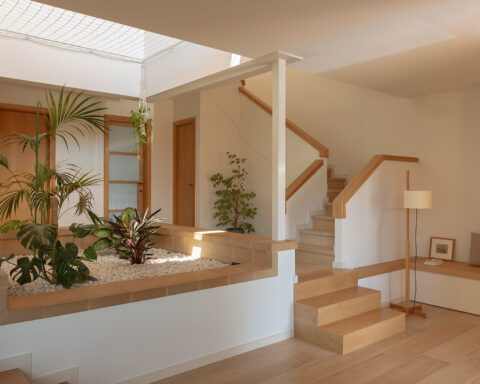
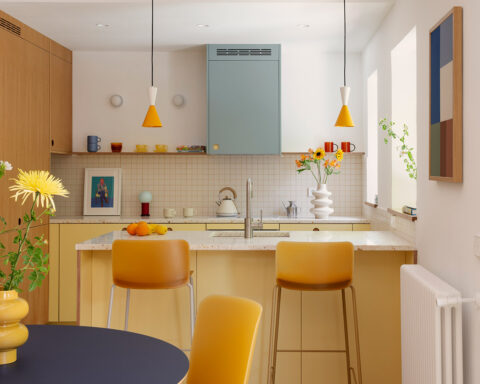
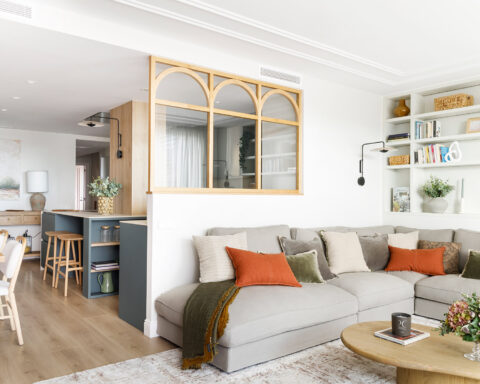
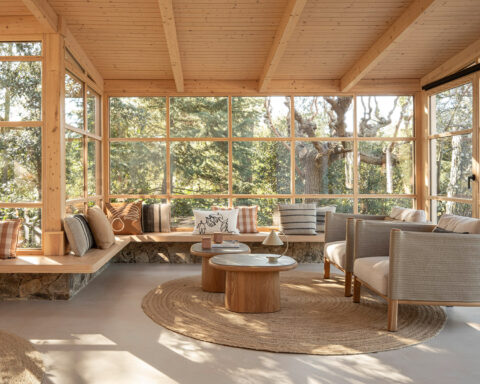
The first problem of the project is also the most revealing of its logic: how to endow a singular, longitudinal space with the complexity of uses that contemporary domestic life demands, without fragmenting it to the point of losing what makes it valuable. Nook Architects’ response is organisational before it is formal. The zone oriented towards the interior courtyard garden is reserved for the large multifunctional space that structures the daytime area: kitchen, dining room, living area, a library with a reading corner and a workspace are distributed across two levels that make use of the existing double height. Four large windows establish visual and spatial continuity with the exterior, where a garden of native species extends life outward, with an open-air dining area beneath the existing porch.
At the opposite end, oriented towards an interior courtyard, the en-suite bedroom operates from a different logic. Its character is one of contained intimacy: a layered arrangement of textiles, filters and transitional elements modulates the light and gradates the views until a more sensorial, gathered atmosphere takes form. The gradation between public and intimate is, in reality, the true project: not a plan resolved through functional zones, but a sequence of habitable densities that the owner moves through and activates according to the moment of the day.


Matter as argument
Nook Architects take a clear position from the outset regarding the material identity of the space. The original unit carries in its structure the memory of an industrial programme: exposed concrete, steel, a brutalist spatiality that the architects choose to respect and activate rather than conceal. Beyond any nostalgia, this decision is architecturally honest: the character of the space retains its prominence, and the residential materials — wood, ceramic — are introduced in dialogue with that base, as counterpoint. The result is a sophisticated and serene atmosphere in which the chromatic strategy, the lighting and the decorative elements introduce subtle references to the spatial and sensory principles of Asian cultures. Nook works with the idea that domestic atmosphere is constructed as much through abstraction as through the physical presence of materials.
The combination holds because it responds to a coherent logic: concrete and steel anchor the space in its constructive history, while wood and ceramic open it towards everyday life. Between both registers Providencia dwells — a space that carries in its name, in the literal sense of anticipatory care, the promise of a composed and contemporary architecture capable of thinking about who will inhabit it before they arrive.


Project: Providencia.
Location: Gràcia neighbourhood, Barcelona
.
Area: 190 m².
Completed: 2026
.
Architecture and interior design: Nook Architects
.
Photography: Nook Architects
Structural engineering: Francesc Gorgas.
Source: Nook Architects.

Nook Architects
Nook Architects is an architecture and interior design studio founded in Barcelona by Rubén F Berenguer and Joan G Cortés, who work from the conviction that every project begins with a story: that of the place, of the people who will inhabit it, and of the specific needs that set it in motion. From that initial act of listening, they build spaces capable of conveying balance and establishing a vital connection with those who live in them. Their position on sustainability is part of the studio’s DNA: they understand materials, functionality, and comfort as ethical values developed from the root of each project, allowing space to adapt to life without rigidity and to accumulate, over time, the mark of whoever occupies it.
Beyond professional practice, both partners maintain an active relationship with education. As members of the ESDAP council and collaborators with various design and architecture schools, they take part in training those who will shape the spaces of the future.
Rubén F Berenguer graduated from the Escola Tècnica Superior d’Arquitectura de Barcelona at the UPC in 2010. A period in Rome deepened his understanding of the built heritage and opened his thinking towards restoration and rehabilitation as forms of cultural continuity. On his return, he collaborated with studios such as GVR Arquitectes and EC Compta Arquitectes, where he developed a transversal knowledge of architectural and urban planning processes. His involvement in public building competitions and large-scale urban planning projects consolidated his ability to combine conceptual rigour with constructive effectiveness.
Joan G Cortés began his professional career in 2009, shortly after graduating from the UPC in Barcelona. A stay in Sweden marked a significant shift in his outlook: there he immersed himself in experimental architecture and design, and took part in the Pole Europe 2K’6 programme in Landscape and Urban Planning at the University of Applied Sciences Northwestern Switzerland, which gave his perspective a decidedly international dimension. To this spatial formation he added a specialisation in financial management of architecture studios and a postgraduate degree in Public Administration for technicians and architects. His time at studios such as BOMA, Mora-Sanvisens Arquitectes and EC Compta Arquitectes allowed him to integrate a thorough knowledge of the architectural process with a solid grounding in urbanism and management.
Nook Architects
Lepanto 258
08013 Barcelona
+34 930 053 825
nookpeople@gmail.com
nookarchitects.com
@nookarchitects
Project by Nook Architects