
The Sierra de Gata occupies the northwesternmost corner of Extremadura, where the province of Cáceres narrows between Portugal and Castile and León before dissolving into the Salamanca plain. It is a modest range by Spanish standards — its peaks fall short of 1,800 metres — yet it carries a sharply defined identity: historical isolation, remarkable forest cover, and a vernacular architecture that has answered granite and slate with an economy of means rarely found elsewhere..
The villages of the comarca — Hoyos, Gata, Robledillo de Gata, Villasbuenas, San Martín de Trevejo — preserve an almost intact medieval fabric of granite and chestnut-wood houses, colonnaded porches, and a relationship with topography that any architect today would envy. San Martín de Trevejo is perhaps the best known, with its cobbled streets and the presence of fala, a minority Romance language related to Galician-Portuguese still spoken in three villages of the area — a linguistic detail that says much about the isolation that has kept the place as it is. The Sierra de Gata has not experienced the mass tourism or large-scale second-home development that has transformed other Spanish ranges. That carries an economic cost for its inhabitants, but it has preserved intact a way of building and of relating to the landscape that elsewhere disappeared decades ago.
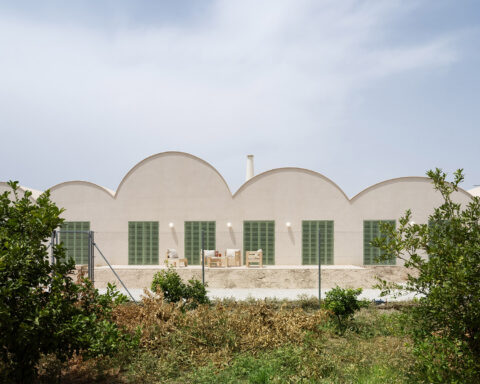
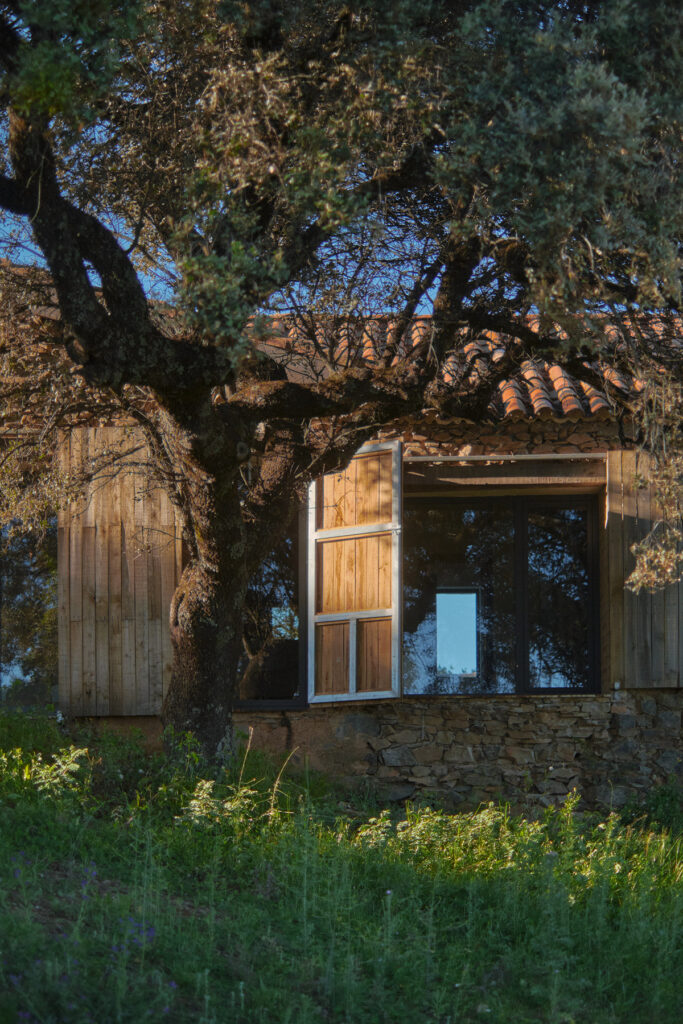
Here, in the Sierra de Gata, stood this construction looking out over the valley, with no one paying it much attention. A former sheep stable with rough-hewn stone walls set in earthen mortar, a curved clay-tile roof, and austere proportions dictated by use and climate — nothing more rhetorical than the work itself. Ábaton found it this way, recognised it for what it was — a piece of vernacular architecture with a character of its own — and decided that the renovation should begin with respect.


The Madrid-based studio has long been developing an understanding of intervention on existing buildings that goes beyond material salvage. More than preserving the stone or reusing the tiles, it means taking sides with the constructive logic of the place: accepting that those who built the stable knew exactly what they were doing when they sited it on that hillside overlooking the oak grove, when they chose the orientation or settled on the thickness of the walls. The renovation of Holm Oak Estate departs from that recognition: the position is right, the structure makes sense, the materials exist in the territory. What changes is the inhabitant and, with them, the relationship between inside and out.
The most significant structural transformation was the opening. The stable was, like all of its kind, a dark and inward-looking construction: light and warmth stayed within, nature remained outside. Ábaton reversed that order.
From the dining area, the opening onto the terrace and pool dissolves any boundary between inhabited space and landscape; beyond, the sierra’s ridgeline occupies the horizon as naturally as the objects on the table. In the bedrooms, floor-level windows frame the oak grove from the bed. The exterior is not the view here — it is the argument.
To accommodate the programme of a single-family home — three bedrooms with en-suite bathrooms, an integrated living area, and a main bedroom and bathroom — without distorting the original massing, the project added a second floor tucked into one of the volumes. This addition lifts the main bedroom and bathroom above the rest, separating them physically and visually while offering the best views over the sierra. The extension respects the scale of the whole: it follows the pitch of the roof, maintains the same material logic, and disappears among the existing volumes when seen from the meadow.


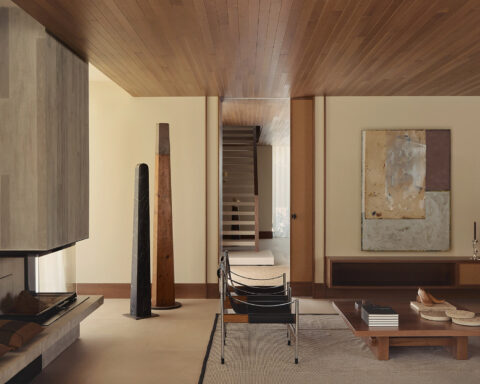
The communal area — dining room, living room, and kitchen — occupies one of the original volumes as a single room, fully open to the exterior through large sliding panels. A freestanding white-bodied fireplace organises the transition between zones without raising partitions. The kitchen, set further back, holds the most domestic character of the ensemble: stone worktops, reclaimed timber joinery, exposed rubblestone at the back wall, and a lacquered red range that introduces a note of strong colour among all that limestone. The carved granite sinks — in the lateral bedrooms’ bathrooms as much as in the principal suite — are pieces drawn directly from the local quarry, with no more transformation than necessary. The material does not disguise itself.
The entrance hall is the space where dialogue with history becomes most explicit: the original stone mixed with local earth remains visible in the lower part of the wall, while the upper surfaces are whitewashed with the finish the studio considers its own. The staircase rising to the second floor resolves that same crossing with technical elegance: the base is exposed brick — reclaimed, rough, weighted with time — while the treads are thin sheet-metal blades that ascend without mass, barely touching. Rusticity and contemporaneity coexist.
The bathrooms continue that conversation between materials. In the principal suite, the screen disappears and the bathroom volume merges with the bedroom: travertine vanity, exposed stone wall, sloped timber ceiling. Others opt for olive-green mosaic tiles lining bath and shower walls, a colour that takes the hillside visible through the window. In another, the sink is a block of carved pink granite — the same granite that appears in the oldest constructions of the comarca. The bathroom as geological extension of the place.


Energy efficiency and sustainability
The commitment to energy efficiency was addressed with the same discretion: thermal insulation integrated into the envelope and photovoltaic panels to cover consumption, without any of these decisions altering the exterior reading of the building. Sustainability here is part of the ethics of an intervention that decides not to build beyond what is necessary.
The interior design and furnishing extend the tone of the project: craft pieces and contemporary design coexist with reclaimed antique furniture, kilim rugs, and linen and esparto textiles. The faded blue of an old sideboard against the exposed stone of the dining room; the solid wood table with rush and esparto chairs; the green-painted coffee table in the living room, aged to the point of forgetting when it was new. The house works as a refuge that has accumulated objects slowly, without decorative haste — and that is exactly what it looks like.
To arrive at Holm Oak Estate is to arrive in a territory where architecture still has memory. The oak grove surrounding the property is an ecosystem that predates the stable by centuries, and will outlast Ábaton’s intervention long after it has acquired the patina it still lacks.
Project: Holm Oak Estate
Location: Sierra de Gata. Cáceres.
Completed:
2024.
Architecture and Interiors: Ábaton
.
Photography:
Derek Pedrós.
Source: Ábaton.

Ábaton
Since its foundation in 1998, Ábaton has established itself as one of Spain’s most influential architecture studios. Its work, renowned for its formal honesty and conceptual depth, is guided by a clear philosophy: to eliminate the superfluous in order to reach the essential. For Ábaton, architecture is not only a matter of space, but a form of intimate conversation —with oneself, with others, and with nature. View full biography.
Ábaton Arquitectura
Ciudad Real, 28
28223 Pozuelo de Alarcón
(Madrid)
+34 913 521 616
info@abaton.es
abaton.es
@abaton_arch
Project by Ábaton Arquitectura