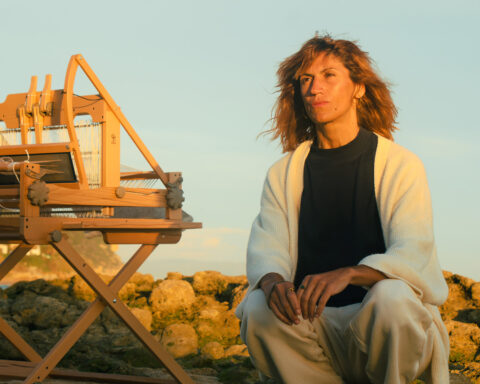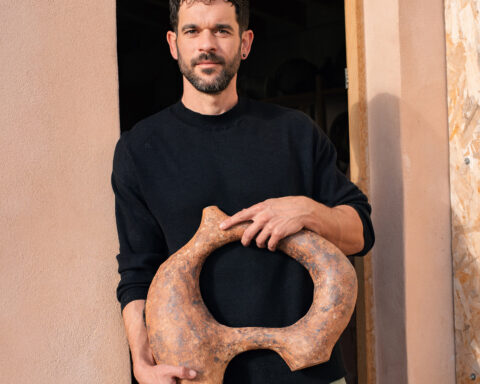


Tornero y escultor, su obra se sitúa en ese territorio híbrido donde la artesanía se abre a la escultura contemporánea y el gesto manual adquiere una dimensión conceptual. Nacido en Legazpi (Guipúzcoa) y vinculado vitalmente tanto al País Vasco como a Galicia, Aitor construye desde el territorio una práctica profundamente arraigada en el paisaje y sus relatos. Su trabajo parte de la convicción sencilla de que la materia contiene historias, y que el artista puede revelarlas sin forzarlas. Así, cada pieza surge como un pequeño universo autónomo, una presencia que condensa memoria, identidad y transformación.
The lathe as a poetic tool
At the core of his practice lies the lathe, understood as an expressive instrument beyond repetition. Aitor works with green wood, freshly cut, embracing the drying process as an active part of the work. The final form integrates the deformations, cracks, and tensions that appear over time.
This way of understanding the craft brings his work closer to sculpture than to the utilitarian object. In collections such as Mundos or Códigos del alma, the piece ceases to be a container or closed volume and becomes instead a tactile narrative, where time is inscribed on the surface.


Sustainability as an ethics of process
Sustainability appears in his work as a structural condition of his projects. Most of the wood comes from nearby environments: controlled pruning, local forests, or certified sawmills. The cycle closes within the workshop itself, where remnants are reused as energy or compost, establishing an almost domestic circular economy.
This relationship with the origin of matter reinforces the territorial character of his work. Each piece retains the trace of its provenance: oak, chestnut, cherry, or ash speak not only of botany, but of cultural landscape. The object thus becomes a fragment of transformed geography.
From learning to recognition
His approach to woodturning came relatively late, but intense. After beginning his training with a still functional outlook, his time in 2022 at the prestigious Escoulen school in France — becoming the first Spaniard to undertake this training with leading masters such as Yann Marot and Alain Mailland — transformed his approach to the craft, introducing a more experimental and sculptural dimension.
In just a few years, his trajectory has been recognised by various institutions within the fields of craftsmanship and culture. The turning point came with the 2025 National Craft Award in the Product category, granted for his collection Mundos, noted for its technical sensitivity, conceptual strength, and commitment to sustainable practice.


The piece as presence
Beyond awards, what defines Aitor Martínez’s work is a way of being in the world through making. In his workshop, time is measured differently: in drying cycles, in seasons, in the patience of repeated gestures. Each work presents itself as an autonomous, biographical entity that holds the traces of its own becoming.
“My workshop and studio is at the same time my home, the place where I am able to materialise my emotions. It is a space full of light in which I feel freer than anywhere else,” explains Aitor.
There is in his work a will toward slowness that feels deeply contemporary. In contrast to the speed of industrial production, his pieces reclaim waiting, imperfection, and direct contact with matter. He does not seek spectacular objects, but objects that remain as silent presences inviting contemplation.
In this balance between tradition and experimentation, between craft and thought, Aitor Martínez López de Arbina stands as one of the most sensitive voices in contemporary Spanish craftsmanship. His work reminds us that, at times, innovation does not lie in inventing new materials, but in learning to listen to those that already exist.

Aitor Martínez López de Arbina
Alejandro Outeiriño Rodríguez 11
32003 Ourense
+34 696 919 478
info@aitorpunto.com
https://aitorpunto.com/
@aitor_punto
Project by Aitor Martínez López de Arbina