
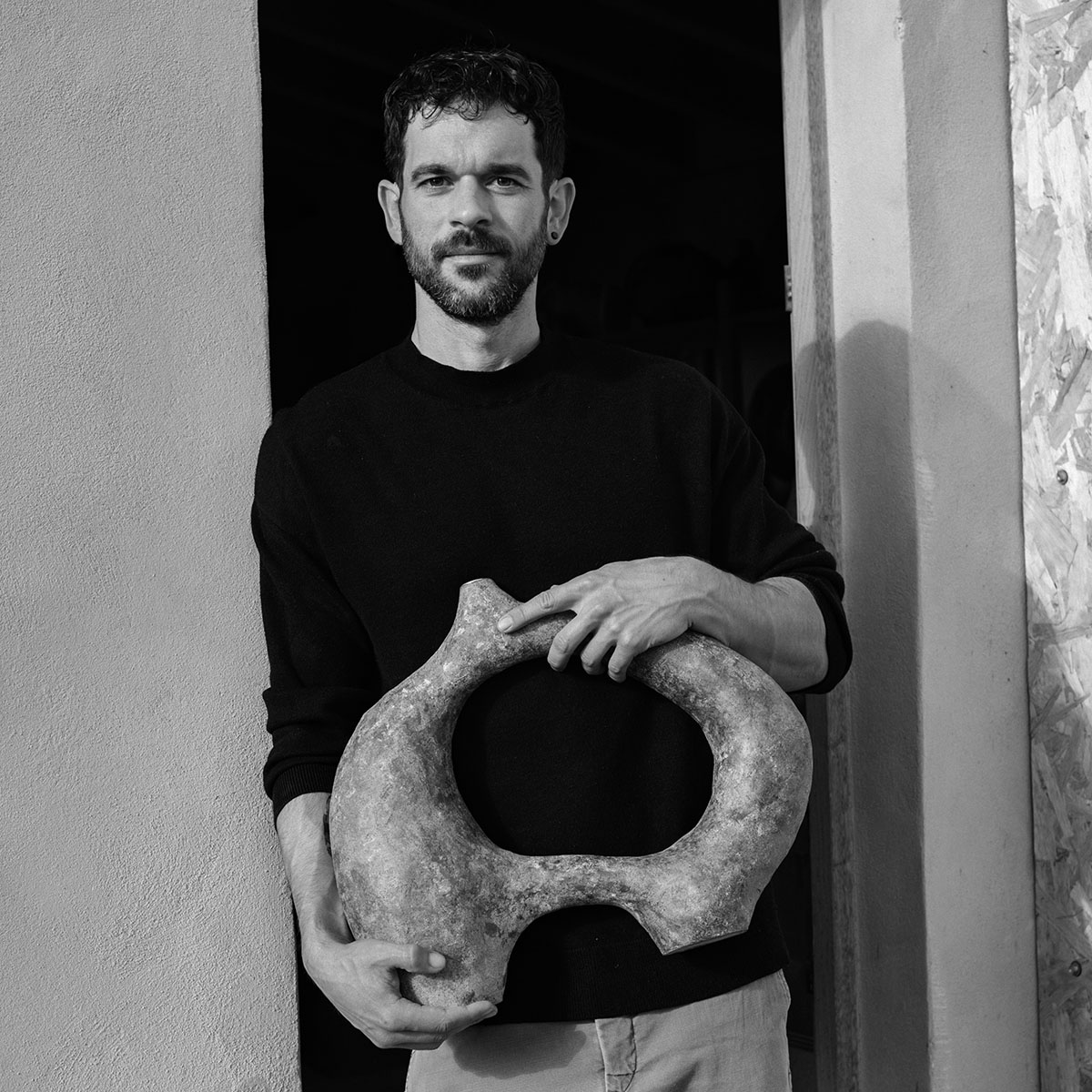
In Galilea, a small village in Mallorca’s Tramuntana mountains, Paco Romero works clay as it was worked before the wheel and before the mould, with his hands, with stones and wood gathered from the landscape itself, letting the material decide much of what is to happen. All of his work comes out of that studio, whether a piece destined for a home or an intervention conceived for an architecture project.
His work does not seek to imitate old forms or reproduce a decorative style associated with the primitive. It is, in his own words, “a way of working in which the material has the voice.” He defines it as an ode to origins: “To the first inhabitants. To the effect that the passing of time has on objects and on people.”
Romero was born in Alicante and trained at the school of art and design, focused at first on painting and canvas sculpture. Even in childhood there was already a relationship with the image: his first memory of holding a brush dates back to age five, sitting his younger brother in a chair and trying, without much success, to get him to sit still for a portrait. “I was never as free creating as I was in that moment,” he admits.
The decisive turn came in Barcelona, where he spent a season in the studio of the Catalan master ceramicist Ramon Fort, from whom he learned the craft that still captivates him. From him he took an idea that has sustained everything he does ever since: “In this craft, technique is subordinate to the material: it isn’t about imposing a form on clay, but accompanying the one clay allows.” Clay, he says, stopped being a material and became a language of its own: “I understood the language of clay and the infinite possibilities it offered, both in ceramics and in painting.”
In 2016 he moved to Mallorca and set up his own studio. He began by making functional pieces — cups, bowls, teapots, vases — which he sold in shops and markets across the island. Over the years, that work evolved toward sculptural and decorative objects conceived for spaces and interiors, many of them born from a specific commission and later turned into permanent work. During this period he also changed his technique: he left the wheel behind to focus entirely on hand modelling, which he finds “more organic and moving.”
Romero’s work has steadily found its place in architecture and interior design projects — collaborations with studios such as Durietz Design, Melt Spaces and Contain Studio, totemic pieces exhibited at the Hotel Nobis in Palma, permanent work at Terraza Balear and at Tea Ritual, the Lab Oliver Award in 2023 — and his inclusion in Kave Home Gallery, which has added his sculptural ceramics to its roster of artists. All of this without altering the scale or the pace of a studio that remains small and, as a matter of principle, continues to produce little.
Faced with the immediacy that dominates much of contemporary production, Romero sees his work almost as a form of resistance. “Once you start working with raw material as the central axis of your work, you realise that time is going to mark the piece, you take a back seat, and you learn to appreciate that every process needs its own,” he explains. “Clay doesn’t care about haste: it has its own rhythms, rhythms that change with every season, rhythms that must be understood and respected.” The same is true of imperfection, which he neither corrects nor conceals: “It’s a direct consequence of the passing of time, something that has always been a source of inspiration for me.”
What Romero seeks, ultimately, is for his pieces to seem as though they had always been there. “With my work I try to create a sense of timelessness, a point of peace, of balance,” he says. “I’d like the person who looks at or lives with the piece to feel that it was always there, that it has been a witness to time and has a story to tell.” In Galilea, among streambed stones and mountain wood, that story keeps being written slowly, one piece after another, no two ever alike.