
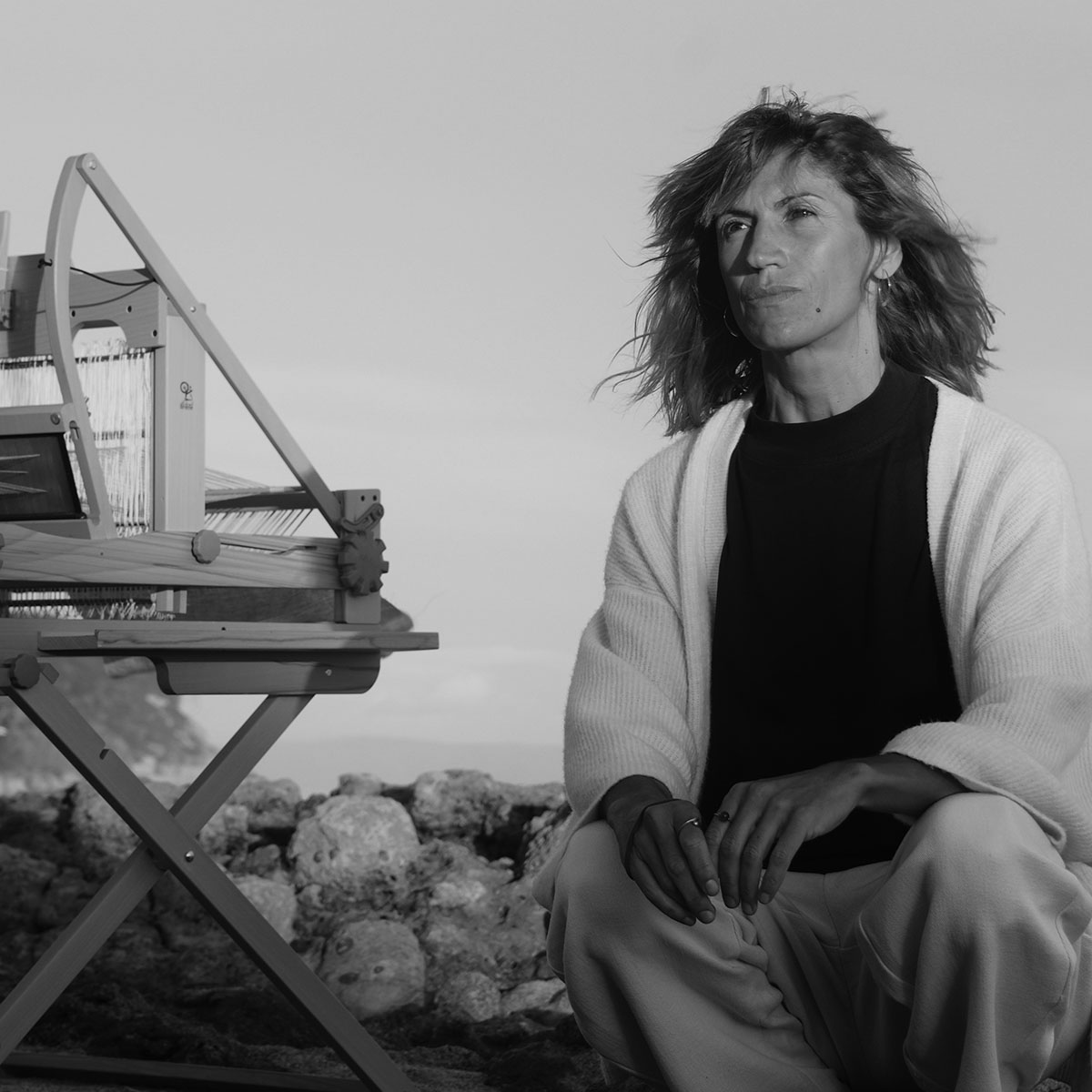
Born in Madrid, Virginia Payo Azabal is a textile artist and graphic designer who lives between Madrid and Vejer de la Frontera (Cádiz). Her practice occupies a deliberately open territory, where the low-warp loom coexists with material research, sculpture and an increasingly direct relationship with architectural space.
Her career has advanced through an accumulation of languages. She trained in window dressing and visual communication at the Istituto Europeo di Design, and went on to complete that training with studies in graphic design, industrial design, interior design, set design and motion graphics. That way of seeing, made of composition, colour, structure and typography, runs through all of her artistic work today. In parallel, she has built a long career in branding and communication. Her experience in set design and furniture design led her to take part in projects such as Casa Pasarela, Casa Decor and the Salone del Mobile in Milan.
Her turn towards textiles arose from a physical need to return to working with her hands after many years in front of a screen. A number of journeys and encounters, among them her time at Xtant in Mallorca, brought her closer to materials and techniques she had not known. She learned to weave at schools in Madrid and Barcelona and then continued on her own, finding in the loom a time of almost meditative concentration and, at the same time, a field for play and research.
Her work is built from natural fibres sourced from Japan, India and Spain, such as hemp, ramie, nettle, linen, jute, silk, banana fibre, pineapple thread, seaweed, plant bark, water hyacinth or mulberry paper. She works with them by observing their behaviour, their resistance and their fragility, and understands the weft as any material capable of passing through the warp, whether previously worked paper, fabric or strips of bark. Mineral pigments, cement, ceramics and aluminium have gradually found their way into her pieces, which often begin on the loom and end up approaching sculpture.
Free from the obligation to produce in series, Virginia Payo conceives her practice as a process of research in which error, attempt and abandonment form part of the outcome. Her current interests point towards a textile that leaves the plane to occupy space and enter into dialogue with architecture, and towards processes shared with other creators, in which an idea passes through other hands and returns transformed.