

I have known the serene, luminous architecture of Marià Castelló and his project Fragments d’Arquitectura for many years, and I have always felt a profound admiration and respect for it. His work, deeply rooted in the essence of his beloved Formentera, has taught me that architecture can be both rigorous and poetic—rigorous in its construction, yet poetic in the way it opens us to light and landscape. Today I present Fragments d’Arquitectura, now crystallized into a remarkable book and an exhibition held in Ibiza from May to September of this year. A singular project that Marià has shared with his studio partner, architect Lorena Ruzafa. Fragments d’Arquitectura reveals another dimension of his creative thought: pieces that are neither buildings nor models, but evocations, memories, geometric poems that draw us closer to the very heart of architecture. An invitation to look with innocence, to pause before the essential beauty of form, matter, and light. Andrés Moratinos
Here we reproduce several pages from the book Fragments d’Arquitectura, along with an excerpt from the text by Jesús Rodríguez Comes that accompanies the images. No one could speak better about this project. The translation is by Ben Clark.


Fragments follow an independent path: the undefined discipline it belongs to. And at the same time, it branches into a network of trails from overlapping disciplines. In contrast with the sobriety of each individual piece, as a whole the project journeys through —and invites one to journey through— a forest-like system of interconnected meanings not immediately apparent.
It is a project clearly linked to architecture. Yet these are not buildings, nor are they models. If anything, they are fragments —of buildings and models—: Fragments of memories, perceptions, ideas, and imaginations “Geometric poems”1 about the themes with which architecture is built. And an (out)stretched hand reaching towards other disciplines.
In a contained and spontaneous way, the Fragments project allows its creators to conceive, design, execute, and “inhabit” small-scale architectures with a degree of freedom and movement that is almost unthinkable within the field. […] Using some of the essential ingredients of the architectural recipe: idea, light, space, matter, time…
The word fragment (from the Latin fragmentum, which in turn comes from frangere: to break or shatter) implies in itself that the broken or shattered part comes from a greater whole. Fragments of something, besides being the result of prior separation, also serve as clues reminding us that they belong to a greater whole —something with a function or meaning that the fragments, on their own and in isolation, can still evoke.


From the peaceful privilege of the paradise that is Formentera, despite the signs on the island of the consequences of what we call “progress”, Fragments and its luminous, harmonious qualities represent, in practice, an optimistic manifesto and a tribute to the peace and harmony every human being deeply longs for and deserves.
The Fragments are like small windows onto that timeless place. They allow us to peer through and glimpse something from the other side. They invite us to experience sensations often associated with dreams.
The “visitor” can also experience a focused, refined, contained encounter —one that allows for a freer, less overwhelming or non-negotiable relationship than what is encountered in the architectural experience at full scale. […] Walking through the Fragments, we are offered the opportunity to consider only that light, only that shape, only that rhythm and cadence, only that texture… We can move closer, step back, shift our perspective…
Some pieces more than others display pathologies common to architecture itself: honeycombing, cracks, chipping, discolorations… These “irregularities and flaws […] are not only signs of life but also sources of beauty”. And they also help us shrink in our imagination, they allow us to travel into their corners, and explore them, to visit the works […].


The 5 centimetres of depth was intuitively perceived as the minimum necessary for the piece to stand on its own and remain stable, while still being deep enough to allow volumetric games of material subtraction without compromising structural integrity. This depth also allows for a
reading of […] their pouring process, and accommodate perforations or openings along the edges of each piece.
The object seems to want to tell us something, but it does so in an unintelligible geometric language. We cannot be sure whether we’re seeing a floor plan, an elevation, a section… or a fusion of them all. And this initial disorientation is an opportunity to return to the innocence of “images of the first time”
Beauty “is the symbol of symbols. It reveals everything because it expresses nothing”. Yet it is “the most difficult thing to describe, for it belongs to the highest dimension of consciousness”. […] In any case, Beauty is not a luxury. It is Life itself: its language, its action, its movement. To create beauty, to appreciate it, to believe in it. These are all basic human acts.
Text: Jesús Rodríguez Comes. Traducción: Ben Clark.


The book Fragments d’Arquitectura
Authors: Marià Castelló + Lorena Ruzafa.
Text by: Jesús Rodríguez Comes.
Photography: Marià Castelló.
Translation and interpretation of the English edition: Ben Clark.
Length: 675 páginas
Weight: 1267 gramos.
Dimensions: 20 × 20 × 4.57 cm. The format recalls the dimension of the exhibited works (20 × 20 × 5 cm), allowing some pieces to be presented at full scale on a single page.
Publication date: 2025

The exhibition
Venue: Col·legi Oficial d’Arquitectes de les Illes Balears – Demarcació d’Eivissa i Formentera. Can Llaneres, Carrer Pere Tur 3, Dalt Vila, Ibiza
Dates: May 30 – September 19, 2025


Marià Castelló
Founded in 2002 in Formentera by Marià Castelló (Ibiza, 1976), the studio operates as a small-scale workshop dedicated to architecture and landscape, with a measured production and a strong bond to the territory. Since 2017, Formentera-born architect Lorena Ruzafa Tur has joined the practice, strengthening an approach that works with Mediterranean light, the rhythms of place, and a sincere materiality that dialogues with the island’s tradition.
Castelló graduated as an architect from ETSAB (UPC) in 2002 with honors. From the outset, his work has been published internationally and was presented at the Venice Biennale (Catalan Pavilion, 2012). Early milestones include the “Emerging Architect” award at the 6th Ibiza and Formentera Architecture Awards (2012), marking a trajectory deeply attentive to the heritage and cultural landscape of Formentera.
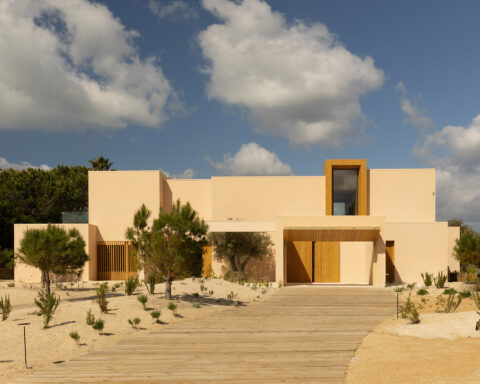
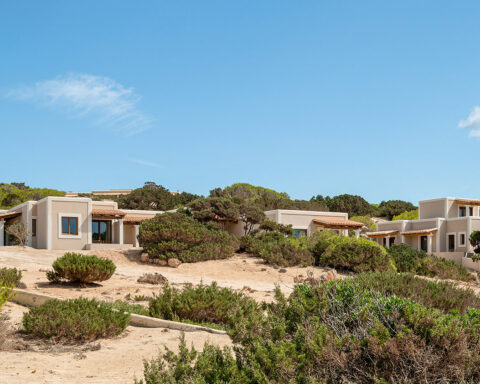
The studio’s architecture explores the balance between the telluric and the tectonic, the heavy and the light, the artisanal and the technological. These principles become manifest in residential projects such as Bosc d’en Pep Ferrer—where carved rock coexists with three prefabricated CLT volumes—and Es Pou, a modestly scaled dwelling that is precisely inserted into the historic grid of dry-stone walls on the island. Both projects have been widely published and awarded.
Beyond housing and landscape, the studio has developed public facilities such as the Centre d’Esports Nàutics de Formentera, directed by Marià Castelló and Lorena Ruzafa, which reaffirms an approach to design that is closely attuned to the physical and social context of the archipelago.
Since 2019, Castelló and Ruzafa have been developing Fragments d’Arquitectura, a singular project that reveals another dimension of their creative thinking: pieces that are neither buildings nor models, but rather evocations, memories, geometric poems that bring us closer to the very heart of architecture. An invitation to look with innocence, to pause before the essential beauty of form, matter, and light. The series was presented in an exhibition in 2025 and crystallized in an extensive book of the same name. The project received an Honorable Mention at the Architecture MasterPrize (Conceptual category).
The work of Marià Castelló and Lorena Ruzafa regards the island as a living archive: each project is a precise reading of the terrain, the light, the wind, and local crafts. The economy of resources, the sober tectonics, and the continuity with built memory define an architecture deeply committed to sustainability and to the essential beauty of place.
Marià Castelló landscape architecture
Camí Vell de la Mola km 2,3
07860 Formentera
+34 971328046
+34 649159994
mcastello@m-ar.net
www.m-ar.net
Project by Marià Castelló