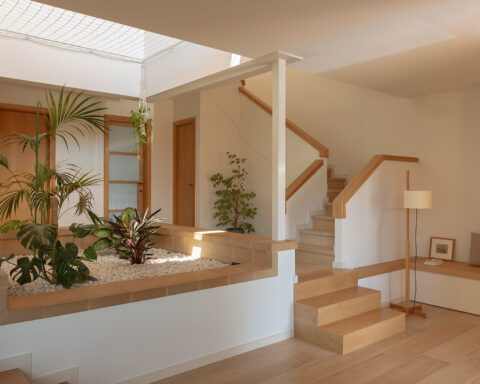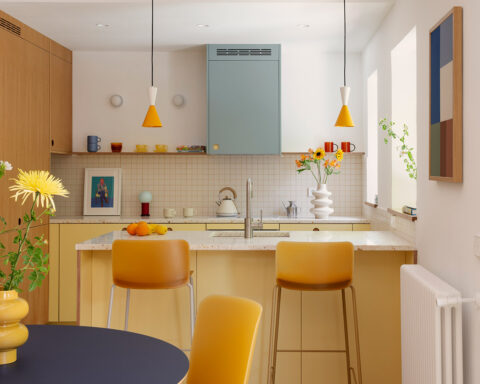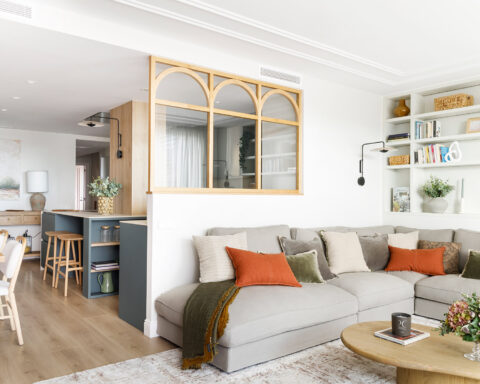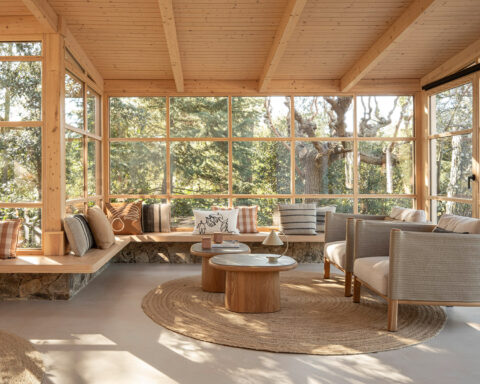


In a Parisian building in the Château Rouge district, designer Mathieu Tran Nguyen creates a domestic universe where memory, material and modernity converse with surprising naturalness. The project, designed for the Danish firm Gubi in collaboration with the Comedi agency, transcends the idea of a showroom and becomes a living apartment: a space in which to contemplate, inhabit and reflect upon contemporary design from a different perspective.
The proposal begins with a simple gesture: restoring the apartment’s serenity. From there, Mathieu organises a sequence of spaces where Parisian stone, softly warm whites and dark oak compose a serene, contemporary language. Geometry appears subtly—grids, lines, studied proportions—setting the rhythm that structures each room.
In this interior, Gubi’s presence unfolds as a conversation. Modern and classic pieces integrate into a domestic atmosphere that avoids theatricality. The apartment becomes a refuge where the Danish brand’s collections can be lived, not merely displayed.
Gubi in Paris
Gubi is a brand deeply connected to the history of 20th-century design, to its icons and to its ability to evolve toward new contemporary expressions. In Paris, its presence takes on an intimate, almost confidential tone. Far from the conventional exhibition format, the apartment functions as a laboratory space in which to explore new narratives, welcome creators and share the brand’s evolution with designers, artisans and prescribers.
Mathieu Tran Nguyen captures this sensitivity and translates it into material. In every room, Parisian light filters its own history—across stone, across wood, across fabric. The apartment becomes a subtle synthesis of two worlds meeting: Danish tradition and French elegance.


Soft geometries, noble materials, quiet rhythms
The interior is articulated through discreet, almost silent decisions: the continuity of white surfaces, the deep presence of smoked oak, the geometry of the floors, the clean lines of the carpentry. Stone brings a serene weight; wood, a warm counterpoint; textiles, a tactile softness. Everything seems conceived to accompany the movement of light throughout the day. In this context, Gubi’s pieces—its chairs, tables, lamps and seating—find a different way of breathing. They are not presented as isolated icons, but as part of an intimate and coherent ecosystem.
A space for living with design
The strength of Appartement Gubi lies in its restraint, in its harmony, in its ability to suggest rather than assert. And it is precisely there that Mathieu Tran Nguyen’s hand becomes evident: in that delicate balance between discipline and sensitivity, between rigour and emotion, that defines designers capable of creating interiors with soul.
This Parisian apartment reveals an understanding of interior design as a form of writing: a grammar of light, material and silence in which every decision contributes to a larger narrative. And that narrative, in this case, speaks of history, of tranquil modernity, and of the serene beauty of a well-considered space.


Project: Appartement Gubi.
Location: París.
Completed: 2024.
Interior design: Mathieu Tran Nguyen.
Furniture: Gubi.
Photography: Jean-Baptiste Thiriet.
Source: Mathieu Tran Nguyen.

Mathieu Tran Nguyen
Mathieu Tran Nguyen is an interior architect based in Paris, where he has directed his own studio since 2019. Trained in the dialogue between material, light and proportion, his work is defined by a sensitivity that avoids grand gestures in order to focus on the essence of space: atmosphere, stillness and a quiet elegance.
Before beginning his independent career, he collaborated with influential figures such as Philippe Starck and Rodolphe Parente—an essential period that shaped his attention to precision in detail, the nobility of materials and the role of time in interior architecture. This experience now informs a mature, intuitive and deeply coherent practice.
His studio develops residential projects, commercial interiors, conceptual installations and bespoke furniture, always guided by the same intention: to work with materials respectfully, to shape soft transitions, to pursue discreet geometries and to cultivate an intimate relationship between place, history and contemporaneity. His interiors—serene, tactile, restrained—explore a balance between the raw and the refined, between memory and the present.
In 2024, he completed Appartement Gubi in Paris, a hybrid project between home, gallery and experimental space for the Danish firm GUBI. It clearly reflects his sensitivity: spaces where every texture converses with light, where stone, wood and warm whites form a distinctive language, and where design is lived with an almost ritual delicacy.
Discreet and exacting, Mathieu Tran Nguyen belongs to a new generation of French designers who work from a place of calm, trusting in the power of atmosphere, in the beauty of honest materials and in the ability of interior design to move without noise.
About Gubi
Founded in Copenhagen in 1967 by Lisbeth and Gubi Olsen, Gubi began as a family-run studio dedicated to upholstery and furniture making, eventually becoming one of Europe’s most influential brands in both the revival and creation of contemporary design icons. Its approach combines historical research, Scandinavian craftsmanship and a thoughtful understanding of contemporary life: Gubi seeks to recover forgotten pieces from the 20th century, collaborate with visionary designers and develop collections that embody a sense of timeless elegance.
Among its most emblematic pieces are the Semi pendant by Bonderup & Thorup, the Beetle Chair by GamFratesi—now a classic of contemporary design—the chairs and tables of Pierre Paulin and Mathieu Matégot, the Timberline lamps by Mads Caprani, the Bohemian collection by Gabriella Crespi, whose brass and rattan designs have regained significant presence internationally, and the MR01 Initial Chair by rising Danish designer Mathias Steen Rasmussen.
Each Gubi collection combines soft forms, noble materials and a tactile sensitivity that oscillates between nostalgia and modernity, shaping a universe in which light, proportion and detail play an essential role. In projects like Appartement Gubi, this philosophy materialises in spaces that do not merely showcase objects but allow them to be lived, revealing the brand’s unique ability to create interiors with soul.
Mathieu Tran Nguyen
Paris
+33 (0)7 85 58 48 56
mathieu.interieur@gmail.com
mathieu-interieur.allyou.net
@mathieu_trannguyen
Gubi
Orientkaj 18-20
2150 Nordhavn
Copenhague (Dinamarca)
Project by Mathieu Tran Nguyen