
An architect trained at the Polytechnic University of Madrid, Juan Ramón Martín is also a sculptor and a drawing professor at the CEU San Pablo University Foundation. In 2006, he began working in metal sculpture, a practice he has pursued continuously ever since. His work follows the language of geometric abstraction, rooted in early 20th-century constructivism. The material he most identifies with is steel. He is especially interested in well-executed work—precision and clean construction. For him, clarity of concept and its physical expression are the driving forces behind his process..
“Two elements of a sculpture (or of an architectural work) must be joined by a transitional link—an empty space or a mass—like two words connected by conjunctions or adverbs. Constructive syntax is fundamental in sculpture. Each piece should present itself to the viewer as a unique image, a proposal, an equation, a concept, or a starting point. The solution remains open. Sculpture, like any form of art, is a weapon charged with reason, intuition, and thought,” he says.
We present here a selection of works sent to us by Juan Ramón, with his own commentary.
Pikionis Towers
This is a unified ensemble of eight sculptural pieces that draw their geometry from the pentelic marble paving designed by Greek architect Dimitris Pikionis in the mid-20th century, along the path encircling the Acropolis in Athens.
These eight sculptures, architecturally inspired and made in steel and/or brass, express themselves through the language of constructivism and cold geometry. Each one measures under one meter and is conceived with a scalar intention.
They are based on drawings I made from life while walking the paths around the Acropolis, particularly the pavement with Pikionis’s intricate geometric designs.
Like architectural elements, these sculptures preserve order and interior space, resonating with the power of structure and tension lines. They contain voids and define metaphysical, inhabitable space. Composed of planes and lines, the eight pieces form drawings, angles, dihedrons, and trihedrons. They cast triangular shadows, as described by Oteiza.


I place great emphasis on technical precision. Every joint must be clean and well executed. Precision and the proper fit between parts are essential so that the work presents itself to the viewer with the strength of a well-conceived, well-built structure.
The abstraction proposed by these eight sculptures becomes clear when we interpret them through an architectural lens. One can imagine a human figure wandering—floating weightlessly—within their vertical space, experiencing its silence.
The sphere and cylinder are ever-present in architecture. The cube and its prismatic derivatives represent the interior space where life unfolds. These are the forms that have housed human beings since ancient times—spaces where the most complex, poetic, and passionate moments occur. In our culture, prismatic space has been likened to human skin, becoming a body that shelters another body—each of these pieces forming part of that human whole.
The eight prismatic sculptures assert themselves visually through a clear geometry. With contemplation, latent, invisible forms emerge—imagined and archived in memory. In that moment, scale disappears. They become conceptual structures—places where either a person or a skyscraper might dwell.
The Months
This series of twelve pieces is titled The Months and belongs to the project The Months and the Hours, which evokes space and time through forms inspired by navigational instruments and clockwork mechanisms—mechanical artifacts born from precision and geometric beauty.
These machines measure the passage of time or determine distances, angles, drifts, or trajectories. These pieces live in a space between being constructed, deconstructed, and reconstructed—a game of freedom where mathematics and visual poetry are the sources from which form emerges. The ultimate aim of this series is to offer viewers objects for contemplative pleasure.
The pieces are made from solid brass, forged cold using a steel-roller bending machine. All joints are bolted, and the surface finish is polished using 800-grit sandpaper. Every step—from concept and preliminary sketches to mechanical tasks such as cutting, bending, drilling, and threading—was carried out manually or with small-scale tools in my Madrid studio.


Mystics
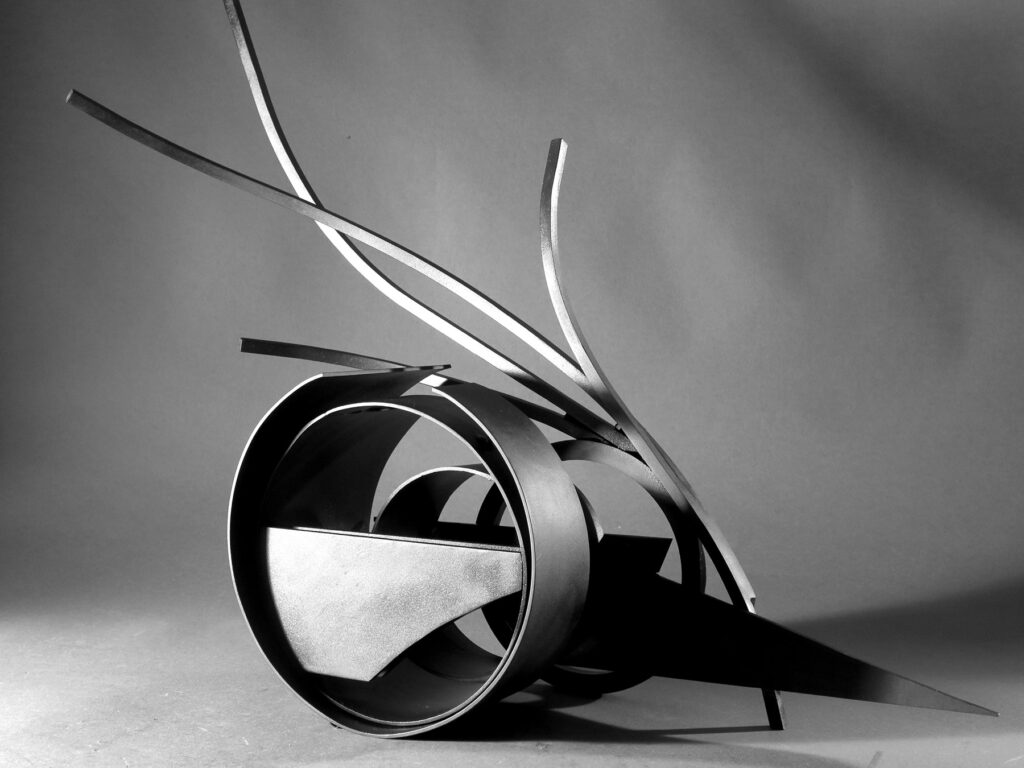
These sculptures are part of the Mystics collection, presented at the Monastery of Santa María de El Paular in 2023. They were created as a tribute to various Spanish mystics.
Made from steel sheet and rod, with a blackened finish, these small-format sculptures explore the following idea: a primary core from which a secondary nucleus emerges and flies outward. The first might represent the physical, organic being—someone who has carried the weight of biological life and charted the biography of the individual. The second, also a core element, represents the spiritual life—the wind that moves through the being, giving it essential meaning. One is enclosed, nearly spherical; the other linear, escaping, flying outward.


These works investigate the ontological aspects of the portrayed individuals without referring to body or head. They explore transcendence through the language of geometry.
They are small in scale and open to the surrounding space, using minimal material—allowing the air between folds to become part of the sculpture. All were made in my Madrid workshop using cold-forged steel with some welds discreetly concealed.

Juan Ramón Martín
Juan Ramón Martín (born 1958, Madrid) is an architect trained at the Polytechnic University of Madrid. He is also a sculptor and drawing professor at the CEU San Pablo University Foundation. In 1988, he founded the architecture and sculpture studio Kleearquitectura, which he continues to direct in Madrid. He has completed numerous architectural and landscape projects.
He was awarded the COAM Prize in 2005 for the Navalcarbón Canal project in Las Rozas. In 2019, he created the Monument to Greek Sailors, permanently installed on the Island of Rhodes after winning the international commemorative competition for the 500th anniversary of the first circumnavigation of the globe. In 2006, he began his ongoing work in metal sculpture.
Juan Ramón Martín
Eloísa de la Hera 9
28035. Madrid
+34 686 45 96 31
www.jrmartinescultor.com
kleearquitectura@telefonica.net
@jrmartinescultor
Project by Juan Ramón Martín