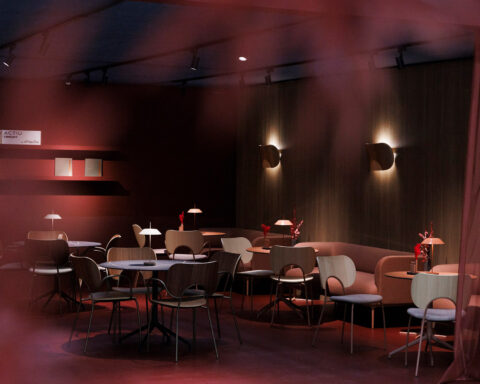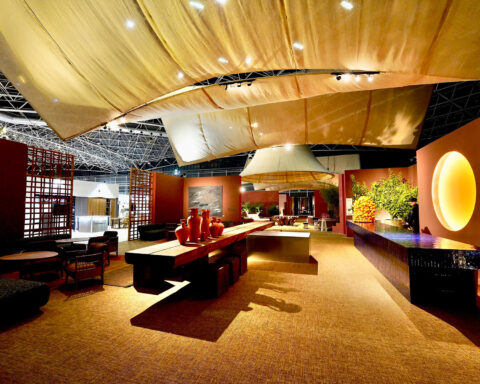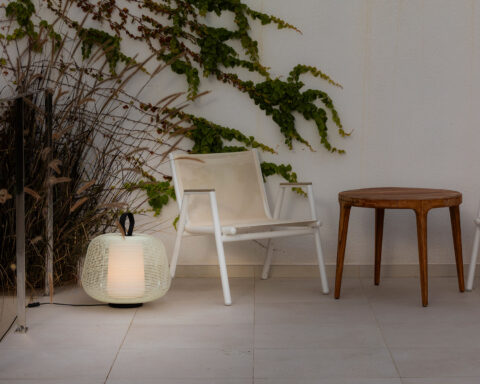


The Lepal armchair, designed by Doshi Levien for Italian brand Arper, emerged from a play of contrasts: a hard, solid outer shell paired with a layered, comfortable seat resting lightly on a slender, angled base.
More than just a comfortable seat, Lepal is an invitation to slow down and let rest become a source of renewed energy. Its form is poetic—a sculptural shell cradling soft cushions that invite you in.
Its elegant geometric structure, curved shell, and plush cushions support both upright sitting and relaxed lounging, offering a light yet supportive space for privacy. Ideal for conversation, reading, or focused work—whether in public or private settings—Lepal is a cozy and calming option for navigating life’s various rhythms.


It balances comfort and ergonomics in a single, cohesive gesture. A dynamic contrast exists between the sculptural silhouette and the cushioned interior, between an embracing inside and a high, gently curving back. Lepal is a design with presence—expressive, bold, and instantly recognizable.
Conceived to adapt across a wide range of interiors, Lepal’s refined monochromatic look is available in either monomaterial or bicolor upholstery, and with a metal or wooden base. The collection is FSC-certified, and its bases are powder-coated. Upholstery details and internal components are assembled without glue, meaning Lepal is fully demountable—making it easy to recycle or repurpose at the end of its life cycle.


Interview by Sujata Burman at the Doshi Levien studio. Courtesy of Doshi Levien
Where did the idea for Lepal originate?
Jonathan: Lepal is a design that brings together beauty and sustainability. Within the broader context of our Arper collections—like the Shaal sofa and Roopa tables—Lepal creates a private, personal space within a larger layout.
Nipa: With Lepal, we wanted a chair that could work in different spaces. We’ve created a family of objects that function individually but also together. It’s not about making things look visually similar—it’s about creating a pluralistic environment.
Can you describe the design process behind Lepal?
Jonathan: I sketch by making. For this project, I began defining the chair’s silhouette by bending aluminum wire into small-scale models. From there, I built full-scale prototypes using wood and cardboard—cutting patterns and manipulating materials until the shape felt right. Meanwhile, Nipa was sketching the design in her notebook, trying to fall in love with the idea and capture the spirit of what I was building—refining proportions, materials, and tailoring details. Our ideas grow from both of us.
What makes this chair different from others?
Jonathan: Our design process always aims to define the project’s visual identity and typology with precision. With Lepal, I wanted to create a strong geometry: clean vertical and horizontal lines, contrasted with an organic, sensual shell. There’s a tension between the hard sculptural exterior, the soft molded cushions inside, and the light framework of the legs.
How did sustainability influence the project?
Nipa: Sustainability was integral from the start. One of the most important challenges was figuring out how to design a chair without glue or adhesives. Thanks to clever construction and upholstery techniques, every component—from the shell to the upholstery and base—is fully separable, allowing for repair, replacement, or recycling. It’s also compact yet comfortable, maximizing material efficiency.
Can you talk about the form and spirit of Lepal?
Jonathan: The cast aluminum and curved wood base contribute to the sense of lightness and poise. The chair’s form mirrors its base. Early models in the studio all had a frame supporting the chair shape—until we realized the A-frame was key to achieving a floating, pivoting sensation.
Nipa: To me, Lepal has a Milanese spirit with a futuristic industrial-engineering flair. It’s a sculpted hard shell with molded cushions, cantilevered over a lightweight frame.
Do you have a favorite detail in Lepal?
Nipa: I love the tailoring. The material combinations and subtle design details are what delight me.
Jonathan: For me, it’s the balance between geometric precision and sensuality—it’s the perfect harmony.

Doshi Levien
Nipa Doshi and Jonathan Levien met as design students at the Royal College of Art in London in 1995. Nipa, born in Mumbai and raised in Delhi, grew up immersed in modernist design ideals and traditional craftsmanship. Jonathan, trained in fine cabinetmaking and industrial design, spent his childhood around his family’s factory in Scotland, learning how things are made.
Their contrasting but complementary backgrounds became a source of creative strength. Today, the celebrated Doshi Levien studio is defined by a hybrid mindset—blending technology, craft, and industrial techniques in furniture, textile, and product design.
For the past 14 years, they’ve worked from a 19th-century former furniture workshop on Columbia Road in East London, where their small team builds prototypes, sketches ideas, mixes colors, and experiments across studio, gallery, and lab.
Their intercultural perspectives are ever-present in their work. One of their early commissions, My World for the British Council, became a manifesto:
“We wanted to merge worlds—not as an aesthetic language, but as a philosophical approach. To see globalization as a positive exchange of cultures, values, materials, and production methods.”
This lens continues to guide their work for international clients such as Moroso, Cappellini, Hay, Kettal, Nanimarquina, B&B Italia, and Arper—as well as cultural institutions like Sèvres – Cité de la Céramique, The Grand Hornu, and their Paris-based gallery Galerie Kreo.
Like the foundation of Nipa and Jonathan’s partnership, the studio’s diverse portfolio is both deep and expansive—rich with color, texture, form, and structure. Their contrasting sensibilities have been magnetic from the start, and they infuse the world of Doshi Levien with beauty, complexity, and meaning.
Source: Arper. Doshi Levien.
Photography: Salva López. Alberto Sinigaglia.
Doshi Levien
49 Columbia Road
London
E2 7RG
+44 (0)20 7739 3631
mail@doshilevien.com
www.doshilevien.com
Arper
Via Lombardia, 16
31050, Monastier di Treviso. Italia
+39 0422 791800
www.arper.com
Project by Doshi Levien