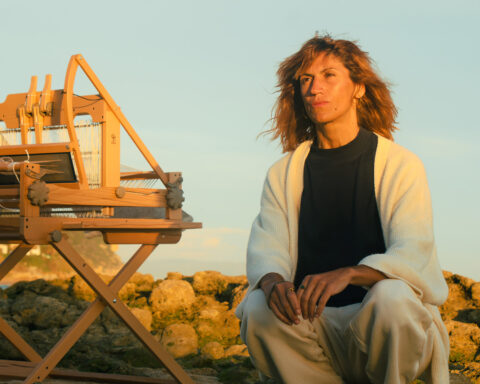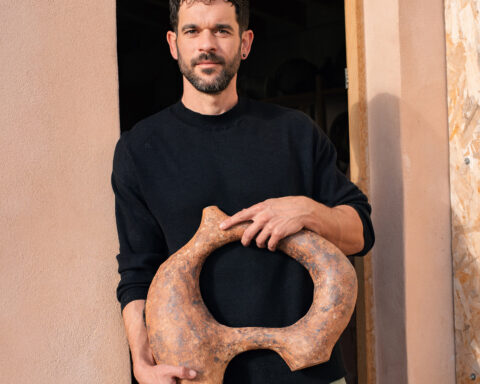


The works of Belgian artist Pascale Zintzen, founder of Oikos Estudio, seem to emerge from a long span of time. Far removed from the logic of rapid production or the aesthetics of the flawless object, they are the result of a slower and more direct relationship with matter. Vessels, sculptures and containers built by hand that preserve the memory of gesture and the trace of process. In them, ceramics appears as a practice deeply connected to everyday life: working the earth, observing the passing of the seasons and inhabiting the time of the studio..
Born in Verviers, Belgium, Pascale Zintzen grew up surrounded by objects, tools and manual processes. From an early age she was drawn to craft and to the capacity of the hands to transform matter. That curiosity led her to explore different disciplines before arriving definitively at ceramics: she studied Archaeology and Art History, trained in traditional upholstery, and always maintained a close relationship with manual trades.
After travelling through different countries, she settled permanently in Barcelona in 2016, a city from which she has developed her artistic practice and studio. Shortly afterwards she discovered ceramics almost by chance, thanks to classes a friend gave her as a gift. That experience marked a turning point. The artist recalls the moment as a revelation: working with clay brought her a profound sense of calm and an immediate need to continue creating. Since then, she admits, rarely more than forty-eight hours pass without shaping earth with her hands.
From that discovery emerged Oikos Estudio, an artistic project whose name derives from the Greek term oikos, understood as house, home or the space where life unfolds. The choice is not accidental: for Zintzen, the studio, family life and the creative process form part of the same vital continuity. Her practice unfolds between her studio in Barcelona and her house-studio in Baix Ebre, a rural landscape near the Ebro Delta where the artist finds the slower rhythm she needs to work. In this environment, surrounded by countryside, olive trees and silence, domestic life and artistic creation coexist naturally. The studio is not a space separate from the world, but an extension of everyday dwelling.

Gesture, matter and memory
Pascale Zintzen’s work is built through deliberately slow manual processes. Her pieces are shaped without moulds, using traditional techniques such as coil building and slab construction. Each vessel rises gradually, layer by layer, in a process that demands attention, repetition and patience.
The artist works primarily with stoneware and high-temperature clays, materials that allow her to explore dense surfaces, irregular textures and deeply tactile finishes. She often incorporates natural pigments gathered during her walks, a practice that introduces the surrounding landscape directly into the pieces.
The result is a body of work that seems to exist somewhere between archaeology and contemporary sculpture. Vessels that recall ancient containers, forms that evoke ritual artefacts or fragments of an imagined culture. This archaeological dimension is not incidental: the artist openly acknowledges the influence of her academic background and her fascination with the everyday ceramic objects of ancient civilizations.
Over time, her work has evolved from pieces closer to the domestic realm toward an increasingly sculptural language. Volumes grow larger, proportions become more radical and surfaces more expressive. The pieces cease to function solely as containers and begin to assert themselves as autonomous presences.


Between ceramics and bronze
In 2025, Zintzen expanded her practice by introducing bronze, worked through the traditional lost-wax casting technique. This addition does not represent a shift in direction but rather a natural extension of her formal vocabulary.
One of the first sculptures in this material is Buffalo Moon, a figure that synthesizes many of the tensions present in her work: strength and fragility, archaism and contemporaneity. Produced in a limited edition of twelve pieces, the work transfers into metal the gestural quality and tactile sensitivity that define her ceramics.
The presence of bronze opens a new material field within her practice, while maintaining its connection to ancestral techniques and manual processes.
Artefacts of Shelter: a collaboration with Matter Edit
On 24 March 2026, Artefacts of Shelter was presented, a collection developed in collaboration with the British studio Matter Edit. The project proposes three pieces — designed to contain liquids, store dry elements and hold ceremonial fragrances — that refer to fundamental human needs: dwelling, preserving and ritualising.
The collaboration draws inspiration from primitive gestures: the moment when the first humans began shaping earth to create shelters and vessels. From this anthropological perspective, the objects in the collection occupy a territory where design, architecture and art intersect.
More than decorative objects, the pieces function as symbolic artefacts — small architectures of clay that speak of protection, identity and collective memory.


Contemporary art and tradition
In recent years, Pascale Zintzen’s work has gained visibility across various European galleries and spaces. Her pieces are represented by Etesian Gallery in Menorca, Galerie Lalune in France and Scenario Collective in Milan, and form part of exhibitions and curatorial projects in several countries.
Her presence also extends into the field of contemporary design through collaborations with brands and cultural initiatives, while maintaining a direct connection to artisanal making.
Despite this growing international visibility, the centre of her practice remains unchanged: the studio, the earth and the repeated gesture of the hands.
A practice as a way of life
In Pascale Zintzen’s work there is no clear separation between personal life and artistic practice. Her work is nourished by domestic rhythms, by raising her children, by walks through the countryside and by time shared with family. Shaping clay becomes a form of attention — a way of remaining present in the world. Each piece emerges from this slow dialogue between body and matter, between cultural memory and everyday experience.
At a time when design tends toward speed and serial production, Zintzen’s works propose another relationship with objects: quieter, more patient and profoundly human. Like her own vessels, her work speaks softly — but with a persistence that endures.

Pascale Zintzen
pascale.zintzen@gmail.com
www.pascale-zintzen.com
@oikos_estudio
Project by Pascale Zintzen