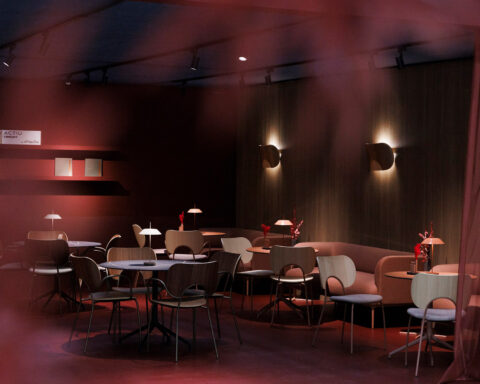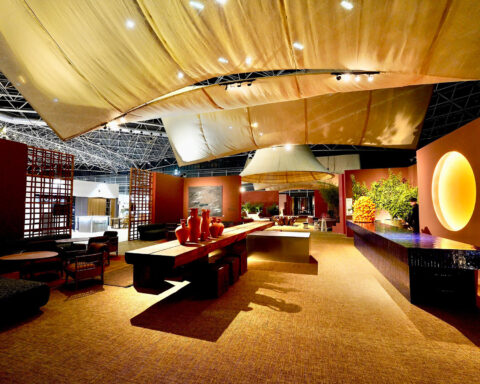


Every spring, Milan once again becomes the territory where contemporary design reflects upon itself—not only as an industry, but as a form of thought applied to everyday life. For a few days, furniture, materials, technological research and craftsmanship enter into dialogue within a shared cultural landscape..
From April 21 to 26, 2026, the Fiera Milano Rho fairgrounds will host the 64th edition of Salone del Mobile.Milano, an event that brings together more than 1,900 companies from 32 countries and spans nearly 169,000 square metres of exhibition space.
Since its founding in 1961, the Salone has evolved into something far beyond a trade fair. It is an ecosystem where industrial research, formal experimentation and cultural debate around contemporary living coexist. For one week, the fairgrounds and the entire city transform into a vast platform for exchange, where designers, architects, manufacturers and gallerists explore new ways of imagining the objects and spaces that shape our daily lives.
In 2026, this cultural infrastructure expands through new initiatives that reflect the transformation of the design sector itself. Among them, Salone Raritas stands out in particular—an exhibition that introduces, for the first time at the heart of the Salone, the territory of collectible design and limited editions.


Salone Raritas: collectible design enters the fair
One of the most significant gestures of this edition is the creation of Salone Raritas, a new exhibition path dedicated to unique pieces, limited editions and objects of high creative craftsmanship. Curated by Annalisa Rosso and with a scenography designed by Formafantasma, this space proposes a direct dialogue between design galleries, contemporary artisans and the international world of design practice.
For years, collectible design had found its place mainly in parallel exhibitions of the Fuorisalone or in specialised galleries. With Raritas, the Salone integrates this territory into the fair itself, acknowledging the growing cultural and economic relevance of a design conceived as a singular object.
The exhibition is organised as a luminous architecture composed of modular islands where each gallery can express its identity without losing the coherence of the whole. Formafantasma’s spatial project operates almost like a lantern: a neutral device that orders the visitor’s gaze and allows each piece to engage in dialogue with the others without being absorbed by the scenography.
More than a simple showcase, Raritas raises a deeper question: what place does design occupy today when it abandons the logic of mass production and approaches the territory of art?
At a time when architecture, hospitality and the high-end residential market increasingly incorporate unique objects and limited-edition furniture, this new space acts as a bridge between two worlds that until recently rarely intersected: gallery culture and the professional ecosystem of design practice.


The return of the biennials: kitchen and bathroom as domestic laboratories
The 2026 edition brings back two of the Salone’s most influential biennial exhibitions: EuroCucina and the International Bathroom Exhibition.
The kitchen, which for decades was a technical and domestic space, now emerges as a technological centre of the home. The integration of artificial intelligence, energy management systems and smart materials transforms this space into a platform where interior architecture, technology and sustainability converge.
At the same time, the bathroom continues its evolution towards a model closer to the domestic spa, where wellbeing, longevity and sensory experience become the new drivers of design.
Both sectors reflect a broader trend: the contemporary home is no longer conceived as a sum of functional rooms, but as a system where technology, comfort and sustainability operate together.

SaloneSatellite: the territory of emerging designers
If the Salone is where the industry presents its collections, SaloneSatellite remains the place where the questions of the future emerge.
Founded in 1998 by Marva Griffin, this programme brings together each year hundreds of designers under the age of 35 and international design schools. In 2026, it will once again host around 700 young creators, becoming one of the most compelling observatories for detecting new sensibilities.
Here, research often appears that does not yet have a clear place within the industry: experimental materials, alternative production processes or new relationships between object and user.
Many of the firms that now define the international design landscape began precisely in this space.
Where contemporary design is heading
Beyond specific product launches, the Salone functions each year as a cultural barometer. The 2026 edition points towards several directions that are beginning to take shape.
Radical sustainability. Sustainability moves beyond superficial discourse to become a structural issue. Circular economy, advanced recycling and material traceability take on a central role in contemporary design. It is no longer only about reducing environmental impact, but about rethinking production processes entirely.
The return of matter. The theme of this edition—“A Matter of Salone”—reflects a growing attention to materials. Stone, wood, metal or plant fibres are presented not only as technical supports, but as carriers of memory and cultural meaning. Design once again turns its gaze towards the origin of objects.
The hybridisation between art and design. The emergence of Salone Raritas confirms a trend that has been developing in recent years: design increasingly moves closer to contemporary art. Unique pieces, limited editions and experimental objects now find their place within the project ecosystem.
Invisible domestic technology. Technology continues to advance, but does so in an increasingly discreet way. Sensors, automation and smart systems are integrated into objects without altering their aesthetic dimension. Design acts here as a mediator between technological complexity and everyday life.
Spaces for wellbeing. Finally, the home is redefined as a place devoted to physical and mental wellbeing. Tactile materials, atmospheric lighting and more flexible spatial configurations point towards a slower and more conscious domesticity.

Milan, a city turned into a laboratory
No edition of the Salone can be understood without the city that surrounds it. During Milan Design Week, districts such as Brera, Tortona, Isola or 5Vie transform into a continuous network of exhibitions, installations and experimental projects.
The Fuorisalone expands the fair into historic palaces, galleries, showrooms and industrial spaces, turning the city into a kind of urban laboratory where design merges with art, architecture and cultural research. In this context, the Salone acts as the core of a much broader system.
A place where design reflects on the future
Each edition of the Salone del Mobile raises different questions about the role of design in contemporary society. In 2026, the conversation seems to focus on three fundamental ideas: matter, sustainability and culture.
Design appears less as a formal gesture and more as a form of mediation between industry, technology and the human experience of space. Perhaps this is why Milan continues to be, every spring, the place where design pauses for a few days to reflect on what it means to inhabit the world.