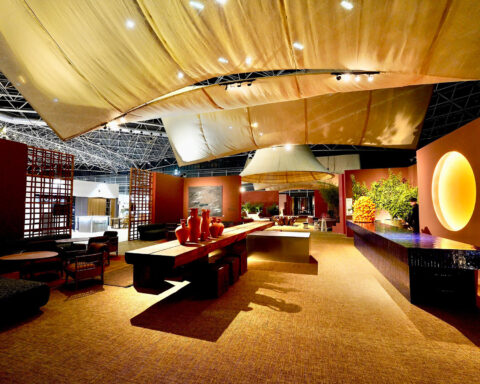


At a time when interior design seems to oscillate between restrained neutrality and the repetition of recognizable codes, proposals emerge that seek to recover expressiveness as a language. In this context, Kodu is born, the new brand by Vical, with an approach that goes beyond the style for which Vical has been known until now.
Kodu is built with the intention of breaking away from predictable perfection and opening design to a freer, more emotional dimension. Its universe develops beyond furniture, through a visual narrative that draws from the language of fashion, scenography, and a reinterpreted sense of pop culture. The pieces are presented as fragments of a scene, where space ceases to be a backdrop and becomes a narrative.
In its collections, color, volume, and materiality do not seek balance, but tension. There is a deliberate intention to place furniture in an intermediate territory, halfway between function and sculptural presence. Beyond resolving a space, they aim to provoke it.
Far from being understood as a parallel brand, it relies on the experience and knowledge of Vical to build its own language, aimed at a generation of interior designers and users who understand space as an extension of their identity. With the claim “Live as you think”, the proposal moves away from the normative to advocate a more personal—and freer—way of inhabiting.
Kodu was born within Vical, a company with many years of history. How did the idea of creating this new brand arise, and what need did you identify in the current landscape of design and interior design?
The truth is that Kodu emerged in a very curious and almost unexpected way, because this change had not been planned. The brand already existed under the name Lastdeco, with a more neutral, more homogeneous positioning… without making much noise. One day, speaking with Nacho, the commercial director, we considered giving it a twist. We felt there was potential to create something completely different: a new brand, bolder, even a little “crazy”, that would move away from that more perfect and controlled sensibility with which we usually work at Vical. From there, everything began. There were many conversations and working sessions together with Pep Gramage, art director of Vical and also of Kodu, who helped us shape the concept and build the entire new visual identity.
We were very clear about it: we did not want to be Vical’s “little brother”, but a brand with its own personality. And that is how we built it, step by step. Based on Vical’s know-how, experience, and quality, but taking it toward a more contemporary, freer, and more expressive language, with its own narrative.


The brand’s claim, “Live as you think”, seems to appeal to a very personal way of inhabiting spaces. What does this phrase really mean for Kodu, and how is it translated into the products and the identity of the brand?
“Live as you think” is an invitation to live in coherence with who you are. It is not just about decorating a space, but about building an environment that reflects your way of thinking, your emotions, and your personality.
At Kodu, we believe that spaces should not impose themselves on people, but accompany them. That is why we design pieces with character, allowing the creation of unique, non-standardized environments.
This translates into collections with a strong visual identity, unexpected combinations of materials, fearless use of color, and volumes that generate presence. Everything is designed so that each space can tell its own story.
At a time when many interiors tend toward neutral and repetitive minimalism, Kodu clearly embraces color, volume, and personality. Is this a deliberately critical stance toward that dominant trend? What would you say is the design philosophy that guides Kodu? Is there a manifesto or a set of principles that orient each collection?
We do not approach it so much as a direct critique, but as a necessary alternative. Minimalism has contributed a great deal to design, but when it becomes the norm, it loses its capacity to move.
Kodu proposes to recover expressiveness. We are committed to spaces that convey, that surprise, and that connect with those who inhabit them. Color, volume, and form are not an excess, but tools to generate identity.
Kodu’s philosophy is based on three pillars: identity, emotion, and creative freedom. We develop each collection from a clear idea: that design must provoke something. We are not only seeking functionality or aesthetics, but an experience. More than a closed manifesto, we have a very defined attitude: designing with personality, avoiding the generic, understanding space as an extension of those who inhabit it, and differentiation.
Who is behind the creative development of Kodu? We would like to know the team that designs the brand: designers, creative directors, product managers…
The Kodu team has been progressively built following the launch of the new brand identity. It is a team that emerges from within Vical, since, essentially, we are the same people behind the project, but working from a different perspective.
Precisely because of that shared origin, we are very aware that we naturally carry the language and sensibility of Vical. For this reason, from the outset, we have sought to open the creative process to new perspectives that help us step outside that familiar zone and incorporate a more experimental, freer, and, in a certain sense, more “daring” approach that defines Kodu.
Within the design team are Javier Boscá and María Jesús Fombuena, together with art director Pep Gramage, who brings a clear and contemporary vision to the brand’s universe. All of this under the direction of Pepe Boluda and Antonio García, heads of purchasing and product, who act as a key axis in giving coherence and meaning to each collection.
In the marketing area, I lead the strategic and communication development, supported by specialized agencies such as MSR Marketing and Focuslink.
In addition, Kodu’s creative development is enriched through external collaborations that help us materialize ideas and take them to a more expressive level. We have worked with studios that bring a fresh vision in creative direction, shootings, and catalog development. Last year we collaborated with Cosas que hacen Boom Studio, and we are currently working with Democracia Studio.
Overall, it is a hybrid, highly connected team that combines internal knowledge, strategic vision, and external contributions to build a language of its own, in constant evolution.


What is the process of developing a collection at Kodu, from the initial idea to the launch of the pieces? The collections present a strong sculptural and experimental dimension. Where do the main creative influences come from: contemporary art, fashion, architecture, pop culture…? Do you work with external designers, or is development mainly carried out within Vical’s internal team?
Development mainly originates within Kodu’s internal team, and this is something we take great care of because it allows us to build a very distinctive, coherent, and recognizable language.
But we also strongly believe in opening windows. This year, in fact, we are launching our first capsule collection with an external designer, and we are especially excited because it is a very powerful, highly expressive project… and very Kodu. It allows us to explore without losing our essence.
In terms of influences, we feel very close to the world of fashion. Not only aesthetically, but also in the way we work as a brand: we like to move through seasons, with two major moments each year: Spring/Summer and Autumn/Winter, which gives us rhythm, evolution, and that sense of constant trend. Creatively, there is a very natural mix: contemporary art, architecture, visual culture… always from a very free perspective. Ultimately, Kodu is about that: mixing, experimenting, and creating pieces that do not go unnoticed.
Many Kodu pieces seem to sit at the boundary between furniture and sculptural object. Is this hybridization between art and functionality one of the brand’s objectives? The collections reveal retro references, pop gestures, and even certain brutalist influences. How are these languages combined to build a coherent identity?
Absolutely. In fact, it is quite intentional. At Kodu, we do not understand furniture as something purely functional. We are interested in pieces having presence, generating conversation, almost being felt as small sculptures within a space. But always with balance: they must function, yes, but also move.
We like that tension between the practical and the expressive. That a piece resolves a need, while at the same time having character and contributing something more to the atmosphere.
What role do materials and textures play in the design of the pieces? Is there a specific pursuit in terms of material innovation or production processes?
Materials at Kodu are not just a medium; they are part of the message. Very often, a piece begins precisely there: from a texture, a finish, or a combination that evokes something in us.
We are very interested in how materials are perceived, not only visually, but also sensorially. Contrast is key: mixing smoother surfaces with rougher ones, playing with gloss and matte, or combining materials that you would not expect to see together. We are not seeking innovation for its own sake, but we are constantly exploring.
Then there is the production side, which is fundamental for us. There is an ongoing dialogue between design and factory to ensure that pieces retain their character without losing quality or feasibility. Ultimately, it is about finding that balance between the creative and the real.


Who is Kodu aimed at? What type of client or interior designer connects best with the brand?
I love this question because it is closely tied to Kodu’s origin. When we began shaping the brand, we asked ourselves exactly this. Vical’s client has a very defined profile, focused on large-scale projects: large homes, villas, highly structured spaces…
And there we saw a clear opportunity. There was a part of the market we were not covering: smaller, more flexible projects, but with a great deal of creative charge.
Kodu is born precisely for that. For that client/interior designer who does not need as much volume, but much more personality. Someone who wants to take risks, mix, experiment… and build spaces with their own identity. Ultimately, Kodu connects with people who understand design as something freer, more expressive, and less normative.
Do you believe that Kodu speaks to a new generation of interior designers and users seeking more expressive and less normative interiors? In what type of spaces do you imagine your furniture: private homes, hotels, contract projects, creative interiors…?
Yes, absolutely. But not only to a new generation, also to many professionals who were already seeking this kind of language and did not always find brands that supported it. We like to think that Kodu is not so much for a type of space, but for an attitude.
It works very well in private homes where there is a clear intention to differentiate, but it also fits perfectly in hotels, restaurants, or more creative contract projects, where design is part of the experience. Ultimately, Kodu exists wherever there is an idea behind it. Where space is not only functional, but has something to say.
Kodu’s visual communication—campaigns, photography, color, art direction—has a very strong character, close to the world of fashion. How has this visual language been developed? Who is behind the creative direction of the campaigns and the brand’s visual universe? How important is brand narrative at Kodu? Do you aim for each collection to tell a story or evoke a specific imaginary?
From the beginning, we were clear that Kodu could not communicate like a conventional furniture brand. We needed a more emotional, more visual language, closer to fashion than to a traditional catalog.
From there, the whole team began working on ideas and how to shape them. We also sought collaborators who could help us take that universe one step further. The truth is that it has been a very natural and very enjoyable process, because we have connected deeply with all the teams we have worked with. It has been easy to share that vision and translate it into images.
Creative direction has been led by Pep Gramage and myself, building that visual language together and ensuring coherence throughout. From there, we work in a highly collaborative way between the internal team and external creatives. It is a very dynamic process, where each campaign, each shooting, adds layers and evolves the Kodu universe.
For us, narrative is everything. It is not only about having a good idea, but about knowing how to tell it, how to make it tangible, and how to translate it into real spaces. We always try for each collection to have its own imaginary, its own energy. That when you see it, you feel there is a story behind it, even if it is not explained literally. In the end, we are not just presenting products. We are building an atmosphere, an attitude, a way of living spaces.
Kodu is a relatively young brand. What are the next steps in its evolution: new product typologies, collaborations, international expansion…? How do you imagine Kodu in ten years?
As you say, Kodu is very young, and that is precisely what makes it interesting. We still have a lot to say. We do not have a fixed roadmap, because what defines Kodu is precisely that capacity to evolve, to experiment, to move. What we do have is a clear intention: we come to do something different, to position ourselves, and to bring a distinct perspective to the sector.


In a context where homogeneity has become a common language, Kodu’s commitment to identity, emotion, and creative freedom introduces a necessary fissure, through the construction of an alternative that assumes the risk of not being neutral, not being universal, not being complacent.
The strength of Kodu lies precisely in that willingness to position itself at the limit: between the functional and the sculptural, between object and image, between lived space and represented space. A hybrid territory that engages with new ways of inhabiting, but also with new ways of seeing.
In that tension—between design and narrative, between product and atmosphere—a brand is defined that is still under construction, but already points in a direction. Not so much toward what interior design is, but toward what it can become when it decides to embrace the risk of expression.
Kodu
Polig. el Carrascot s/n
46850 L’Olleria (Valencia)
+34 960 663 141
info@koduhomedesign.com
koduhomedesign.com
@kodu_home
Vical
Polig. el Carrascot,
Av dels Vidriers, 9,
46850 L’Olleria (Valencia)
+34 962 200 060 vical@vicalhome.com
www.vicalhome.com
@vicalhome