

There are projects that are explained by their landscape before their architecture. Ses Clotades, the house that Marià Castelló built in Formentera between 2021 and 2025 — following a design process that began in 2016 — belongs to that category of works where place exercises a real authority over every formal decision. And that authority, far from constraining the architect, liberates him towards a precision that is rarely achieved.
Castelló works from Formentera with an intellectual coherence and a fidelity to the territory that place him in the lineage of the tradition Álvaro Siza consolidated in Portugal: the one that understands architecture as listening rather than imposition, that turns the act of building into a gesture of continuity with the memory of place. His works — and Ses Clotades is their most mature expression to date — possess that quality of things that were always there, even if they have just been built.
A landscape shaped by hollows
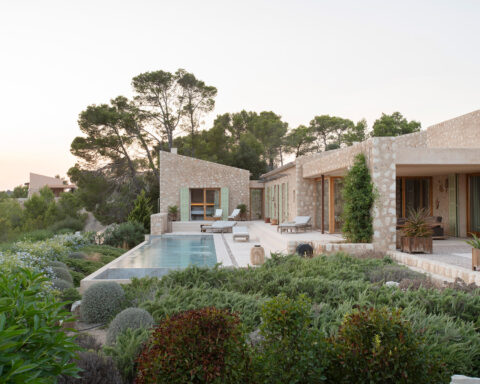
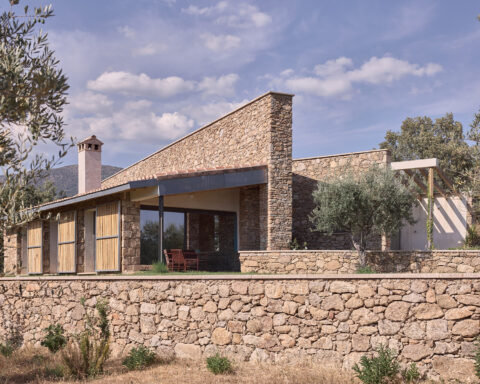
Ses Clotades names an area of the isthmus connecting La Mola with the rest of Formentera’s territory, a geographical threshold of singular character. Castelló describes it with a precision worth quoting: it is “a shifting topography, a play of ascents and descents, the result of the slow consolidation of a vast dune system today largely colonised by an extensive woodland mass.” In that threshold between pine forest and cultivated fields — a landscape shaped by hollows that sink between small sand hills — the house emerges by adopting the language of its surroundings.
The implantation responds with “a dialogue of contraries: addition and subtraction, ascent and descent, solidity and permeability, light and shadow.” Three volumes rest on a concrete podium: two bodies of different heights housing the living spaces, and a third that burrows into the earth to become water. The swimming pool thus forms part of the tectonic logic of the whole — buried and reflective, like a mirror of the inverted landscape.


Volumetry and programme
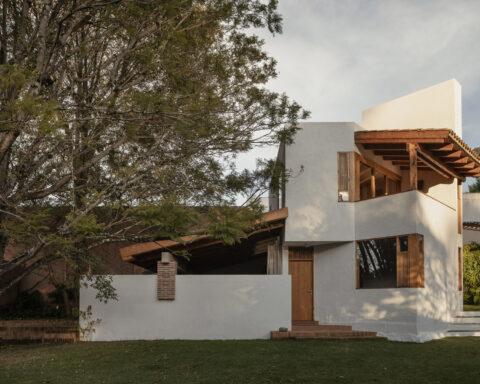
The taller volume conceals itself among the nearest pines, lightened by a constellation of patios that erode it and render it porous. It is a volume inhabited by voids. It contains a complete and autonomous residential unit — capable of functioning independently when the house is occupied by a single person or a couple — with an open living space on the ground floor, a principal bedroom on the first floor, and a solarium-belvedere on the roof, from which deep views open southward towards Ibiza and the silhouette of La Mola.
The smaller volume, compact and opaque, functions in a complementary way: it houses three en-suite double bedrooms and a guest bathroom. The physical separation between the two bodies allows for independent management of privacy according to occupancy, an arrangement that reveals the project’s programmatic intelligence. Between the two volumes, the connecting element acts as pivot and vestibule: “a permeable gallery that links the most intimate spaces with the exterior and shifts its character with the seasons.” In summer it functions as a ventilated porch; in winter, enclosed, as a greenhouse solar collector.
The lower level — technically a basement, but conceived with an altogether different spatial ambition — houses the library, gymnasium, service areas, and parking. Strategically positioned patios flood these rooms with natural light and create, in the architect’s words, “atmospheres of silent monumentality.” This is one of the project’s most audacious moves: subverting the dark condition of the basement until it becomes one of the most poetically charged spaces in the house.


Sustainability as ethics
The environmental strategy of Ses Clotades would merit a separate analysis, but its greatest virtue is that it proves indistinguishable from the project itself. Castelló states it plainly: it transcends “the simple implementation of technology to become a manifesto that crosses aesthetics in favour of ethics.” On an island with structural water scarcity like Formentera, the management of rainwater is a matter of historical survival, and the house takes up that tradition with a large-volume cistern in the basement. The patios reduce electrical demand by bringing natural light to every level. The lower volume’s roof integrates photovoltaic collection. Cross-ventilation replaces active climate control wherever possible.
The materials follow the same logic: projected natural cork and lime binder for the insulation of the enclosing walls — materials with a minimal ecological footprint that allow the house to breathe — along with iroko and pine carpentry and shutters that will age with the dignity of the surrounding landscape. The materiality, like everything in this project, is an exercise in coherence and restraint.


Art, geometry, and natural matter
The architecture of Ses Clotades has also drawn the attention of artist Elena Vinyàrskaya, whose intervention has given the house “a layer of conscious domesticity.” Vinyàrskaya has acted not only as artist but as curator of the set design: through a selection of her own works, designer furniture pieces, and objects with their own histories, the interior abandons its condition as container to become a stage of textures and meanings. Textiles, ceramics, and props balance the formal purity of the house with the warmth necessary for it to be lived in.
The furniture follows the same principle: many elements have been designed to measure and integrated into the architecture — among them the D12 collection for Diabla — and the knowledge of local craftspeople permeates every detail. The result is a work where “the precision of geometry and the imperfection of natural matter coexist in a silent equilibrium,” as the architect observes.


Rooted in Formentera
Marià Castelló has spent decades building one of the most singular and least conspicuous trajectories in contemporary Spanish architecture. His rootedness in Formentera — a small, fragile island with a cultural and landscape identity of great specificity — has produced a body of work that could hardly have emerged from any other place or any other disposition. Ses Clotades is, in that sense, a work of maturity: the house that only someone who has learned to listen over a long time can build.


Project: Ses Clotades.
Location: Formentera.
Area: 295 m².
Design: 2016-2021. Construction: 2021-2025.
Architect: Marià Castelló.
Site supervision: Lorena Ruzafa + Marià Castelló.
Quantity surveyor: José Luis Velilla Lon.
Structure: Ferran Juan.
Facilities: Alcoitech Climatización.
Design team: Lorena Ruzafa, Marga Ferrer y Natàlia Castellà.
Contractor: Urbafor.
Art & Set Design: Elena Vinyàrskaya.
Photography: Marià Castelló.
Source: Marià Castelló

Marià Castelló
Founded in 2002 in Formentera by Marià Castelló (Ibiza, 1976), the studio operates as a small-scale workshop dedicated to architecture and landscape, with a measured production and a strong bond to the territory. Since 2017, Formentera-born architect Lorena Ruzafa Tur has joined the practice, strengthening an approach that works with Mediterranean light, the rhythms of place, and a sincere materiality that dialogues with the island’s tradition.
Castelló graduated as an architect from ETSAB (UPC) in 2002 with honors. From the outset, his work has been published internationally and was presented at the Venice Biennale (Catalan Pavilion, 2012). Early milestones include the “Emerging Architect” award at the 6th Ibiza and Formentera Architecture Awards (2012), marking a trajectory deeply attentive to the heritage and cultural landscape of Formentera.
The studio’s architecture explores the balance between the telluric and the tectonic, the heavy and the light, the artisanal and the technological. These principles become manifest in residential projects such as Bosc d’en Pep Ferrer—where carved rock coexists with three prefabricated CLT volumes—and Es Pou, a modestly scaled dwelling that is precisely inserted into the historic grid of dry-stone walls on the island. Both projects have been widely published and awarded.
Beyond housing and landscape, the studio has developed public facilities such as the Centre d’Esports Nàutics de Formentera, directed by Marià Castelló and Lorena Ruzafa, which reaffirms an approach to design that is closely attuned to the physical and social context of the archipelago.
Since 2019, Castelló and Ruzafa have been developing Fragments d’Arquitectura, a singular project that reveals another dimension of their creative thinking: pieces that are neither buildings nor models, but rather evocations, memories, geometric poems that bring us closer to the very heart of architecture. An invitation to look with innocence, to pause before the essential beauty of form, matter, and light. The series was presented in an exhibition in 2025 and crystallized in an extensive book of the same name. The project received an Honorable Mention at the Architecture MasterPrize (Conceptual category).
The work of Marià Castelló and Lorena Ruzafa regards the island as a living archive: each project is a precise reading of the terrain, the light, the wind, and local crafts. The economy of resources, the sober tectonics, and the continuity with built memory define an architecture deeply committed to sustainability and to the essential beauty of place.
Marià Castelló
Camí Vell de la Mola km 2,3
07860 Formentera
T +34 971328046
M +34 649159994
mcastello@m-ar.net
www.m-ar.net
Project by Marià Castelló