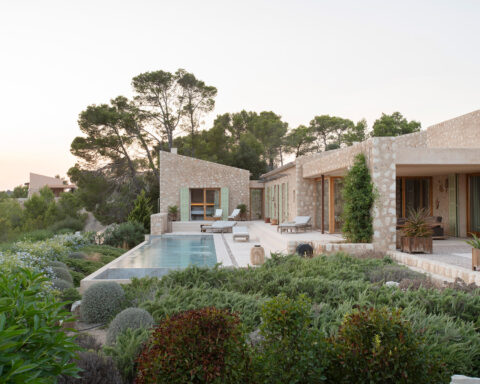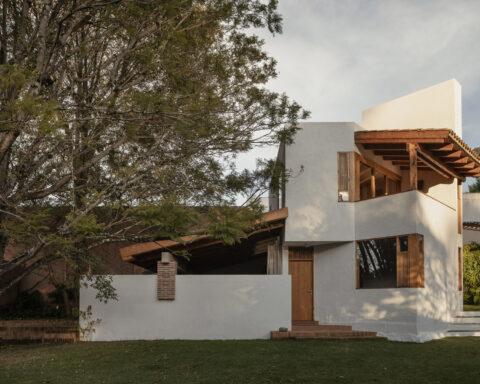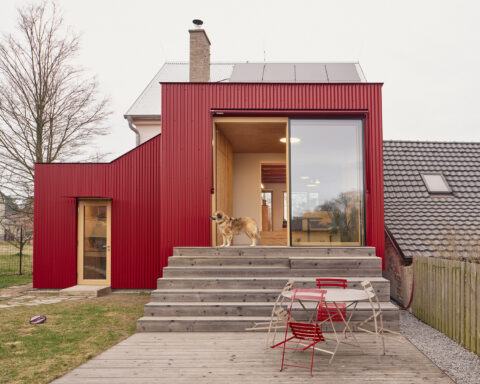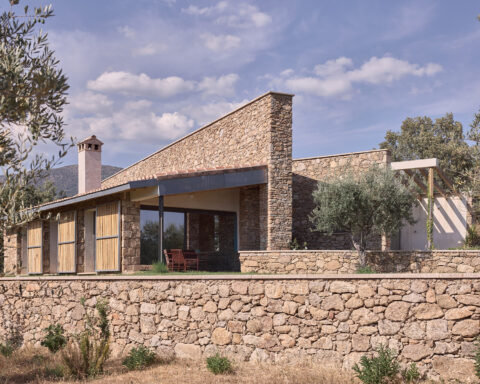


On the island of Menorca, in a place where the sea breeze mingles with the silence of olive groves and limestone becomes memory, stands Son Alberti. An old rural estate built in the 16th century that, for generations, served as a refuge for agricultural work and the care of the land. Abandoned for years, its new owners, a family from Paris, entrusted the French studio Atelier du Pont to renovate it and turn it into a retreat for rest. In collaboration with the local architect Poncio Palliser, the house has been reborn as a place for pause, for the slow-paced summer, for time that stretches under the light.
The architects approached the renovation by starting from the essence of the place. The original architecture, with its thick walls and sober volumes, has been left untouched: it has been respected as one respects a living organism. The intervention strategies have been woven around what was already there, refining its language and intensifying its relationship with the Mediterranean landscape that surrounds the house. The result is a quiet conversation between past and present, between what is inherited and what is reinterpreted.


The 380 m² interior becomes a universe of warm textures and filtered light. Lime, a faithful companion of the Menorcan building tradition, is used to coat walls and ceilings, returning clarity to rooms historically closed to the outside. Its porous surface reflects light delicately, creating atmospheres that shift throughout the day, as if the house breathed with the sun. To allow light greater freedom to move through the spaces, new windows were opened and the layout was reorganized. Now the air circulates, and the rooms—once closed off and protected from the exterior—breathe.
The work was carried out with the participation of local artisans, whose hands have known the logic of the territory for generations. Menorca has a long tradition of masonry, carpentry, and ceramic work, and that knowledge permeates every room. The furnishings are integrated into the architecture in the form of built-in pieces: benches, shelves, and countertops that seem to have emerged from the very stone walls. They are lines that accompany, extending the serenity of the spaces. A palette of earthy tones, muted terracotta, mineral beiges, and unadorned woods reinforces the dialogue with the surroundings.
After the renovation was completed, the spacious, white, light-filled rooms called for an intimate gesture. To restore warmth and a certain emotional vibration, the studio decided to introduce organic forms painted in earthy and rosy tones—patches of color inhabiting the walls as if they had been there from the beginning. To these are added antique tapestries, found by the owners at Parisian auctions, which bring depth, memory, and a kind of silent murmur to each space.


The house also enjoys self-sufficiency: solar panels and a groundwater collection system allow Son Alberti to live in harmony with its environment. Beyond the home, the garden descends gently toward a swimming pool set between marés stone walls. There, the still water gathers the sky and returns golden reflections, becoming a small intimate oasis where the murmur of the island can be heard.
Son Alberti is, above all, a lesson in sensitivity to place. Atelier du Pont—founded by Anne-Cécile Comar and Philippe Croisier in Paris—has spent years advocating for a contextual architecture, generous and open to everyday life. Their work, which ranges from urban planning to art direction, is always structured around a central idea: each space must be born from the landscape, the culture, and the hands that build it.
In Menorca, that philosophy finds fertile ground. The island, with its slow rhythm and ethic of caring for essential things, welcomes the intervention naturally. Son Alberti now breathes as a luminous and silent home, open to summer and to the long nights beneath the Mediterranean sky. A house where the light lingers for an instant before leaving, where life unfolds with simplicity, without haste, and integrates naturally with rest.


Project: Son Alberti.
Location: Menorca.
Architecture: Atelier du Pont.
Local associate architect: Poncio Palliser.
Photography: Maria Missaglia.
Source: Balkin Bureau.

Atelier du Pont
Between reason and emotion, between drawing and matter, Atelier du Pont has, since its founding in 1997, built its own geography of architecture —an archipelago of projects that speak with the earth and the air, with the memory of craft and the contemporary urgency to imagine a more conscious way of living.
The studio was born in 1997 from the shared impulse of three young architects —Anne-Cécile Comar, Philippe Croisier and Stéphane Pertusier— who dreamed of creating an architecture that resembled them: free, rigorous, and deeply human. Over time, the atelier evolved into a collective of nearly fifty people, a community where creation is understood as a choral act, open to experimentation, to dialogue with artisans, and to listening to the world around.
In their work, the constructive and the sensitive are never opposed. Each line drawn is destined to become tangible matter; each material —stone, wood, or earth— becomes a conversation with nature and with those who shape it. In the tradition of the Gesamtkunstwerk, Atelier du Pont conceives architecture as a total work of art: interiors extend the exterior, furniture is born from the building, and the house opens to the landscape.
Their architecture unfolds across multiple territories: from the intimate scale of a house in Menorca, where time seems to pause in the touch of lime and stone, to large public buildings and workplaces where well-being becomes a form of ethics. Always there is a search for harmony between place and life, between technical precision and the freedom to imagine.
Far from dogma, their environmental commitment is a daily practice guided by common sense and the desire to build less, but better. Each project is an opportunity to rethink resources, reinvent the act of making, and return to architecture its artisanal and cultural dimension.
Atelier du Pont is, ultimately, a way of inhabiting the world: a bridge between people, materials, and landscapes. An architecture that breathes, that listens, and that builds the future from the beauty of what is essential.
Atelier du Pont
9 impasse Lamier
75011 Paris
+33 (0) 1 53 33 24 10
adp@atelierdupont.fr
www.atelierdupont.fr
110 rue de Sèze
69006 Lyon
4 chemin de l’Arenas
06200 Nice
38 Cami des Castel
07702 Mahon (Menorca)
Project by Atelier du Pont