
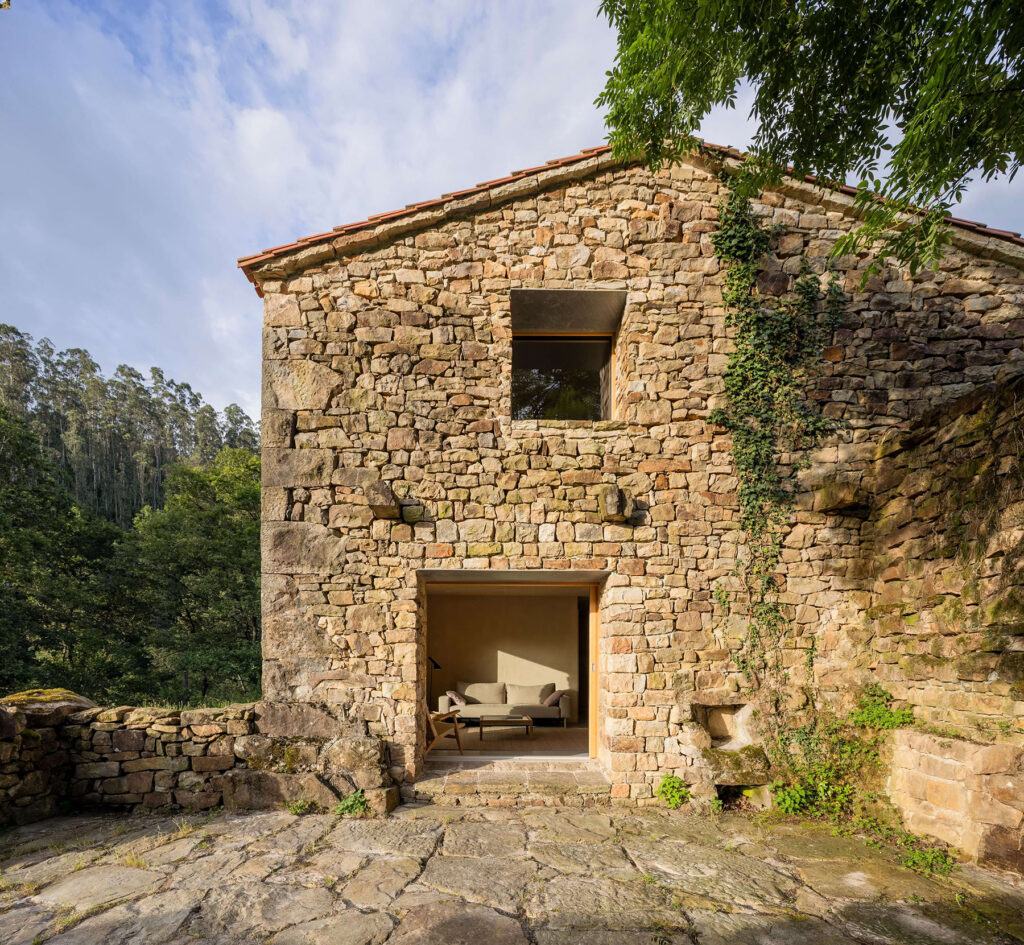
Most architecture projects are born of a commission; this one, however, was born of a desire. More than twenty years ago, architect Helena Aguilar came across an old stone hut in ruins in the Valles Pasiegos of Cantabria and decided to keep it. There was no client, no brief, no reason other than the bond that a place can create. Over time, together with Juan Ramón Cristóbal, her partner and fellow architect, that bond became a project: the rehabilitation of the hut as their own home, as a laboratory for their convictions and, finally, as a space open to whoever might wish to inhabit it..
The Cantabrian shepherd’s hut is a typology deeply rooted in the semi-transhumant way of life of the region since the sixteenth century. Its logic was strictly functional: the ground floor housed the livestock, whose warmth helped heat the dwelling above, reached from the outside via a stone staircase that still stands today. The dry-stone walls, nearly eighty centimetres thick, were a response to the conditions of a territory of high rainfall, situated on the foothills of the Cantabrian mountains, little more than fifty kilometres from the sea. That thickness, which originally seeped with damp on all sides, would paradoxically become the project’s primary resource.
The original volume is preserved
The central decision of Mínima‘s intervention was not to touch the façade. The original volume remains intact, with its pitched roof, dry-stone masonry and exterior staircase. The transformation happens inward, through what the architects call a second skin: an interior envelope built in layers over the existing walls — organic insulation membrane, ceramic brick and unpainted lime render — which turns the stone mass into the thermal heart of the building. The floor slab and roof are insulated with high-performance materials, and the new joinery, timber-framed with passive triple glazing and argon gas, maintains visual continuity with the landscape without compromising the airtightness of the whole.
The system is completed by a mechanical heat recovery ventilation unit — Orkli Pkom 4 — and an integrated heat pump that cover heating and hot water demand. On the coldest days, a wood-burning stove provides occasional supplementary heat. In summer, the thermal inertia of the stone walls does the work. The result is an energy demand so low that it can be met entirely by the power generated by a small hydroelectric turbine in the nearby river. The whole achieves EnerPHit certification from the Passivhaus Institute — the most demanding standard for retrofit projects — without any of this being perceptible from the outside or interfering with the interior experience of the space. The technology remains invisible; what one perceives is the silence of a place where time seems to have stopped.


The ground floor transformed into the daytime living area
The layout respects the original logic of the hut. The ground floor, formerly given over to livestock, becomes the main living space: kitchen, dining area and sitting room arranged in a single continuous sequence where natural light enters through the new openings. Adjacent to this level, the old exterior enclosure — a semi-enclosed space bounded by large stone walls that had served as a midden and was covered in vegetation — is rehabilitated as a courtyard. The floor is paved with the original slabs from the stable, some still bearing the grooves cut to ease their maintenance, carrying the material memory of the former space into its new domestic condition.
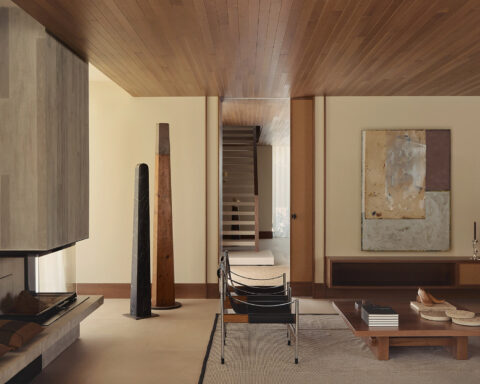
On the upper floor, two bedrooms clad in oak offer a contained atmosphere in which proportion, materiality and light work with precision. The furniture — dining table, coffee table, bedside tables — was designed by the studio itself and made from the original structural beams of the hut, adding another layer of continuity between what was and what is.
The structural oak of the roof becomes a surface for work and for rest; the lime mortar that covers the floors reappears in the horizontal plane of the coffee table. These are discreet correspondences, not decorative gestures, and their effect is that of a space that feels long inhabited.
This hut has ceased to be a ruin and become something else: a living witness to an ancient history, still present for the enjoyment of those who know how to value it.


Casa Mínima functions today as a home and as a tourist accommodation for up to six people. That dual condition is an extension of the studio’s philosophy: the house exists to be lived in, and those who stay there temporarily can experience first-hand what Mínima proposes before embarking on a project of their own. It is a form of demonstration that only works if the architecture is honest enough to stand without explanation.
In the Valles Pasiegos, where mist rises slowly from the valley floors and stone has been accumulating centuries of damp, this hut has ceased to be a ruin and become something else: a living witness to an ancient history, still present for the enjoyment of those who know how to value it.


Project: Casa Mínima. Rehabilitation of a traditional Cantabrian shepherd’s hut.
Location: Valles Pasiegos, Cantabria.
Completion: 2025
Certification: EnerPHit (Passivhaus Institute).
Architects: Estudio Mínima — Helena Aguilar y Juan Ramón Cristóbal.
Area: 160 m². 2 floors.
Photography: Biderbost Photo, xcept those credited to @Estudio Mínima.
Construction system
Structure: Existing stone masonry walls and timber roof structure. Envelope: High-performance interior skin: 80 cm stone wall + organic insulation membrane + brick + lime render. Joinery: High-performance timber windows, passive triple glazing. Ventilation: Mechanical heat recovery ventilation — Orkli PKOM 4. Climate control: Integrated heat pump + auxiliary wood-burning stove. Main materials: Stone, lime mortar, oak, ceramic.
Furniture
Dining table: Reclaimed solid oak — Estudio Mínima design. Made from the original structural beams of the hut. Coffee table: Reclaimed solid oak with lime mortar surface — Estudio Mínima design. The horizontal surface reproduces the same lime mortar used on the floor. Bathroom tables and bedside tables: Reclaimed solid oak — Estudio Mínima design. Unique pieces made from the building’s original structural timber.

Mínima
Helena Aguilar and Juan Ramón Cristóbal trained as architects at the Escuela Técnica Superior de Arquitectura de Madrid (ETSAM), where both graduated around the year 2000. Their early professional years were spent in the competitive world of large public architecture competitions, a demanding environment that brought them recognition in Spain and abroad, but one that would prove too relentless as their family grew.
It was that moment of personal inflection that led them to reorient their practice. They chose to specialise in ecological and energy-efficient architecture — a discipline then little developed in Spain — through specific training in Switzerland, where Helena deepened her knowledge of the Minergie standard and both became certified Passivhaus Designers. On their return, they settled in San Lorenzo de El Escorial, in a natural setting they consider inseparable from their working values. There they founded Mínima.
The studio was born from the conviction that sustainability is not a label but an ethical position, and that the architect’s craft can — and must — contribute actively to a more coherent way of life. Mínima defines itself as an activist within the profession, and that stance is present in every project decision. Its approach rests on five pillars: bioclimatic design that draws on the conditions of place, energy efficiency oriented towards autonomy, low environmental impact in the choice of materials, bioconstruction criteria to ensure a healthy interior environment, and a commitment to essentiality that recalls Brâncusi’s dictum — simplicity as complexity resolved — and that gives the studio its name.
Helena brings to the work a strong analytical capacity and a research trajectory that began with a four-year grant during which she visited several European universities; it was in that period that her early interest in ecological architecture took root. Juan Ramón combines technical rigour with the ability to build trust and cohesion among all the agents involved in a project, from the design phase through to construction management. Partners in both their personal and professional lives, they work together and offer their clients a close, personalised relationship that sets their scale apart from that of larger practices.
To make their philosophy tangible, they have opened Casa Mínima as a demonstration space: a place to stay where prospective clients can experience first-hand what the studio proposes before committing to a project of their own. It is a gesture consistent with their way of understanding the work: as accompaniment and as a choice of life.
Mínima
San Lorenzo de El Escorial (Madrid)
+34 91 8324432
estudio@minima.bio
www.minima.bio
@minima.bio
Project by Mínima