
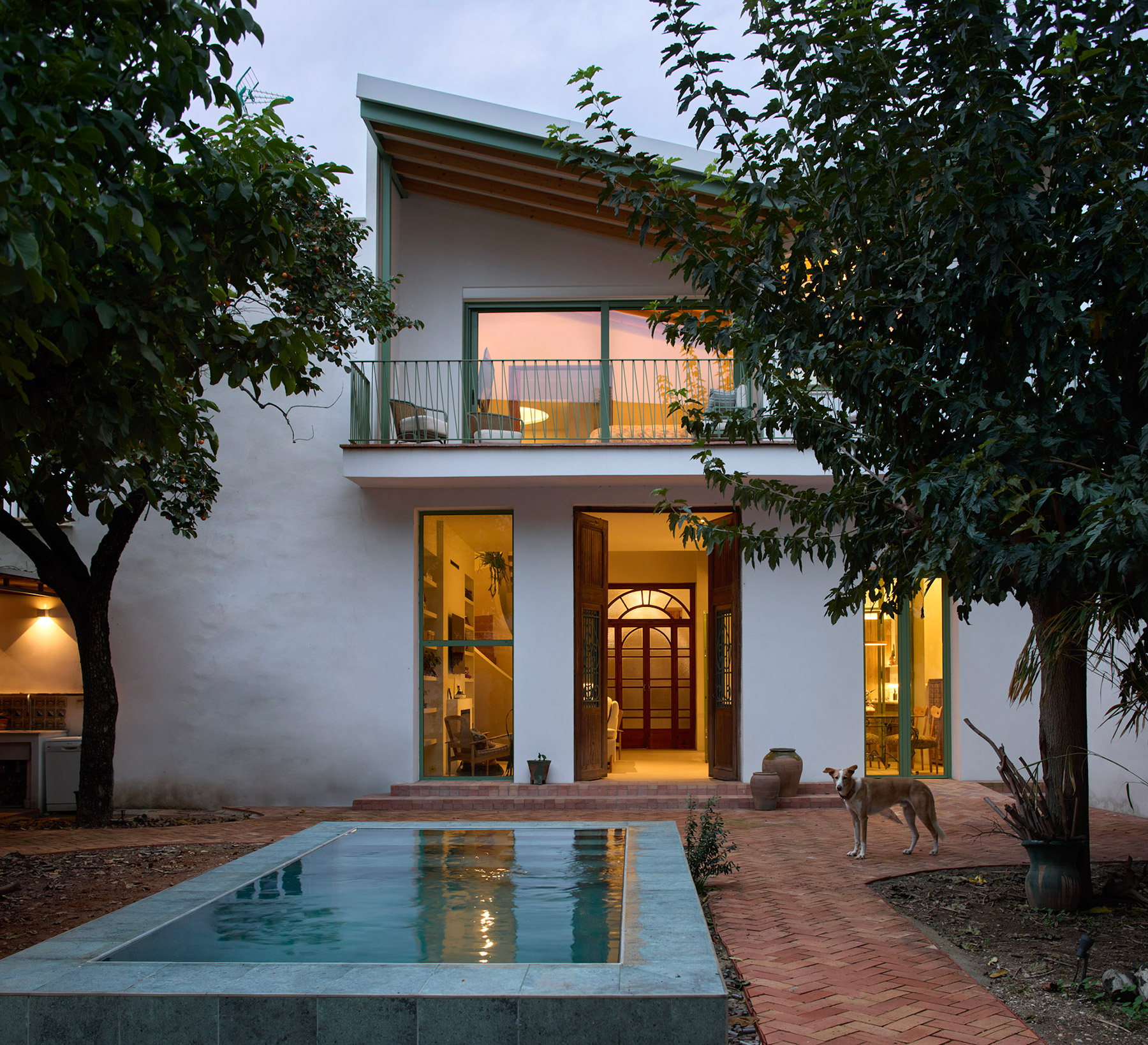

In the interior of the province of Valencia, in the town of Turís, a family house is once again reclaimed as a lived-in place after several decades of quiet transformations. Architect Jose Costa approaches the project from a starting point rooted above all in memory: that of a house linked to the figure of the country doctor, and to a time when domestic architecture was closely interwoven with public life. In those years, the doctor—together with the pharmacist, teachers and priest—formed part of each town’s cultural elite and enjoyed the respect of the local community.
The story dates back to the early 1940s, when the grandparents of the current owner, Nilda, rented the house shortly after it was built. The dwelling had to assume a dual condition: family home and medical practice. As was common at the time, medical care was not separated from domestic life, and the house became a place of constant movement, where private life and patients shared the same space.
Years later, once the property was acquired, the family expanded the house towards the rear patio, then still surrounded by fields. At the far end of the garden, the doctor built a small elevated structure, a retreat where he could withdraw to read away from everyday bustle. That gesture—an intimate space within the domestic domain—remains one of the project’s quiet keys.


With the family’s move to Valencia in the late 1970s, the house became a second residence. Later alterations were fragmentary, responding to specific needs, until the building lost its status as a permanent home. Nilda’s decision to turn it into her new residence opens a new chapter: recovering the house as a living structure capable of accommodating another way of inhabiting.
The intervention is therefore conceived with the aim of reconciling scale and use. Nearly 300 square metres had to respond to a reduced everyday occupancy—one or two people for most of the year—while also expanding at specific times to host family gatherings, reclaiming its historic role as a place of reunion.
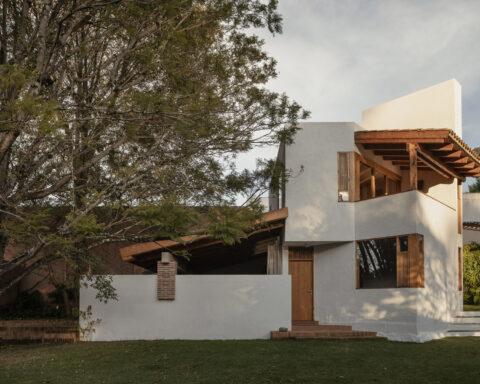
A reading of the existing building reveals two distinct halves. The street-facing side retained the solidity of the original architecture: brick façade, timber joinery and pitched roof. Here, the intervention opts for continuity. Elements such as the entrance gate are restored, floors and tiles are reused, and an atmosphere is preserved that maintains the link with the house’s material memory. This area accommodates the more domestic and compartmentalised part of the programme, with bedrooms and bathrooms intended for intermittent stays.
The rear half, opening onto the garden, accommodates the main programme: living room, dining area, kitchen and the first en-suite bedroom. Its condition was more deteriorated, and the new way of inhabiting called for generous spaces connected to the outdoors. Here, the architect proposes a more substantial intervention: partial demolitions, new structures and a façade that opens towards the patio, reorganising the heart of the house around shared space.


Excessively deep in its original configuration, the house finds its true spatial adjustment in this operation. Above the kitchen, a vertical patio introduces light and ventilation into the centre of the plan. Enclosed in glass and covered, it functions almost as an indoor garden, an intermediate space that orders the domestic sequence.
Opposite this contained void, the new staircase assumes a structuring role. It acts as the piece that articulates the two halves of the house, establishing a transition between what is inherited and what is transformed. Its presence introduces rhythm to the circulation and allows the intervention to be read as a layering of time rather than a rupture.
The project is completed by a series of small exterior operations that reinforce the domestic character of the ensemble: a pool conceived as an alberca, a painting studio-storage space and the recovery of the former garden structure, now transformed into a playhouse. Restrained gestures that extend the life of the house into the patio, preserving its familial and everyday nature.
In The doctor’s house, Jose Costa works from an idea of continuity that develops architecture’s ability to recover memory. The intervention seeks to restore the dwelling as a space for life. As in its origins, the house once again becomes a place where intimacy and togetherness find a natural balance.


Project: Casa del médico.
Location: Turís (Valencia).
Completion: 2025.
Architect: Jose Costa.
Collaborating team: Ana Aguado, Belén de las Heras, Eduardo Schiebek.
Technical architect: Javier Betancor.
Contractor: Edibe Arquitectura y Construcción.
Photography: Mariela Apollonio.

José Costa
José Costa is an architect and founder of José Costa ARQ., an architecture studio based in Valencia that understands architectural practice as an active tool for improving the ways we inhabit space. The studio operates as an open platform, bringing together professionals from different disciplines who share a common ambition: to work with rigour, sensitivity and commitment through architecture.
The practice focuses on residential, cultural and workplace projects, always approached from a critical and analytical perspective. Each commission is conceived as an opportunity to explore the limits of programme and context, combining technical efficiency with creativity, material research and constant attention to the people who will occupy the spaces. Reuse, integration with the surrounding environment and close observation of real patterns of use are essential components of the studio’s working methodology. Read full biography.
Jose Costa Arq.
The House
Denia 50
46006 Valencia
+34 617 525 323
estudio@josecosta.es
josecosta.es
Project by José Costa