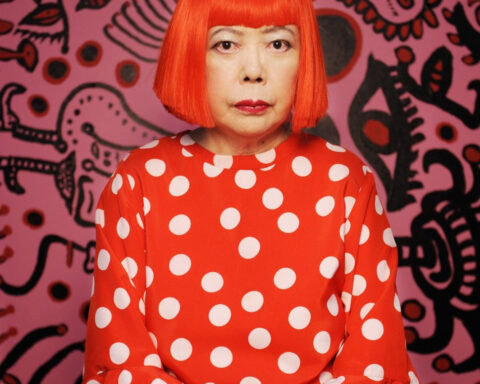


Yayoi Kusama is surely one of the world’s most celebrated living artists. Her sculptures of pumpkins and polka-dotted flowers are recognised the world over, and her infinite mirrored rooms are central to the 21st century shift towards art as an immersive experience.
The exhibition explores Kusama’s unique worldview, beginning with artworks created during her childhood and including works made this year. In between, it traces Kusama’s extraordinary career, from her experimental years in post-war Japan to her contributions to the avant-garde scene in New York in the 1960s, to her return to Japan in 1973 and her subsequent re-emergence as an internationally renowned artist.
Here are some of the works that can be seen in the exhibition.
Early years
Yayoi Kusama grew up in a nursery and seed farm in the regional Japanese city of Matsumoto, where she delighted in the nature around her. Around the age of ten, Kusama began to capture her experiences in drawings, initiating some of her most enduring artistic themes.
After briefly studying traditional Japanese painting in Kyoto in the late 1940s, Kusama returned to Matsumoto. She was inspired by international artistic trends and was encouraged to take up art through her correspondence with the American painter Georgia O’Keeffe. During this period he produced a large number of experimental paintings, which he exhibited in his homeland and in Tokyo.
By the mid-1950s, Kusama’s ambition had outgrown regional Japan and the possibilities offered by post-war Tokyo. In November 1957 he left for the United States, with silk kimonos in his suitcases, American banknotes hidden in his clothes and some 2,000 drawings and paintings. Kusama arrived in Seattle and, within a month, presented her first solo exhibition in the United States at the Dusanne Gallery. Six months later, she moved to New York to pursue her dream of international success.

oil and enamel in sack.72.3 × 91.5 cm. The National Museum of Modern Art, Tokyo

Ink and gouache on paper. 25.0 × 17.5 cm. Private collection.
Nueva York
On her arrival in New York in 1958, Kusama visited the Empire State Building and gazed out over the busy streets of Manhattan. At that moment she realised that, to be recognised in New York, she had to do something truly spectacular. Her first impression of the city was of “a fierce and violent place”, an extremely stressful “hell”. Despite these conditions, she persevered, determined to make a name for herself at the centre of the art world.
Through a repetitive creative process, Kusama painted large canvases that immersed both the artist and the viewer in a vast monochromatic field. From 1963 onwards she extended her interest in self-immersion, or “self-erasure”, to three dimensions. For her Accumulation sculptures, Kusama covered furniture and found objects with phallus-like forms of fabric, a sculptural style she would continue for decades to come.
In 1965 and 1966, Kusama presented her first rooms of infinite mirrors at the Castellane Gallery in New York. These installations, which immersed visitors in 360-degree reflections, brought Kusama one step closer to her ambition to lose herself in a space that multiplies to infinity.


248.0 × 82.0 × 151.0 cm. The National Museum of Modern Art, Kyoto
Kusama and counterculture
Kusama’s work underwent a major shift in the second half of the 1960s. Between 1967 and 1969 she presented some seventy-five happenings, socially and politically charged events related to the countercultural movements of the time, such as the protests for sexual liberation and against the Vietnam War. Most of Kusama’s happenings took place in prominent public places in New York, such as Central Park, Trinity Church and the Brooklyn Bridge. The participants in these public interventions were often naked, and Kusama – the self-proclaimed High Priestess of Polka Dots- used her paintbrush to erase their polka-dotted bodies.

Colección de la artista.
Kusama Fashion Company
Kusama regularly wore outfits of her own design. Beyond her personal wardrobe, she made radical garments that aligned with the spirit of the sexual liberation movement. To extend the reach of her fashion designs beyond the art world and make them commercially viable, she founded Kusama Fashion Company in 1969. That same year she launched a ready-to-wear collection. Ranging from relatively conventional styles to radical designs, Kusama’s clothes were sold in New York shops and in her own boutique on the corner of Sixth Avenue and West Eighth Street.

Return to Japan
In 1973, Kusama returned to Japan after almost sixteen years living in the United States. At that time, she suffered the death of several important people in her life, including her father in 1974. A period of introspection and psychological crises followed, leading him to choose, in 1977, to live with regular access to psychiatric care. Eventually he established an independent studio, but for a time his working space was limited, so he began to create small-scale collages. These detailed and intimate works combine cut-out photographs and illustrations, often with insect, marine or botanical motifs and his characteristic drawn and painted nets, webs and dots.

Ota Fine Arts
Pumpkins
Kusama first saw a pumpkin when she was a primary school student visiting a seed nursery with her grandfather. Among the yellow flowering vines, she discovered a gourd the size of a man’s head and, when she went to pluck it, it began to talk animatedly to her. Enchanted by its nature, the young Kusama adopted the pumpkin as a recurring motif in her art. She painted her first pumpkin as a teenager in 1946. She likened the ritual of painting pumpkins to Zen meditation:”I would face the spirit of the pumpkin, forgetting everything else, and concentrate my whole mind on the form before me.”
In the late 1970s, Kusama returned to one of the most enriching and wonderful ways of life of her childhood. After initially painting pumpkins with yellow and black or black and white dots, she has seamlessly transformed the image of the pumpkin into sculptures, infinite mirrored rooms and a multitude of commercial products, elevating it to one of the most recognisable icons of contemporary art around the world.

Collection of Daisuke Miyatsu.
Return to the world stage
In 1981 she was represented in a major exhibition of contemporary Japanese art at the National Museum of Modern Art in Tokyo, which cemented her place in the national art scene, but she soon returned to the world stage. In 1989 her first international retrospective exhibition was held at the Center for International Contemporary Arts in New York, and in 1993 she was the first contemporary artist to represent Japan at the Venice Biennale.
In her work of the last decades of the twentieth century, the artist looks simultaneously to the past and the future. Her soft botanical sculptures and repetitive multi-panel paintings recall her Accumulations and Infinite Networks of the 1950s and 1960s, while expanding her artistic exploration of the natural and cosmic worlds. Kusama’s expanded vision materialised again in Dots Obsession, 1996, an environment populated with polka-dot inflatables. This work has since been realised in many variations, incorporating mirrors since 1998. This was an evolution of the artist’s revolutionary infinity mirrored rooms of the 1960s.

Collection of the artist.

Ota Fine Arts.
Kusama en el siglo XXI
Since 2000, Yayoi Kusama has become one of the world’s most recognised artists. From major international exhibitions and monumental sculptures installed in public spaces to widespread recognition of her signature motifs and striking visual identity (most notably her red wig), Kusama has become a key figure in popular culture. In 2016 she was named one of Time magazine’s 100 most influential people in the world. In the 21st century, Kusama’s rise has been amplified by the power of social media. Images of her infinity-mirrored rooms and collaborations with luxury brands such as Louis Vuitton have brought her art to the attention of millions.
Despite her status, Kusama remains committed to a deeply personal art. Whether in poetry, painting, large installations or rooms of infinite mirrors, Kusama expresses reasons for hope in the face of existential finitude. Her creativity is her lifeline.


Collection of the artist.

Synthetic polymer paint on canvas. 194.0 × 194.0 cm
Collection of the artist.
Kusama hoy
In 2002, Kusama published her autobiography, in which she wrote: “What I think first and foremost is that I want to create good art. That is my only desire. It would be futile and pointless to focus on the ever-shortening time frame before me, or to dwell on my limitations. I will never stop striving to create works that will shine after my death. There are nights when I can’t sleep simply because my heart overflows with the aspiration to make art that lives forever.” Kusama’s vision continues to expand, whether painting in solitude or developing new works, site-specific installations and rooms of mirrors.
In this exhibition, a new infinity mirror room is presented for the first time alongside a selection of recent paintings created since 2021. During this time, Kusama’s mobility has diminished and her living space has become her workspace. Consequently, the size of her canvases has shrunk. These paintings are filled with images drawn from nature and childhood memories, as well as other ideas that have preoccupied the artist since her early years in Matsumoto. Kusama’s continuous and prolific output is a testament to her unwavering desire to create art.

Synthetic polymer paint and felt-tip pen on canvas. 60.6 × 50.0 cm
Collection of the artist.

Synthetic polymer paint and felt-tip pen on canvas. 100.0 × 100.0 cm
Collection of the artist.
Ascension of Polka Dots on the Trees
Kusama’s kaleidoscopic world extends beyond the walls of the NGV and envelops the trees of Melbourne’s iconic Grand Boulevard. Kusama initially presented Ascension of Polka Dots on the Trees at the Kirishima Open Air Museum, Japan, in 2002.
Melbourne has created a special iteration in a bold pink and white polka dot fabric. Nearby, the glass wall of the NGV International is covered in a pink and black polka dot design that draws visitors into Kusama’s creative world through this iconic Melbourne entrance.


Road, Melbourne de la Galería Nacional de Victoria. Foto: Tobias Titz
Dancing Pumpkin
In the Federation Courtyard, visitors discover an imposing 5-metre-high bronze pumpkin sculpture recently acquired by the GNV. Dancing Pumpkin (2020), twisting under the skylight, is one of Kusama’s largest and most ambitious imaginings of her beloved pumpkin motif to date. While her previous pumpkin sculptures have static, solid bases, Dancing Pumpkin has eleven leg-like sections, all but three of which float above the ground, suggesting joyful movement.

The Hope of the polka dots buried in infinity will eternally cover the universo
The exhibition also includes the Australian premiere of The Hope of the polka dots buried in infinity will eternally cover the universe, 2019 which visually entangles viewers inside 6-metre high tentacular shapes covered in yellow and black polka dots.

Narcissus Garden
Another highlight is the presentation of Narcissus Garden, a new iteration of the installation that Kusama first presented unofficially at the 1966 Venice Biennale. This installation consists of more than 1,400 stainless silver balls, each 30 cm in diameter, which are presented en masse as you enter the Gallery. As the metallic spheres reflect off each other, they create an infinitely recurring landscape that envelops the viewer. In reference to the Greek myth of Narcissus, who was so captivated by his own reflection in the water that he drowned in it.

Dots Obsession
The Great Hall also features Dots Obsession, originally conceived by the artist in 1996. This spectacular work, which hangs above and below Leonard French’s iconic cut glass in the Great Hall, features large inflatable spheres of yellow and black vinyl covered in the artist’s signature polka-dot pattern. For Kusama, polka dots symbolise both the individual and the cosmos, when presented in large numbers.

The Obliteration Room
Also on display in the NGV’s free children’s gallery is The Obliteration Room (2002-present), a large-scale interactive installation that invites audiences of all ages to transform a white domestic interior into a kaleidoscope of coloured dots.

Throughout her career, Kusama has used dots and other repetitive shapes to cover different surfaces and fill entire rooms. Kusama calls this process “obliteration”, a concept on which much of the artist’s work is based, which consists of fragmenting something in order to return it to the universe. In this work, Kusama invites children and their families to participate in this process.
Through rarely seen materials from the artist’s own archive, including photographs, films, letters, magazines, posters and other ephemera, the exhibition highlights the radical nature of Kusama’s performances, fashion designs and activism in the late 1960s.
The exhibition reveals how Kusama’s psychedelic parties and events – known as happenings- became vehicles for the exploration of radical ideas, such as sexual liberation. Also on display are experimental fashion designs first created by Kusama during this period.
Yayoi Kusama exhibition.
Dates: 15 diciembre al 21 de abril
Place: National Gallery of Victoria. 180 St Kilda Rd. Melbourne VIC 3006. Australia.

Yayoi Kusama
Yayoi Kusama was born in 1929 in Matsumoto, Japan. She began painting as a child to express hallucinations and to escape family dynamics marked by abuse and neglect. At the Kyoto School of Arts and Crafts, she studied Nihonga, a traditional Japanese formal style of painting. She moved to New York in 1958, inspired by the rise of Abstract Expressionism and a letter from Georgia O’Keeffe.
In the following decade, Kusama worked on her Infinity Nets series, paintings, soft sculptures, collages, films, and installations that featured repetitive motifs and alluded to her hallucinations. In the 1960s, he staged happenings throughout New York City, one of which included his painting of polka dots on nude participants. In 1973 he returned to Japan and in 1977 moved voluntarily to a psychiatric hospital, where he lives today. After immersing herself in the world of poetry and comics, she returned to creating art depicting the iconic polka dots of her childhood visions. This time she scattered the polka dots, which for her represent the moon and the sun, movement, and a path to infinity, in a hall of mirrors. In 1993, she represented Japan at the Biennale di Venezia, and in 2017, she opened the Yayoi Kusama Museum in Tokyo.
Throughout her prolific career, Kusama has continuously explored the themes of mental illness, repetition, obsession, creation, destruction, sex and feminism through her paintings, sculptures, collages, drawings, films, poetry, fashion and performance art. She has received numerous awards and her work has been featured in numerous touring and retrospective exhibitions.
Source: National Gallery of Victoria. Melbourne.
Project by Yayoi Kusama