

In Girona, a terraced house on the verge of collapse becomes the perfect excuse for Victor Bouman to rethink how a long, narrow, and dark volume can be inhabited. The original house consisted of two main bodies joined by a smaller lateral volume: more than 30 meters in length and barely 4.5 meters in width, with a tall, narrow courtyard wedged between the three blocks and a structure severely damaged by water in the roofs, party walls, and floor slabs. The challenge was not only to stabilize a ruin, but to transform this extreme geometry into a luminous, livable home.
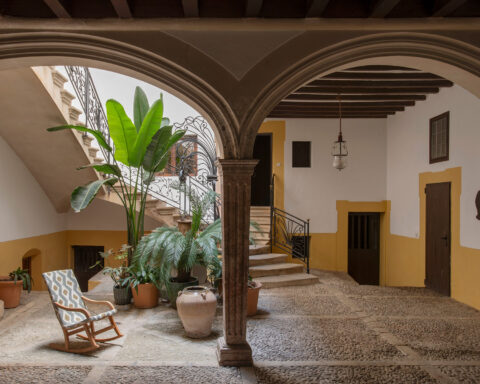
The aim of the intervention was to break the tunnel-like feeling and allow air and light to cross the house from end to end. To achieve this, the height of the two interior volumes is reduced so they now have one and two floors respectively, and a new three-story internal courtyard is carved out of the main volume. Along the 30 meters of the plot, a sequence of voids appears, a chain of courtyards that interrupts the solid mass of the original house and allows natural light to reach every room. The vegetation that colonizes these air shafts reinforces the sensation of entering and exiting the house as one moves through it, as if the dwelling were breathing rhythmically toward the outside.


The program is organized by levels from bottom to top: the ground floor concentrates the daytime spaces, in direct contact with the courtyards and vegetation, softening the boundary between interior and exterior. On the first floor are the parents’ spaces—bedroom, bathroom, and studio—in a more private strip that nevertheless always maintains visual connections with the voids. The top floor is dedicated to the children, with bedrooms and their own spaces that complete the ensemble and benefit from the light entering through the roofs and skylights.
Radical honesty in materials and finishes
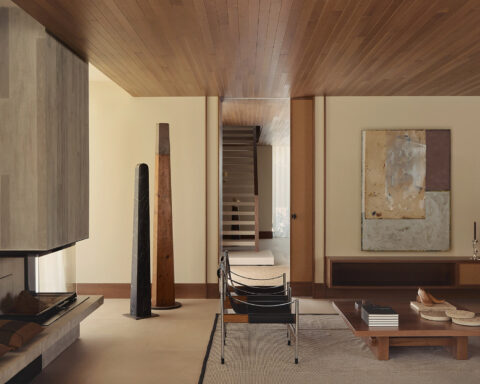
In terms of materials and finishes, the project opts for radical honesty: neither the preexisting structure nor the operations needed to save it are concealed. The river-stone party walls are left exposed, as are the thin brick vaulted ceilings, and the existing floors are preserved wherever possible. Structural reinforcements are also shown without embarrassment: timber floor structures, in-situ concrete beams, steel shoring elements, and colored concrete compression layers that add weight and stability to the vaults, stitch the house horizontally to the party walls, and at the same time function as the finished flooring. When the decision is made to cover something, it is done with lime mortar in served spaces and with microcement or tiling in wet areas, always guided by a logic of sobriety and permanence.


Energy as part of the project
The home’s climatic behavior makes the most of the thermal inertia of its built mass. The thick party walls and vaulted floor structures act as a large heat sink that keeps the interior cool in summer after having cooled down in the preceding months. Cross ventilation, supported by operable skylights in the roof, completes the strategy and ensures comfort in all rooms without resorting to major technical devices. In winter, underfloor heating warms the ground floor, while radiators on the upper levels are supplied by an efficient aerothermal system, closing the circle of a renovation that understands energy as an inseparable part of the project.
This project is, ultimately, an operation of suturing rather than replacing: an exercise in listening to the house and the neighborhood, in freeing light and air where previously there was only mass, and in returning the dignity of a home to a stretched, exhausted volume. From ruin to domestic warmth, through courtyards, sincere materials, and a climatic logic that allows architecture to work with time instead of against it.


Project: Pont Major
.
Location: Pont Major, Girona.
Completion: 2025.
Architecture: Victor Bouman.
Photography: Pol Viladoms, Anna Queralt.
Interior design: Almeda Estudi.
Construction: Construccions Marc i Jou.
Windows: Elke Wood Windows.
Timber structure: Leif DKarpenter.
Building services: Tecninstal Banyoles.
Landscape design: Natàlia Mitjà.
Source: Victor Bouman.

Victor Bouman
Víctor Bouman is part of a generation of architects who have turned simplicity into a form of precision and made the landscape their main ally. An architect trained at the Escola Tècnica Superior d’Arquitectura de Barcelona (ETSAB, 2016), his work today unfolds between Girona and the Costa Brava, where he designs quiet, compact homes that are deeply attentive to the climate and to the real lives of those who inhabit them.
After finishing his studies in Barcelona, Bouman moved to London to work at PTEarchitects, getting involved in large-scale housing projects that allowed him to understand the city through repetition, density and the social responsibility of residential design. When he returned in 2016, he joined several practices in Terrassa, especially RGA arquitectes, where he delved into timber construction systems and into a way of designing in which construction detail and material efficiency go hand in hand. This journey, between the large London scale and small-scale work in Catalonia, gradually shaped a precise way of looking at how everyday comfort is constructed.
In 2020 he founded Bouman Arquitectura, a studio based in Girona and Llançà (Costa Brava) that is defined above all by a calm, straightforward and honest way of working. From these two bases, urban yet very close to the territory, the studio works with private clients and developers on new-build projects, refurbishments, interior design, retail and landscape, guided by a clear thread: creating spaces that are easy to live in, quiet and sustainable, where architecture does not impose itself on life but supports it discreetly.
His work could be described as an ongoing conversation with place. Each project begins with a careful reading of topography, orientation, climate and built memory, based on the idea that it is the surroundings—urban or natural—that should influence architecture, and not the other way around. Hence his preference for contained volumes, compact floor plans, pitched roofs that speak to the rural landscape and the use of natural, sustainable, locally sourced materials that reduce environmental impact and age with dignity.
At Bouman Arquitectura every decision is guided by a double gaze: that of the planet and that of the people who will inhabit the space. This explains the emphasis on energy efficiency, reduced emissions and natural materials, but also on the right temperature, carefully worked light, silence and that hard‑to‑name sense of comfort you feel when you walk through the door and everything seems to be in its place. His projects do not seek to dazzle on a first visit, but to sustain over time a relationship of trust with their inhabitants, like those houses that, over the years, become part of the landscape until they seem as though they have always been there.
At a time when architecture often swings between spectacle and hyper‑technification, Víctor Bouman’s trajectory points to another path: a calm, close‑to‑home architecture that looks to the future through the humility of resources and the intensity of place. A practice rooted in Girona and the Costa Brava, yet in dialogue with a global concern: how to live better, consuming less and caring for what sustains us.
Victor Bouman
Carrer Cardenal Margarit 1
17002 Girona
+34 664 36 06 43
victor@boumanarquitectura.com
boumanarquitectura.com
@boumanarquitectura
Project by Victor Bouman