

The artist Maria Economides was born in Thessaloniki in 1980, into a family working in the timber trade. She grew up surrounded by natural materials — dust, textures, tools, the specific gravity of manual work — in an environment that, as she herself acknowledges, shaped the way she understands matter long before she knew that was what was happening. She studied Business Administration to take over the family business, but the need to work with her hands persisted beneath that other path.
In 2010 she moved with her family to Shanghai, where she lived for eight years. It was a formative period in an unusual sense. Without yet touching clay, Maria was absorbing something that would later appear in her work. “What always fascinated me was how the old and the new coexisted there — the traditional way of life next to the completely modern. You could see someone working with their hands, just as people did centuries ago, and a few steps away a futuristic building. That balance deeply influenced the way I see creation.“


Back in Greece in 2018, she found in clay the medium that gathered everything she had been carrying. “At a vulnerable moment in my life, clay changed me; it was as if it was shaping me while I was shaping it. It felt like a dialogue where both of us were discovering ourselves.”
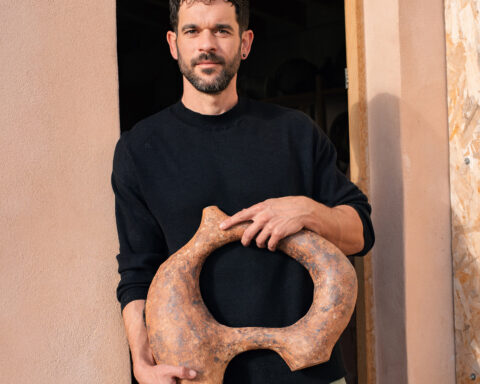
Maria’s practice revolves around the coiling technique, through which she builds her pieces slowly, layer upon layer, before working them through carving and trimming until the surfaces and proportions acquire the lightness and fluidity she seeks. The resulting pieces are thin and light, made to be held and embraced. They carry within them something that recalls ancient forms, yet their spirit is unmistakably contemporary.
A central part of her process involves mixing ceramic stains directly into the clay body. By layering, twisting, stretching, and trimming, marbled surfaces slowly emerge that can evoke geological formations, erosion, landscapes seen from above, or moving water. Maria describes this process as a balance between intention and unpredictability, and it is precisely that tension that sustains it. Alongside these pieces she also works with terra sigillata, an ancient ceramic technique that she reinterprets through high-temperature firing and experimental surface treatments. The underlying question is always the same: how something historically connected to ancient pottery can still feel alive, minimal, and modern.
The vessel is the form that structures her entire body of work. Maria thinks of it almost as a body, or as a silent container of memory and emotion. Some pieces convey calm and groundedness; others appear twisted, unbalanced, under pressure. In both cases, the object carries emotional weight without becoming literal, without illustrating what could simply be said. “Through my work, I speak about memory, time, and continuity. Each vessel carries a part of me, and when it travels abroad, I feel as if I travel with it.“


That temporal dimension belongs to clay as a material as well. Maria insists that clay remembers. Through the repetitive processes of building, carving, trimming, and firing, the vessels become records of transformation and presence. And in that permanence she finds something close to hope: “The beauty and strength of clay last much longer than we do. And that gives me hope — that through my vessels, a small part of me will remain for a very long time.“
Her work has reached international recognition organically, through spaces with their own discernment. Her commercial line has been present at the Van Gogh Foundation in Arles (2023 and 2024) and at the boutique of the Musée des Arts Décoratifs in Paris on the occasion of the Elsa Schiaparelli exhibition (2022). One of her pieces is part of the permanent collection of the Museum of Ancient Technology in Athens. She has participated in group shows and fairs across Europe and the United Kingdom — among them Milan Design Week (2021), London Craft Week (2023) under the event’s official programme, and Art Athina (2022 and 2025) — and in 2023 held her first solo exhibition in Paris, at the space La Boulangerie. In 2025 she was present at the Banan Art Fair in Saudi Arabia, consolidating an international presence that continues to grow.
All of this from a small studio, with minimal tools, in the heart of Athens. The scale of the production does not contradict the reach of the work — it reinforces it. What Maria Economides does is exactly what she says she does, and that coherence between word and practice is, at its core, the reason her pieces matter.
Maria Economides
Iraklitou 5
10673 Atenas
mariashanghai21@gmail.com
@maria.economides
Project by Maria Economides