

In the Baix Empordà, the town of Calonge—a municipality with a long history located between the Gavarres massif and the Mediterranean—has undergone a profound transformation. Once driven by an industrial economy centred on cork, it has become a leading tourist destination on the Costa Brava, with a large number of summer homes and restored farmhouses. It is within this context that the renovated masía at the heart of this project is situated: a home that embraces the character of the place and reinterprets it through a contemporary lens. The project developed by Tinda’s Project, with Eva Mesa and Jaime Valdés leading the interior design and Manuel Maíllo responsible for the landscape, approaches the dwelling as a continuous system in which architecture, interior spaces and garden are part of a single, cohesive living experience.
The intervention extends across the main house, an annex building for guests, and a generous sequence of outdoor spaces organised on different levels. Far from proposing an ornamental renovation, the project focuses on organising, updating and giving coherence to the spaces through real use, responding both to family life and to the reception of guests. Natural materials, a restrained colour palette and the recurring presence of black lacquer—a recognisable hallmark of the studio—articulate a serene language, removed from overt Mediterranean clichés and open to broader references, particularly Oriental influences.
Main house: family spaces organised around daily life
The main house is arranged over two floors and is conceived for the family’s everyday use. On the main level, the entrance hall acts as a true connecting node. From here, one accesses the living room, dining room, kitchen and a children’s bedroom with en-suite bathroom. The entrance door, made from recycled and restored wood, establishes an immediate relationship with the original materiality of the masía, while black lacquered details provide visual continuity between spaces.


The living room is reorganised by reducing its surface area to incorporate a children’s bedroom, responding to family priorities. Within this new spatial balance, the suspended Gyrofocus fireplace becomes the structuring element of the space, allowing the room to be divided into two differentiated areas—one more closely associated with rest, the other with conversation—without the need for physical partitions. Deep sofas, rugs and carefully selected artworks reinforce a calm atmosphere conceived for everyday living.


The dining room, visually connected to the outdoors through large windows, is conceived as a transitional space between interior and landscape. Custom-made furniture and light upholstery converse with the natural tones of the surroundings, while darker accents in lighting and lacquer finishes add character.


The kitchen is updated without breaking with its original character. The extension of the crockery cabinet, the introduction of upholstered stools and the restoration of existing carpentry elements improve functionality while maintaining aesthetic continuity with the rest of the house. The integration of a contemporary artwork introduces a restrained and deliberate chromatic counterpoint.


On the lower floor lies the main suite, conceived as a more intimate and secluded realm. The bedroom, with direct access to a terrace, maintains a sober décor based on neutral textiles and wood. The bathroom, clad in travertine marble, is organised as a generous, light-filled space, featuring a freestanding bathtub, a large-format shower and a naturally lit vanity area. This level is completed by a gym overlooking the garden, integrating physical wellbeing into the domestic routine without disrupting the spatial continuity of the home.


Guest house: autonomy and hospitality
The guest house is located in a second, independent building, conceived to offer both autonomy and comfort. The programme includes a social and leisure area, two en-suite bedrooms and a separate office with direct access from the exterior.


The social space is organised around a bespoke central piece of furniture that visually separates the television area from the games area. This solution allows the space to be shared without interference, maintaining a clear and orderly reading of the whole. Materials and finishes replicate the language of the main house, reinforcing the sense of unity across the architectural ensemble.
The guest bedrooms favour a simple and functional décor, in which wood and natural textiles take centre stage. One of the rooms features a custom-designed four-poster bed, while the other opts for a more contained atmosphere with deeper chromatic tones. The bathrooms, clad in travertine marble, maintain material coherence with the rest of the project.


The office, completely independent, responds to the need for a workspace isolated from the domestic sphere. Its direct access from the garden reinforces its autonomy, allowing for professional use without interfering with the rhythms of the home.
The garden as the structure of the ensemble
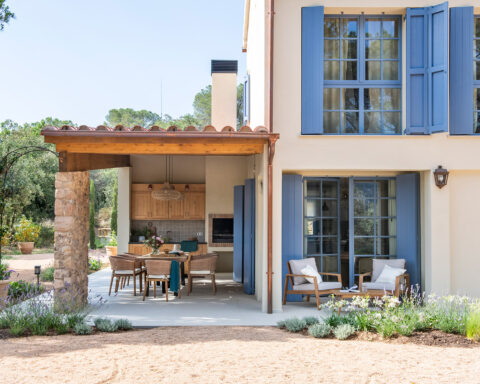
The landscape project does not merely accompany the architecture but acts as a true articulating element between the two buildings. Organised on different levels, the garden integrates the swimming pool, a semi-covered chill-out area and an outdoor dining space located on a higher level, from which cross views are established between the main house and the guest house.
The restoration of wooden paving, the introduction of new plant species and the optimisation of the irrigation system respond to a long-term vision in which maintenance and sustainability are essential components of the design. The outdoor spaces are conceived as natural extensions of the interior: places designed to be lived in, not merely contemplated.
As a whole, the project in Calonge reflects Tinda’s Project’s way of working, conceiving design as an integral process in which interior architecture and landscape are developed in close coordination, responding to the real lives of those who inhabit the spaces and to an ongoing dialogue with the place.


Project: Calonge. Girona.
Author: Tinda’s Project.
Interior design: Eva Mesa y Jaime Valdés.
Landscape design: Manuel Maíllo.
Photography: María Pujol.
Styling: Mar Gausachs.
Source: MASmedia. Marta Alonso.

Eva Mesa. Tinda’s Project
Desde muy pequeña, Eva Mesa tenía el don de transformar espacios: disfrutaba creando lugares que contaban historias y revelaban personalidades. Tras completar sus estudios en la UAB y el DIAC en Cataluña, se sumergió en el negocio familiar de fabricación de muebles, desde donde cultivó su pasión por el diseño funcional y sensible. Posteriormente, junto al interiorista Jaime Valdés y al paisajista Manuel Maíllo, fundó el estudio Tinda’s Project, con el objetivo de convertir sueños, pasiones e ideas en espacios únicos, distinguibles y llenos de carácter.
Eva Mesa lidera Tinda’s Project desde Barcelona, y su enfoque creativo se basa en una filosofía simple, pero profunda: diseñar espacios que enamoren desde el primer momento, que reflejen la esencia de quienes los habitan y que funcionen con sentido y belleza. Su pasión por el diseño personalizado —el savoir‑faire del diseño a medida— ha sido el sello distintivo del estudio. Para Eva, el interiorismo no es solo estética, sino una herramienta para mejorar la vida.
En los proyectos de Tinda’s Project, el uso de texturas no es un valor añadido: es la voz del espacio. Eva sostiene que las texturas —visuales o táctiles— son el alma del diseño interior, capaces de teñir una estancia de calidez y personalidad. Trabaja con revestimientos que aportan naturalidad, pavimentos que invitan al contacto, textiles que acarician y detalles decorativos que narran historias. Cada material selecciona con delicadeza para que el conjunto invite a ser vivido con plenitud.
Con más de 25 años en el mundo del interiorismo, Eva Mesa ha consolidado un estilo donde priman el buen oficio, la sensibilidad y la autenticidad. Su trabajo trasciende las modas para anclarse en la identidad de las personas y en la armonía de los espacios. Tinda’s Project no persigue el diseño espectacular: busca el diseño que acoge, que permanece, que inspira y hace sentir.
Tinda’s Project
Santa Teresa, 8
Barcelona
(+34) 937721934
info@tindas.es
tindas.es
Jorge Juan, 14 Bis
Madrid
Project by Eva Mesa. Tinda’s Project