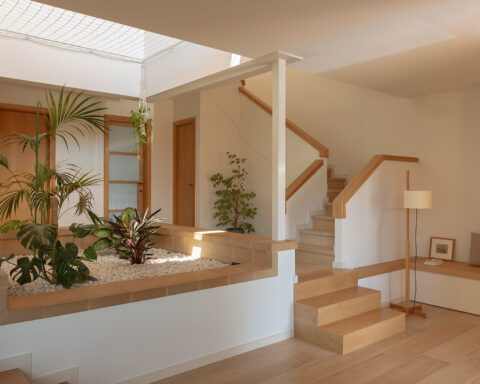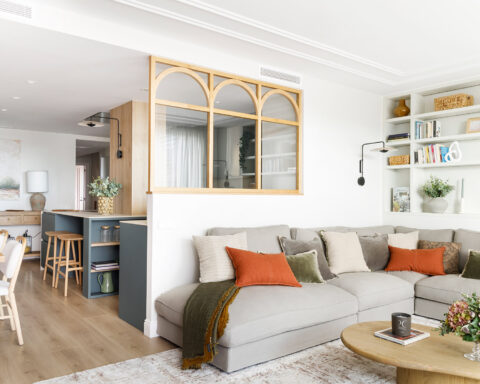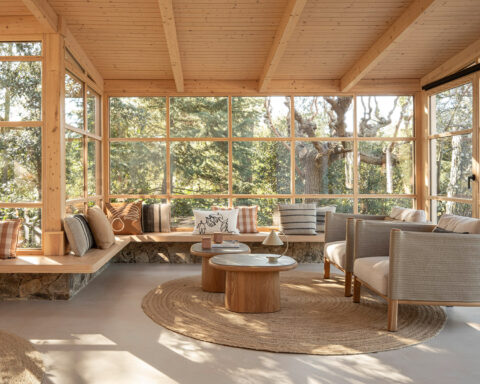


In Valencia’s Ensanche, early twentieth-century buildings carry in their structure the imprint of a way of life that no longer exists. Corridors that distribute, rooms that chain together, floor plans that function as domestic labyrinths. Casa Cirilo begins with one of those apartments: a 1920 flat that, after decades of successive interventions, had lost its hydraulic floor tiles and much of its original character, while retaining its fragmented layout, its interior rooms without natural light and an excessive compartmentalisation..
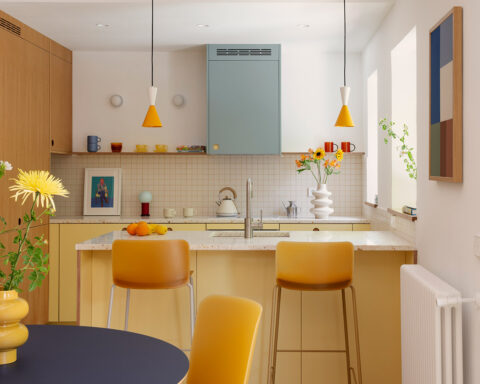
The owner —a cooking enthusiast and habitual host— wanted to turn this home into a place for gathering: to cook while some friends kept him company by the stove, others talked in the living room, with both spaces remaining connected. The kitchen was to be the heart of the home.
Architect Juan Montoliu has designed the apartment as a sequence. The floor plan is reorganised into three programmatic strips that place the kitchen at the centre —physical and symbolic— of the apartment, making it a zone of transition: it connects and separates the public from the private. Access to the bedrooms is concentrated at a single point, allowing the sleeping area to be closed off without breaking the spatial continuity of the whole.
Arches define the interior architecture
From this logic of transition emerges the architectural gesture that defines the project: a series of extruded arches generating barrel vaults in sequence. The forms organise the space —corridors disappear, traditional compartmentalisation dissolves— and accompany movement, guide circulation, envelop the user. Each vault takes on a distinct role within the sequence: the first, more contained, creates a recessed niche housing a study and library. The second runs the length of the kitchen, turning it into the true stage of domestic life. The third extends toward the sleeping area and concentrates access to the bedrooms.
The curves compress and expand the scale, alter the acoustics, intensify depth and multiply the entry of natural light. In the living and dining room, these vaults enter into dialogue with the original timber beam and ceramic block floor structure, left exposed: a balance between new geometry and the building’s constructive memory, between the precise and the inherited.


Restrained materiality with a reduced color palette
The materiality of the project follows the same logic of restraint and coherence. The palette is concise and carefully considered: natural oak parquet, clay render, lacquered finishes in sand tones. A neutral backdrop that amplifies the presence of Rojo Alicante marble, the protagonist of the kitchen worktop and the main bedroom. The small-format porcelain tile —6 × 6 cm— takes on a structural role in the composition: it becomes the unit of measurement that modulates the entire geometry of the home. Walls and ceilings are set out from the beginning to ensure that every plane starts and ends with whole tiles. On site, the tape measure and laser gave way to a hand-made rule composed of twenty tiles. Craftsmanship, here, is also method.
In the sleeping area, this same porcelain tile clads both the interior of the bathrooms and the exterior of the volumes that contain them —walls, doors, open wardrobes— creating a visual continuity that reinforces the identity of the project.
Casa Cirilo is the result of listening carefully to a way of living and translating it into architecture. A home where form and use are one. Where the kitchen occupies the centre because that is what its owner decided.
Materials and Furniture
Natural oak parquet flooring in dry areas. Small-format 6×6 porcelain tile for floors and wall cladding in wet areas. Clay render wall finish in dry areas. Bespoke furniture in lacquered MDF. Rojo Alicante marble kitchen worktop.
Floatation pendant lamp by Ingo Maurer. Taccia Small and Parentesi lamps by Flos. Tesi flexible steel wall-mounted strip light by Ideal Lux. Utrecht Armchair by Gerrit Thomas Rietveld for Cassina. Standard Chair by Vitra. Midst Table by Muuto. Vintage mid-century furniture from Heirloom Store. 8 Bar Stool by Marc Morro for Hay. Small-format porcelain tile by Grespania.

Project: Casa Cirilo.
Location: Valencia.
Area: 101 m².
Completed: 2025.
Interior design:: Montoliu Hernández.
Architect: Juan Montoliu Hernández.
Photography: Adrián Mora Maroto
.
Source: Linka News.

Juan Montoliu Hernández
Juan Montoliu Hernández studied architecture at the Universidad Politécnica de Madrid (ETSAM) and holds a Master’s in Environmental Design from the Architectural Association School of Architecture in London —one of the most influential architecture schools in the world— a training that has profoundly shaped his understanding of the relationship between space, environment and sustainability.
His professional career unfolds between Madrid and London. After his early years at Ruiz-Larrea & Asociados in Madrid, where he built his foundation in sustainable architecture and building rehabilitation, he moved to London to join Feilden Clegg Bradley Studios LLP, an internationally renowned firm known for its commitment to rigorous design and low-impact architecture. He later worked as Senior Architect at F3 Architects LLP, consolidating a career defined by technical excellence and uncompromising quality.
In 2018 he returned to Spain and founded his own practice in Valencia, Montoliu Hernández, where he serves as Architect Director. The studio is today a firm committed to timelessness, craftsmanship and respect for the built environment: an architecture that not only addresses the functional needs of those who inhabit it, but is capable of conveying the history, character and unique values of each place.
His work reflects a conviction: that good architecture is born from listening, precision and a deep respect for materials, heritage and people.
Montoliu Hernández
Cádiz 58
46004 Valencia
+34 637 450 707
jmontoliu@montoliuhernandez.com
montoliuhernandez.com
@montoliuhernandez
Project by Juan Montoliu Hernández