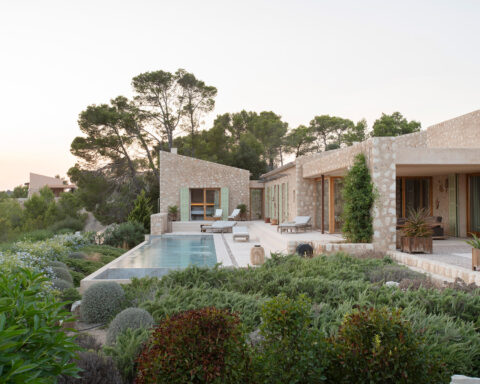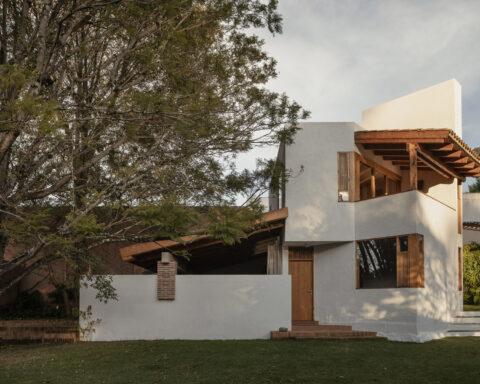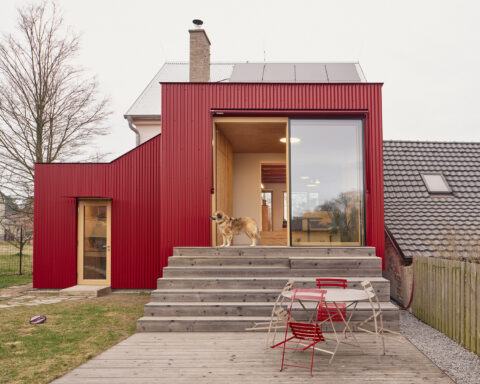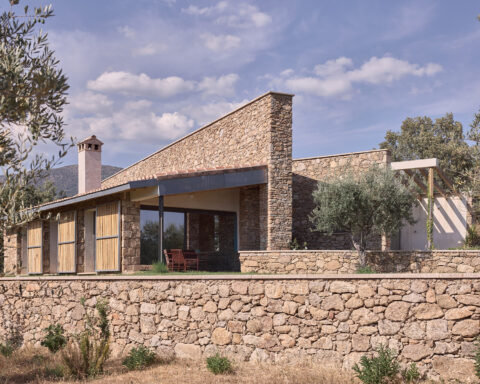

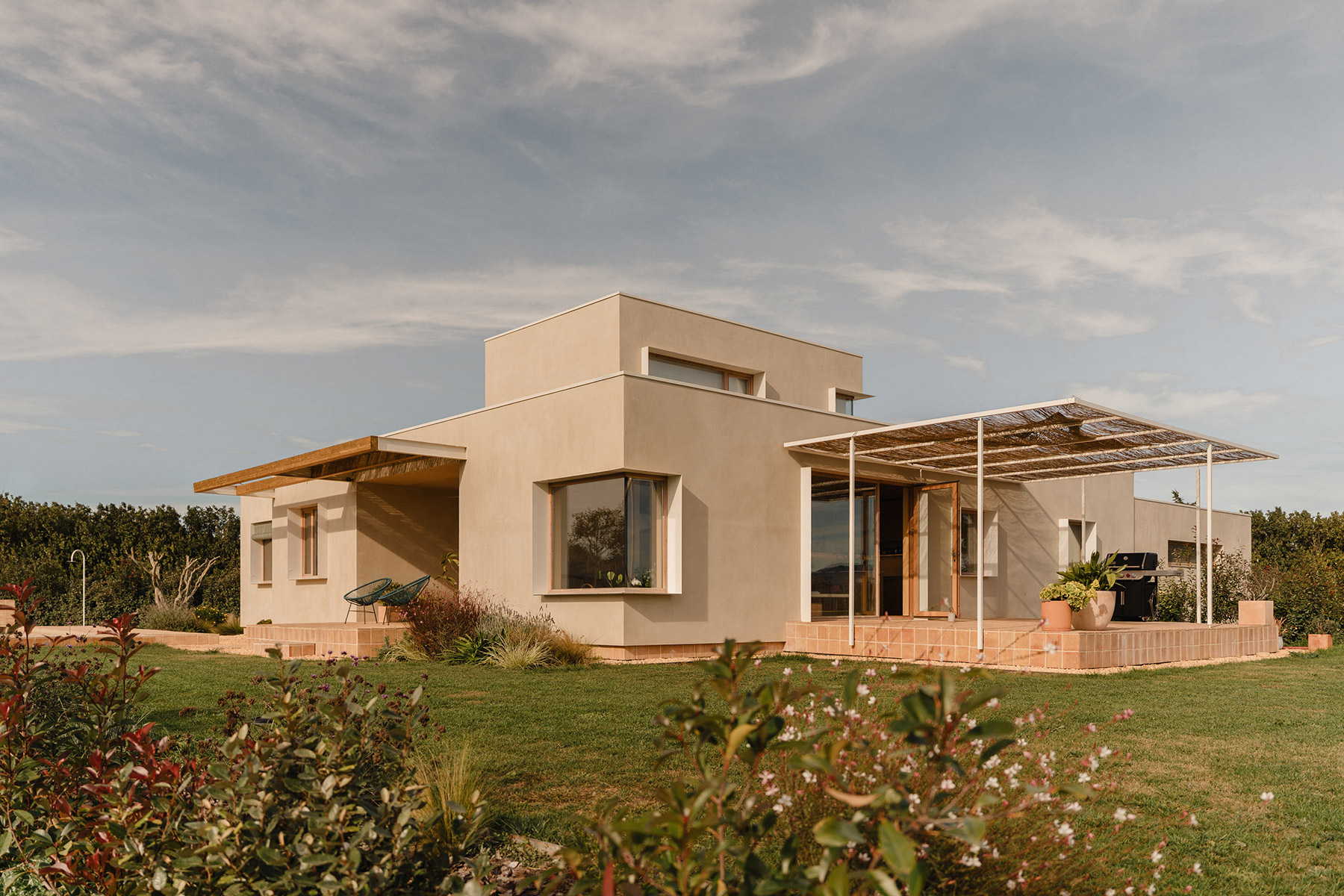
In Vilamacolum, a small village in the Alt Empordà surrounded by open fields and a beautiful agricultural landscape, architect Clara Crous designs her own home. Casa al Pradet emerges from a rare dual condition: it is both house and manifesto, domestic space and workplace. An architecture conceived from within, where life, professional practice, and territory are inseparably intertwined..
The triangular plot, located at the edge of the village, establishes the framework of the project from the outset. In direct contact with the rural landscape and set at a lower level than the urban core, the site demands specific decisions: raising the house 1.2 metres to protect it from runoff and fragmenting the volumes to shelter it from the tramontana wind. The house thus adapts to its physical and cultural conditions, engaging in dialogue with the discontinuous layout of traditional Catalan farmhouses and their annexes.
The origin of the project is closely linked to Clara’s family biography. Their relationship with the countryside and her husband’s technical knowledge of digital fabrication directly shaped the design of the house. Construction was even planned around the agricultural calendar, beginning after the maize harvest, when local labour could take part in the building process. This alignment is understood as a way of conceiving architecture as part of a broader productive ecosystem.


From this logic emerges a house designed to be built with precision and proximity. The structure is resolved through a lightweight timber frame prefabricated in the workshop, optimising time and resources. The system enables an agile construction process defined from the earliest stages. As the architect explains, “I was drawn to timber because it allows a high degree of control from the beginning… being able to control every last detail.”
This desire for early control also defines the spatial character of the house. The project unfolds as an aggregation of volumes of varying heights and proportions, evoking the incremental growth of traditional rural dwellings. It is a reinterpretation that translates this evolutionary logic into a contemporary language.
Materiality reinforces this continuity with the territory. The house is built using natural, locally sourced materials: lime mortar, cork, clay, terracotta, and hydraulic tiles coexist with the timber structure and integrated furniture. Inside, timber organises the space and creates a cohesive atmosphere in which structure, cladding, and furniture share the same material continuity. More than a finish, it becomes a spatial support that defines the domestic experience.
Some traditional elements are reinterpreted through contemporary solutions. Alicante shutters, for instance, are integrated into a home automation system that regulates their movement according to sun and wind, while a perimeter strip of ceramic gravel improves drainage. These are discreet decisions that shape the everyday life of the house.


The spatial experience is built on precision. Timber construction requires a high level of prior definition — something the architect embraces as a core part of the project. “It requires a lot of work at the beginning, but then the construction is like a Lego set: the pieces fit together and there is less improvisation,” she explains. This logic results in an architecture where continuity, light, and domestic scale are perceived as the outcome of decisions made long before construction began.
Casa al Pradet also marks a turning point in Clara Crous’s trajectory. Initially conceived as her own home, the house ultimately becomes a natural extension of the studio, a place from which to explain her way of designing. “Architecture is not meant to be seen in photographs — it has to be experienced,” the architect notes, using the house as a meeting space with clients and collaborators. The dwelling thus operates both as laboratory and synthesis, condensing an approach to building rooted in proximity, materiality, and lived experience.
Rather than standing as an isolated object, the house belongs to a broader continuity. Its placement, construction system, and materiality respond to a careful reading of the site, but also to a commitment to an architectural practice that champions natural materials and processes controlled from the outset. In the architect’s own words, the aim was that “everything that architecture means to me would be embodied in this house.”
The result is a dwelling defined less by formal gestures than by the density of its decisions. An architecture built from proximity — to place, to materials, and to everyday life — proposing a way of inhabiting where tradition and contemporaneity are closely interwoven.


Materials
Lime mortar render — façade. Lightweight timber frame — walls. Laminated fir beams and birch panels — ceilings. Polished concrete — ground floor. Custom hydraulic tiles — flooring. Handmade fired terracotta — exteriors and terraces. Pine wood — windows. Oven-painted iron frames — exterior window frames. Motorised Barcelona shutters — windows and terraces. Lime stucco — en-suite bathroom. Clay walls — grey bathroom. Handmade beige zellige — bathrooms. Three-layer fir wood — kitchen, wall panelling, bespoke furniture and shelving. Compac — kitchen countertops. Stainless steel — custom kitchen hood.
Products and brands
Hydraulic tile flooring: Mosaics Torra.
Switches: Jung.
Faucets: Icónico.
Chairs, stools and armchairs: Vergés Design.
Formentor armchair: Blasco&Vila.
Maca hammock: Calma Outdoor.
Small linden wood and alabaster lamp: Siete Formas.
Cesta, Disa, TMM lamps: Santa & Cole.
Kitchen bar lamp: IHI Studio.
Wooden bedside lamp in the suite: Alex Mestre.
Funiculí lamp: Marset.
EK61 lamp: Carl Hansen & Søn.


Project: Casa Al Pradet.
Location: Vilamacolum (Girona).
Built area: 235 m². Parcela: 1.054 m².
Completed: 2024.
Studio: Clara Crous Arquitectura.
Author: Clara Crous Fort.
Design team: Jordi Collell Puig, Amanda Soler Vela.
Client: Clara Crous Fort, Carles Torracabota Bosch.
Technical architect: Francesc Xavier Coromina i Corominas.
Photography: Montse Capdevila.
Contractor: Fustech.
Carpentry: Deco Fusta Pey.
Metalwork: Moragas Salvans.
Kitchen: Albert Aubach.
Technical installations: Jaume Ruiz.
Machined timber solutions: 7Vetes.
Polished concrete flooring: Grup Curanta.
Source: Linka. Lucía Zaballa.

Clara Crous
Clara Crous’s architecture emerges from direct contact with construction. Educated at the Universitat de Girona and with an academic period at the Sapienza Università di Roma, her trajectory has always developed in close proximity to building sites, materials, and territory. This dual formation —technical and experiential— has shaped an approach in which architectural thinking remains inseparable from execution.
Before establishing her independent practice in 2017, she worked in several studios linked to architecture and construction in Catalonia, participating in both rehabilitation projects and industrialised building processes. Particularly significant was her experience in a company dedicated to prefabricated timber housing, where she became familiar with lightweight construction systems, the precision of technical design, and the importance of detail in the early phases of a project. This early understanding of timber as both a structural and cultural system has remained a constant in her later work.
From her studio based in the Empordà, Clara Crous develops architectural and rehabilitation projects grounded in a rigorous attention to place and to the people who inhabit it. Her practice follows a line that reclaims natural materials —wood, lime, clay, organic insulation— integrating them into contemporary solutions that avoid both formalism and nostalgia. More than a language, her architecture proposes a way of building: measured, conscious, and deeply connected to process.
Rehabilitation has been one of the pillars of her trajectory, understood as an exercise in reading time and respecting pre-existing conditions. In parallel, her new-build projects explore how to transfer this same material ethic into contemporary contexts, with particular attention to timber construction and to systems that allow greater control of the project from its origin.
Her work is defined by a meticulous approach to detail, as the consequence of an architecture conceived through experience. Space, light, temperature, tactility, and the ageing of materials form part of a perspective that understands architecture as something lived rather than merely observed.
Today, her practice continues to evolve from that initial coherence: a grounded architecture, technically precise and committed to more sustainable ways of inhabiting, where innovation is pursued as the natural outcome of an honest relationship between matter, place, and everyday life.
The studio’s projects have been featured in a range of local and international media outlets, including AD, Diseño Interior, On Diseño, and La Vanguardia.
Clara Crous Arquitectura
Carrer Mar 20,
17474 Vilamacolum (Girona)
hola@claracrous.com
claracrous.com
@claracrousarq
Project by Clara Crous