

In a small village in the Alt Empordà, a former carpentry workshop has been changing its skin for decades without losing its own. La Fusteria is the name under which Clara Crous Fort presents the rehabilitation of this former workshop: a project that works from continuity, extending the building’s useful life and adapting it to a contemporary domestic programme without erasing the traces of what it once was.
The owners, long rooted in the village, wanted a house where they could host family members who live far away, especially during the winter months. The possibility of use as a holiday rental completes the programme. Two distinct functions, with shared objectives: comfort, spatial quality and attention to detail.
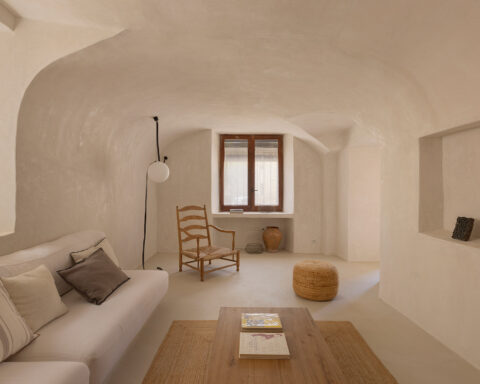
The most decisive gesture of the intervention is the reorganisation of the programme. Concentrating the daytime spaces on the ground floor allows the kitchen, dining room and living area to coexist beneath the Catalan vaults that have structured the building since its origin. These brick structures, which for decades sheltered workbenches and tools, now become the spatial engine of the house. Their geometry orders the circulation, calibrates the scale and keeps the memory of the workshop alive. The upper floors are given over to the bedrooms and private areas, distinguishing between the shared and the private.


Restoration rather than addition
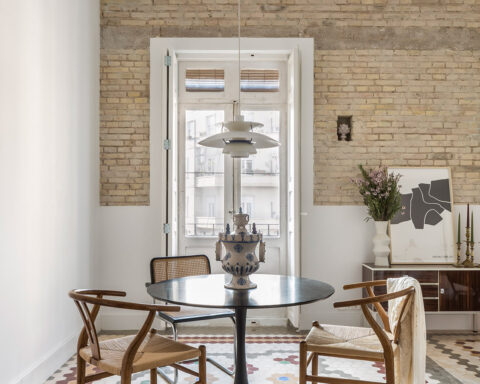
The materiality of the project is built from restoration rather than addition. The finishes added in previous interventions were removed, allowing the original walls of stone masonry and solid brick to speak. Lime mortars and stuccos allow the surfaces to breathe and return texture and light to the interiors. The recovered handmade toba paving on the ground floor and the ceramic pieces on the upper floors complete a palette that speaks directly to the constructive tradition of the place. In the bathrooms, handcrafted red ceramic and natural marble basins form compositions of remarkable material density.
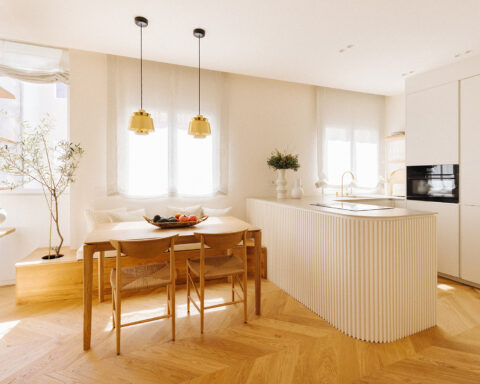
The three-layer spruce wood, used in the interior joinery and the kitchen, introduces a warmth that balances the weight of the stone. The kitchen, organised around a natural marble island, becomes the focal point of the daytime space, generating a natural gathering place beneath the springing of the vaults.
The lighting follows the same criterion of material precision. Pieces by Santa Cole, Islas, Nemo, Siete Formas and Mayice are distributed across the different spaces with the logic of the well-chosen object: each light fitting has a defined scale, position and function.


The front courtyard
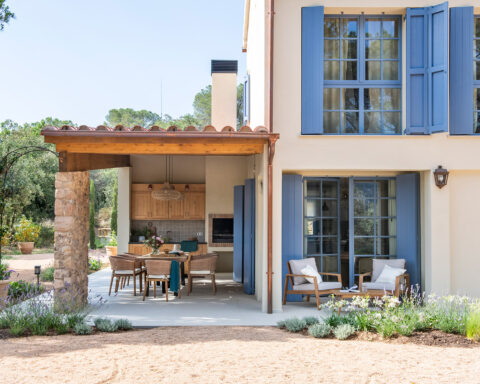
Outside, the front courtyard recovers its role as threshold between the street and the house, with a pool clad in handcrafted stoneware and a dense planting of Mediterranean species that turns the enclosure into an intimate, sheltered garden.


The upper terrace
The upper terrace, accessible from the first floor, opens the house to the agricultural landscape of the Empordà with a generosity that contrasts with the containment of the lower floors.
The renewal of this building develops an architecture understood as a practice of care. Crous works on the existing with an attitude that seeks continuity as its outcome. The workshop is still there, recognisable in its arches and walls, while the house settles into it bringing contemporary comfort. An architecture that preserves the memory of the building for the enjoyment of its new inhabitants.


Materials
Lime render on façade. Stone masonry and solid brick. Microcement on ground floor. Fired terracotta on first and second floors. Lime stucco on wall surfaces. Exposed stone on bed headboards. Pigmented limewash in dining room. Lacquered pine exterior joinery. Three-layer spruce wood for doors and kitchen. Natural marble worktops. Handcrafted red ceramic in bathrooms.
Furniture. Lighting
Teula Raig and Mig Con by Islas. Marseille by Le Corbusier by Nemo. Luna by Siete Formas. Hi by Mayice. Aurum by Ferm Living. Cestita by Santa Cole.


Project: La Fusteria.
Location: Vilamacolum, Alt Empordà.
Built area: 232 m². Plot: 116 m².
Completion: 2025.
Interior architecture: Clara Crous.
Design team: Jordi Collell Puig, Amanda Soler Vela.
Photography: Montse Capdevila.
Contractor: Manolo Martínez.
Carpentry: Deco Fusta Pey.
Metalwork: Moragas Salvans.
Kitchen: 7Vetes.
Microcement: Ingremic.
Source: Linka News. Lucia Zabala.

Clara Crous
Clara Crous’s architecture emerges from direct contact with construction. Educated at the Universitat de Girona and with an academic period at the Sapienza Università di Roma, her trajectory has always developed in close proximity to building sites, materials, and territory. This dual formation —technical and experiential— has shaped an approach in which architectural thinking remains inseparable from execution. See full biography.
Clara Crous
Carrer Mar 20,
17474 Vilamacolum (Girona)
hola@claracrous.com
claracrous.com
@claracrousarq
Project by Clara Crous