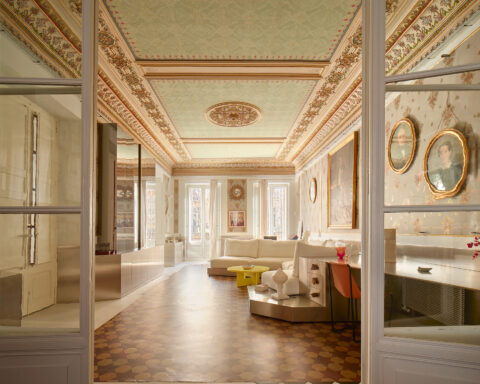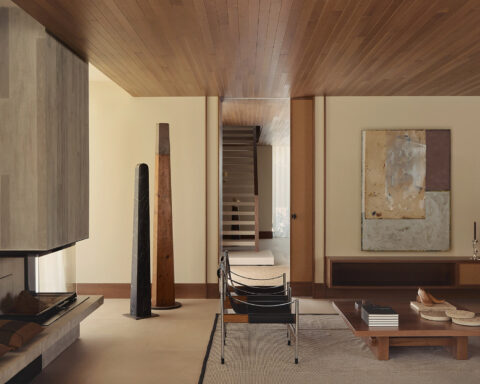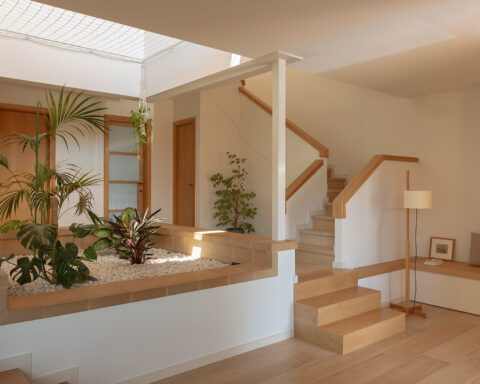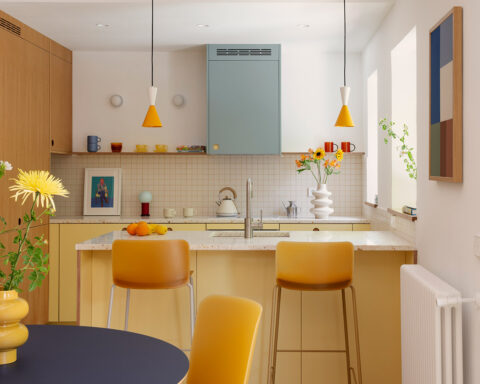


Amid the fields near the Serranía de Ronda, close to Gaucín—one of Málaga’s most beautiful white villages—and surrounded by lush vegetation, a ruined farmhouse has been reborn as a boutique hotel that seems to float between the memories of Andalusian tradition and the vitality of contemporary design. Its name, Cortijo Génesis, could not be more fitting: it symbolizes the beginning of a new life, a return to essence, viewed through the free and sophisticated lens of interior designer Victoria-Maria Geyer.
The project unfolds across six hundred square meters of intimate architecture, with capacity for twelve guests. Five bedrooms, a charming courtyard with a colorful tiled fountain, a pool reflecting the mountain sky, and an expansive garden designed according to permaculture principles compose this retreat where nature and design coexist in harmony.


Geyer has imbued the place with the vibrant energy of her personal style: a joyful, refined chromatic eclecticism that draws from the bold Palm Springs aesthetic, adding a distinctive mid-century Californian twist. In the courtyard, surrounded by beautiful arches typical in Andalusian farmhouses, iron loungers with orange cushions trimmed in white invite relaxation, while blue-and-white striped umbrellas evoke the nearness of the sea. Every corner of the courtyard—with its multicolored ceramic tables—breathes a festive and romantic air, as though the hacienda were opening its arms in a generous embrace.
Inside, each bedroom is inspired by a semiprecious stone: green aventurine, yellow citrine, blue lapis lazuli, red carnelian, or pink morganite. The walls, in neutral tones, serve as canvases where fabrics, objects, and light trace delicate vibrations of color. Handcrafted pieces and unique works, such as the woven raffia heads by Natalia Brilli or the modernist tapestries by Marc Baumann, coexist with lamps by Heaps & Woods, rugs by Elitis and Edelgrund, and blinds by Pierre Frey, composing a collection of interiors that is both personal and cosmopolitan.


The common areas become the soul of the hotel. In the living room, the Wenceslas sofas by Heimat—Victoria-Maria’s own collection—dialogue with orange-and-white striped fabrics by Manuel Canovas, set before a 1960s Roger Capron table, while above the fireplace, Gordon Hopkins’ canvas The Lemon Bowl introduces a fresh, luminous artistic note. In the reading room, a rainbow-painted slatted ceiling unfolds with jubilant rhythm, accompanied by a Popus Edition sofa and Maison Thevenon textiles that add an ethnic, chic flair. In the kitchen, saffron-colored tiles radiate light across the space.
Every object has been chosen with the care of a collector: here, as a gentle invitation to contemplation, is the Waldemar Rothe hammock from 1974, sourced from Morentz Gallery, a singular piece that speaks to the designer’s passion for unique finds with history.
Cortijo Génesis is, ultimately, an intimate yet exuberant refuge where design becomes a form of hospitality. Victoria-Maria Geyer ensures that every room is a universe of color and emotion, a place where beauty welcomes and celebrates life.


Project: Cortijo Génesis.
Location: Near Gaucín (Málaga).
Interior design: Victoria-Maria Geyer.
Completed: 2025.
Photography: Matthieu Salvaing.
Notable works and pieces: Woven raffia heads by Natalia Brilli. Modernist tapestries by Marc Baumann. Cronos and Manon lamps by Heaps & Woods. Rugs by Elitis and Edelgrund. Fabric blinds by Pierre Frey. Living room: Heimat sofas, Victoria-Maria Geyer collection, Manuel Canovas fabrics. 1960s Roger Capron table, The Lemon Bowl canvas by Gordon Hopkins. Waldemar Rothe hammock from 1974, Rosenthal/Morentz Gallery. Reading room: Popus Edition sofa with Maison Thevenon textiles.

Victoria-Maria Geyer
Born in Germany and based in Brussels for more than a decade, Victoria-Maria Geyer has become one of the most distinctive voices in European interior design. Her work, defined by a refined eclecticism, reveals the ability to transform spaces into lived-in narratives, where the personal story of each inhabitant enters into dialogue with a present that feels both vibrant and timeless.
Trained within the rigor of German tradition and enriched by a cosmopolitan sensibility, Geyer has learned to unite the sobriety of clean lines with the delicacy of detail. In her projects, color acquires a precise role—never strident, always in harmony with noble materials and a carefully curated selection of furniture, artworks, and vintage pieces. The result is interiors full of character, alive with personality, that transcend trends to become an intimate reflection of those who inhabit them.
From her Brussels-based studio, she has developed residential and hospitality projects in Belgium, France, and Spain, consolidating a language of her own that draws equally from classical elegance and contemporary spontaneity. Each interior she creates is a balance of freshness and sophistication, of domestic warmth and the expressive force of art.
Today, the name Victoria-Maria Geyer is synonymous with soulful interior design, capable of stirring emotions and sparking wonder. In every space she conceives lies the conviction that beauty is also a form of hospitality: a way of welcoming, of caring, and of celebrating life.
Source: APR. Alexandra Public Relations.
Victoria-Maria Geyer
Rue François Stroobant, 6
1050 Brussels. Bégica
info@victoria-maria.com
victoria-maria.com
Project by Victoria-Maria Geyer