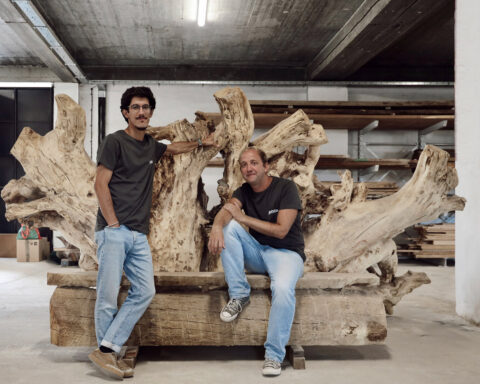


In his workshop in Burgohondo (Ávila), Julio and his team prepare the lime that is later used on facades and walls all over the peninsula. Julio’s first contact with this material was in his youth, when, in order to earn a living, he painted or whitewashed walls with lime paint.
Later, in Barcelona, he met the master painter and stucco artist Joan Campreciós, who, descended from a long line of master stucco artists, taught him much of the possibilities offered by lime as a building material. He also taught him how to use lime in the execution of sgraffito, a technique in which Julio specialised over the years until he became one of the most renowned masters of the craft in Spain.
Thanks to the itinerant nature of his company, Julio has been able to travel throughout Spain for the last thirty years. These trips have given him the opportunity to familiarise himself with the different techniques that are characteristic of lime work in each region of the country, techniques that he has ended up integrating into many of his works.
“We are itinerant and we adapt to the peculiarities of each part of the Spanish geography, with its specific constructive arts. We like to do things that look like they have been there all our lives. A facade looks good when it blends in with the environment. I love lime. This is my life’s work. Life is about finding your space, your place. I am happy with what I do. Because it’s not what we do, it’s what we are“, says Julio Barbero.


In this way he has incorporated elements from the sgraffito of Segovia, known for its geometric and arabesque motifs; he has sometimes adopted the simplicity of the Madrid-style plains; he has explored the complexity of the Catalan sgraffito, with its wide range of motifs, ranging from human and animal figures to scenes from everyday life; and he has experimented with the trompe l’oeil style of Toledo, which are plasters in which facades of brick or other materials are recreated, in the manner of trompe l’oeil.
Julio and his team’s work process begins with the slaking of quicklime, produced from some of the best quarries in Spain and Portugal. The continuous hydration of the calcium oxide in his company’s tanks allows them to always work with high quality traditional fat lime mortars, those that have spent at least three years in storage.
Throughout his extensive professional career, Julio has carried out many projects throughout Spain, including the exterior plastering of the Palacio de Trénor, in Asturias; the work on the elevated section of the Segovia Aqueduct; the restoration of the Castillo de Turégano, also in Segovia; the stone grouting work carried out on the Puerta de Alcalá in Madrid; or the numerous sgraffito and other lime finishes on countless façades of residential buildings, both historic and new, in the cities of Ávila, Segovia and Madrid.