
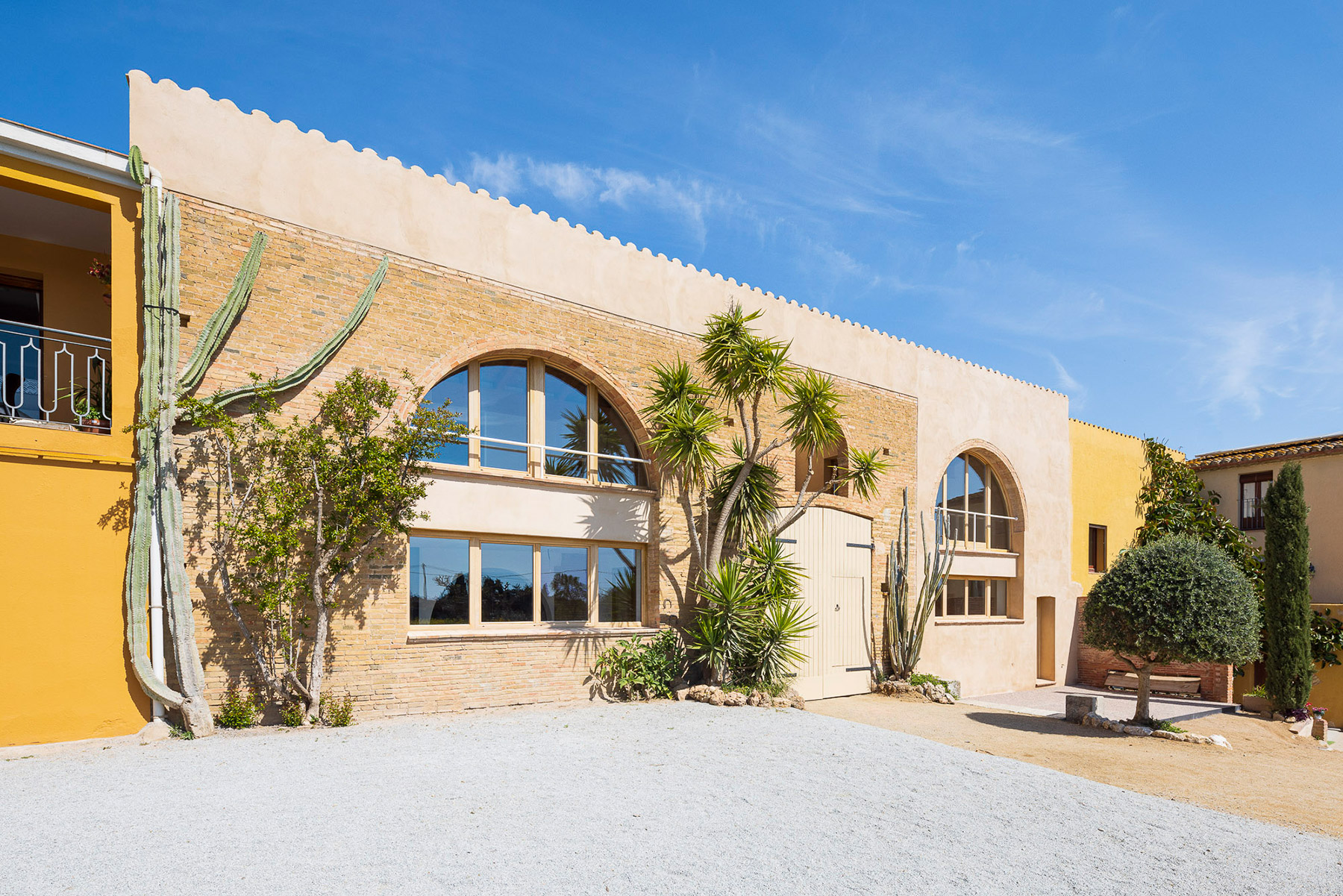
In the southeast of Peralada, a small town in the Alt Empordà known for its medieval castle and its vineyards, lies a property that has been devoted for generations to sheep farming and rural tourism. Among its buildings — a farmhouse from the nineteen-twenties and a family home from the seventies — stood a barn built in 1930, party-walled on both sides, with barely two facades and an interior structure of almost radical honesty: two brick arches and two brick pillars carrying the timber beams, the intermediate floor and the single-pitch roof. That stable, which for decades housed sheep and stored hay, is today a 150-square-metre home designed by architects Paola Bagna and Jonas Labbé..
The brief was to transform the building without betraying its character. The client was looking for something that might be described as a rural loft: a luminous, generously laid-out space from which its inhabitants could connect with the surroundings and take in the long views across the Empordà plain.
The architects’ response was to take the original materials and constructive elements as the starting point and guide for the project. The south facade, with its two large semicircular openings in handmade brick — originally designed to let in light from the south and dry the straw stored on the upper floors — and the robust north facade of stone, fifty centimetres thick, thus became the founding elements of the intervention.


The interior courtyard, heart of the home
The most significant move in the project is the creation of a courtyard inside the building, on the other side of the original wooden entrance door. This void — which symbolically recovers the space once occupied by agricultural machinery — solves the problem of light and ventilation in a ground floor with almost no openings, while at the same time organising the entire layout of the home: to its left, the living room, kitchen and dining area; to its right, a multipurpose workspace. The folding glass doors of both spaces can be opened fully onto the courtyard, dissolving the boundary between inside and outside and turning the ground floor into a fluid sequence of connected rooms. At the centre, the staircase occupies a double-height space that shares the role of structural and luminous heart of the house with the courtyard itself.
Stone takes centre stage indoors
The north stone wall, fully preserved and thermally insulated from the outside, transitions from being the skin of the building to becoming the matter of its interiors. To allow its presence to unfold across its full width and height, the first-floor slab does not cover the entire building, letting the kitchen and dining area rise up to the roof in a double-height space that establishes visual connections between both levels, keeping in full view that irregular, living, history-laden stone wall.
In this area, the brick party wall that reveals the prestressed concrete beams is also preserved, making legible the different eras and constructive layers that coexist within the building. The original materials — stone, brick, timber — contribute texture and historical density; the new ones — ceramic floor tiles, oak joinery, white lacquered metal, plaster, earth render and poplar wood in the kitchen — respond with smoother surfaces, pastel tones and a contemporary quality that does not compete with the existing fabric but frames it and brings it to life. Even the original roof timber beam finds a new purpose, reused as a bench in the entrance space.


The semicircular arches define the geometry of the home
The semicircular arch, present from the outset in the south facade and in the two interior structural arches, becomes the leitmotif of the entire intervention. Once the intermediate floor slab was introduced, the large facade arches were hidden from the ground floor, visible only from the upper bedrooms and from outside. The architects therefore reintroduced that language into the interior: new semicircular arches separate the kitchen and dining area from the living room, and a quarter-circle element marks the transition between the staircase and the kitchen zone, incorporating a new structural pillar at the same time. Both gestures — the arch and the curve — are presented as sculptural objects within the home, pieces that condense the formal memory of the building and project it into its new spaces.
The result is a house that finds its own rhythm between the intimate scale of the more sheltered rooms, characteristic of Catalan rural architecture, and the expansive generosity of the courtyard and the double-height spaces: a play of materials, geometries, light and time that makes it possible to inhabit the past in full present-day comfort.


Project: Can Gori.
Location: Peralada, Alt Empordà, Girona.
Conversion of a barn into a family home.
Area: 150 m².
Completion: 2023.
Architects: Paola Bagna & Jonas Labbé.
Technical architect: Imma Ferrer.
Structure: Codi Estudi.
Building services: Enclos.
Carpenter: Sayo.
Builder: Construccions Godó.
Photography: Arnau Rovira Vidal.
Source: Paola Bagna.

Paola Bagna
Born in Empuriabrava, on the coastline of the Alt Empordà, Paola Bagna trained as an architect at two schools that define her understanding of the discipline: the Escola Tècnica Superior d’Arquitectura de Barcelona and the Technische Universität Berlin. A dual education that foreshadows what would become a career shaped by movement, cultural exchange and the ability to adapt to very different built environments.
With more than fifteen years of professional practice, Bagna has developed private residential projects and commercial spaces in London, Barcelona, Paris, Berlin and Abidjan. A scattered geography that gives shape to her working model, which she herself describes as “everyday nomadism”: rather than a fixed office, a network of collaborators and shared workspaces in Catalonia and Berlin from which she directs each project with the same attention and commitment as if she were in a single place. It is within this framework that Paola Bagna Architect operates — her international studio, a light and efficient structure designed to respond nimbly to commissions across different countries and contexts.
The studio’s work always begins with one essential premise: listening. Before any formal effort, Bagna takes time to understand what the client wants and to carefully measure the space she is about to work with. From that precise knowledge of the place, she develops initial sketches, works in three dimensions and maintains a continuous dialogue with the client until every detail has been refined. This methodology proves especially meaningful in small-scale projects, where, as she points out, “proposals depend greatly on the centimetres more or less available”.
The typology that fascinates her most is housing, and within it, the transformation of what already exists. Her architecture is rooted in respect for and reinterpretation of the built fabric, adapting it to new uses and new ways of living. In this process, materials play a central role: for Bagna, they must converse with one another naturally and with a certain nobility, and above all, they must age well — gaining presence over time and acquiring a beautiful patina through use. This sensitivity towards matter has led her to explore reuse as a practice, salvaging pieces and elements from one project to incorporate into another, as happened with the early twentieth-century parquet rescued from a project in Paris that eventually became the furniture designed for Galatea Wine, a wine bar in Berlin.
A singular chapter of her career unfolded between 2015 and 2017, when Bagna moved to Abidjan to lead the rehabilitation of a two-thousand-square-metre house built in the nineteen-sixties — designed by architect Henri Chomette — with the aim of transforming it into an eighteen-room boutique hotel. That experience in Côte d’Ivoire, intense and entirely without routine, broadened her ability to work within complex construction environments and consolidated an outlook open to experimentation and cultural exchange — a dimension she also explored through Electropique, a project she organised there combining music and architecture as a form of community encounter. Today, based between Empuriabrava and Berlin, and fluent in five languages, Paola Bagna continues to pursue the same goal in every project: spaces that improve the lives of those who inhabit them, built with simplicity, functionality and an attention to detail that is never taken for granted.
Paola Bagna
Berlín (+49) 176 29554551
Empuriabrava (+34) 616 838 420
info@paolabagna.com
paolabagna.com
@paola_bagna
Project by Paola Bagna