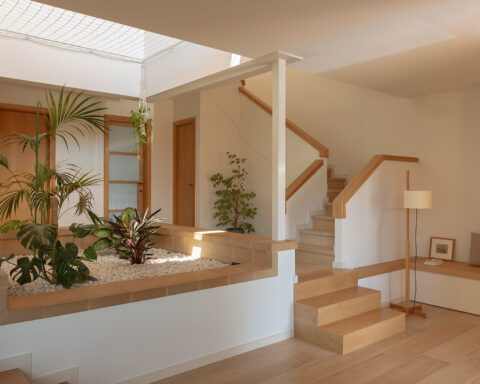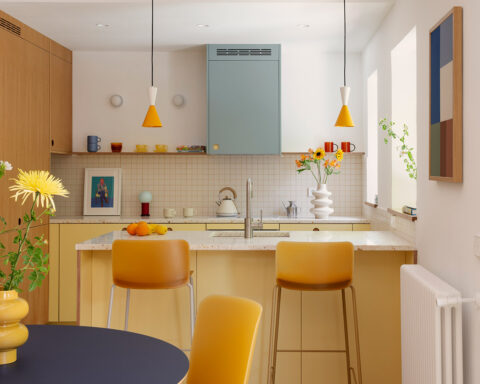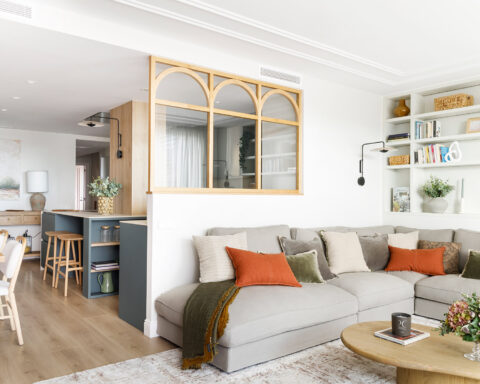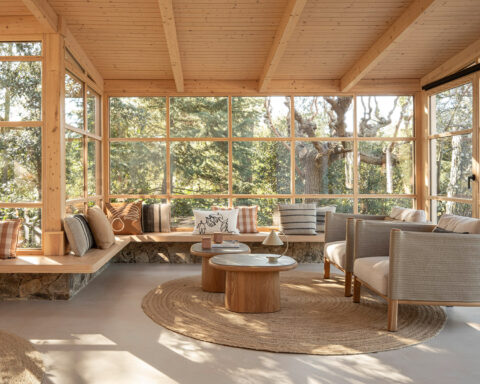


In northern Catalonia, between the sea and the mountains, El Gironès unfolds a landscape of contrasts where rivers, Mediterranean hills and small rural settlements coexist with the historic presence of Girona. A territory shaped by the calm of its paths, its agricultural memory and a deep relationship with the landscape, where traditional architecture remains part of everyday life. Here stands the 18th-century farmhouse at the centre of this restoration, now inhabited again through a renewed sensibility. Listed within the Architectural Heritage of Catalonia, the house is part of a 21-hectare estate long tied to vineyards and olive groves, until the frosts of 1956 altered its history forever. After years of abandonment, the new owners acquired the property in 2022 with the intention of turning it into their permanent home.
The project was entrusted to the bioarchitecture and geobiology team led by Silvia Mallafré, whose practice places the health of the habitat at the core of its work. The intervention began with an honest reading of the existing house, assessing both its material condition and the transformations accumulated over time. Before making any decisions, a geobiological study was carried out to detect possible natural or artificial anomalies that might affect rest and wellbeing. This initial analysis defined the overall approach to the rehabilitation.


The main façade, facing south, was kept almost intact. Original enclosures and the arched stone portal were restored, while an inner wooden layer was introduced as a thermal and visual transition space. This discreet gesture preserves the identity of the house while improving its environmental performance.
The entrance already introduces a sequence where memory and renewal coexist. The terracotta floor and Catalan vault ceiling are preserved, while lime mortar walls unify the ensemble. The original staircase remains in place, accompanied by small contemporary gestures: a north-facing powder room framing exterior ivy, an internal window opened as a subtle device to bring nature indoors, and a mural painting extending that vegetal presence further inside.
On the ground floor, the intervention focuses on restoring lost spatial continuity. Reopening former blocked arches brings fluidity back to the common areas, while small operations refine the relationship between body and architecture. In the reading room, for instance, the floor is slightly lowered to avoid meeting an existing beam; the new level creates a more intimate setting by the fireplace, designed for everyday rest. A new lateral entrance connects the house with the pool, expanding the ways of inhabiting the ensemble.
In the kitchen — the heart of the farmhouse — essential elements such as the floor, ceiling and the structure of the former oven are preserved and reinterpreted. The oven now incorporates the extractor hood, cabinetry is crafted in stained oak, and a light metal structure with integrated lighting defines the central island. The restoration of a marble sink and a century-old table introduces an emotional dimension that transcends materiality. Enlarged window openings allow light to descend to the new sills, now conceived as benches, reinforcing the domestic character of the space.


The staircase leads to the main floor, where the intervention becomes more intense. Once compartmentalised, the space is reorganised around a large central room defined by four recovered arches. The restoration of beams and original elements coexists with contemporary decisions, such as replacing the flooring with new oak after confirming the irreversible deterioration of the previous one. Arches near the staircase are transformed into bookshelves, while those facing the façade organise access to the bedrooms.
The main bedroom is conceived as a continuous space where rest and care intertwine. The former fireplace is reinterpreted to house a freestanding bathtub, separated from the sleeping area by a clay wall that defines the dressing space. The bed’s position responds to geobiological criteria, seeking the most suitable orientation for rest and opening visually towards the forest. The bathing area, designed bespoke, unfolds through natural materials and a fluid sequence of spaces connected by transparencies.
The second bedroom proposes a more playful and flexible duality, with differentiated areas that balance intimacy and everyday use. The application of graphite paint on the floor introduces an invisible protective layer against potential electrical or magnetic fields, revealing the level of attention that defines the project.
Ceilings are insulated from the interior and finished with textile panels integrating lighting, completing a warm and silent atmosphere. Every decision — from lime mortars to natural materials and integrated craftsmanship — responds to a logic that prioritises environmental health without renouncing the memory of the place.
The restoration of this farmhouse in El Gironès seeks to activate a contemporary way of inhabiting rural heritage. Silvia Mallafré’s intervention stands within that delicate balance between conservation and transformation, where the project becomes a space of care. A house that is not only recovered, but once again breathes as an everyday refuge.


Project: Masía El Gironés.
Location: El Gironés (Girona).
Completed: 2024.
Geobiology, design and bioarchitecture: Silvia Mallafré, bioarchitecture and geobiology.
Collaborators: Construccions Reive, Coinpro instal·lacions, Delacrem, Gramomar, Xemeneies i Metàl·liques Santa Cristina, Miralls i vidres Solar.
Craftsmanship, furniture and materials: Nuria Gigh, Marta Penina, Mercantic, Atemporal, Porcelanosa Grupo, Mas Valls.
Photography: Maria Pujol.
Source: Silvia Mallafré.

Silvia Mallafré
Silvia Mallafré develops her practice at the intersection of interior architecture, environmental health, and a sensitivity to natural processes. An interior designer, bioarchitect, and geobiologist, her trajectory has been shaped by a constant inquiry: understanding how spaces influence the physical and emotional wellbeing of those who inhabit them.
Trained in interior design at Elisava, she expanded her education through international experiences at the Winchester School of Art (University of Southampton) and the UIAH in Helsinki. Years later, she added a specialization in bioarchitecture at Universitat Pompeu Fabra, where she deepened her research into the relationship between construction, habitat biology, and applied sustainability. This shift marked a turning point in her understanding of the project—not only as an aesthetic or functional matter, but as a living environment capable of directly affecting health.
Her early professional years unfolded within architecture and interior design studios, working on residential, commercial, and refurbishment projects. This stage provided a solid technical foundation and a direct understanding of the building process. Over time, her practice evolved toward a more personal approach, integrating tools from geobiology and bioconstruction into interior design.
Since 2011, she has worked independently, focusing on the creation of healthy spaces for homes and workplaces. Her work combines design with the analysis of the invisible layers of the built environment—natural radiation, air quality, materials, orientation, and electromagnetic fields—proposing solutions that balance technical knowledge and sensitivity. In parallel, she has promoted initiatives related to housing and rehabilitation in Barcelona, exploring more conscious and human-centered ways of inhabiting.
Silvia Mallafré’s practice is defined by a calm and attentive approach, where each project begins with listening. Her work is built through accompaniment, addressing both the physical conditions of space and the personal stories that run through it. At the intersection of science, intuition, and everyday experience lies the core of her research. Her trajectory outlines a singular position within contemporary interior design: a perspective that understands design as a form of care.
Silvia Mallafré
Plaça Mil·lenari nº2
08160 Montmeló (Barcelona)
+34 930 319 510
info@silviamallafre.com
silviamallafre.com
@silviamallafre
Project by Silvia Mallafré