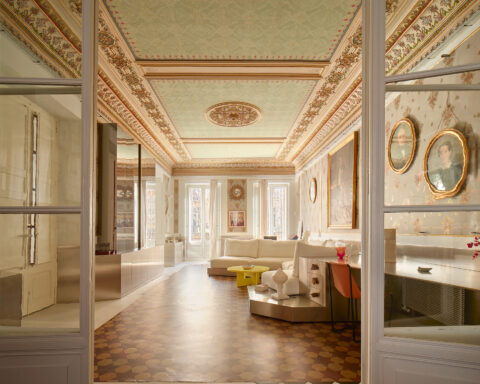


This residential neighbourhood, which remained an independent town until 1877, lies in the southeastern part of L’Eixample and still preserves the essence of a small village, with a strong appeal rooted in its relaxed lifestyle and multicultural atmosphere. Filled with small art galleries, vintage shops, cafés, bars, and retro restaurants, it has become the epicentre of fashion, art, design, and gastronomy in Valencia. A neighbourhood to be experienced through its architecture, with modernist buildings that speak of other times, where homes built in the early 20th century abound, characterised by high ceilings, generous openings, and colourful tiled floors.
Within this context stands Casa Ángel, a renovated residence by architect Adrián Pérez Cócera, conceived as an intervention that engages with the layers of time and the intensity of the surrounding urban life. The architect’s aim was not merely to update spaces, but to interpret an architectural legacy deeply rooted in the identity of this Valencian neighbourhood, starting from a careful reading of the original building and with a clear intention to allow memory and contemporary use to coexist.


Mosaic floors, mouldings, wooden carpentry, and generous ceiling heights are not understood here as nostalgic remnants to be preserved, but as active material within the project. They become the point of departure from which the entire intervention unfolds. The architecture is built upon what already exists, enhancing its presence and using it as a guiding thread to organise spaces and define new possibilities of use.
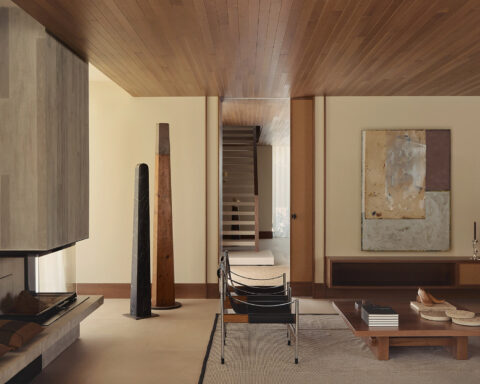
The recovery of the original flooring, ceilings, and doors responds not only to a heritage-based criterion, but to a spatial and sensory logic. These elements naturally connect the rooms, provide continuity, and reinforce the home’s identity. Upon this foundation, contemporary additions are introduced with restraint: clean lines, integrated built-in solutions, and a minimal presence that avoids any unnecessary gesture.
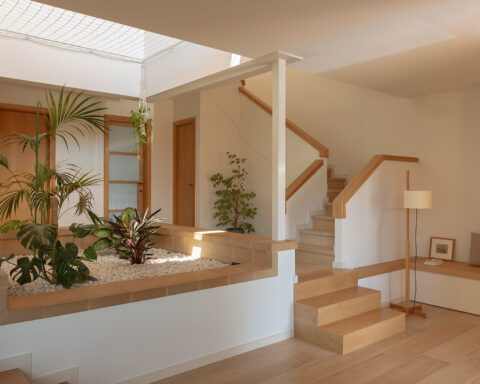
Light plays a structural role in the project. The restored original windows allow natural light to flow throughout the home, generating a constant perception of spaciousness. Where exterior light does not reach with the same intensity, the patio acts as a complementary resource, ensuring brightness in the inner areas. This strategy is reinforced by carefully designed indirect lighting, integrated into cornices and mouldings, which accompanies the spaces without excessive prominence, delicately highlighting textures and volumes.


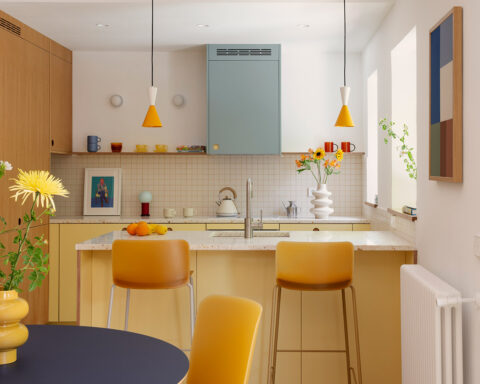
The chromatic palette reinforces this restrained approach. Neutral tones and recovered materials coexist to create a serene atmosphere, where each element finds its place. Built-in shelving and benches are conceived as extensions of the architecture itself, integrated into the walls and designed to optimise space without fragmenting it visually.
One of the project’s most significant gestures appears in the bathroom, where a built-in bathtub, executed in the same material as the floor, establishes continuity between surfaces. This decision dissolves functional boundaries and transforms the bathroom into a natural extension of the rest of the home—a space conceived from calm and everyday use, where form and function are carefully balanced.
In this project, lighting, materials, and construction decisions do not operate as superimposed layers, but as a coherent system. Light becomes another architectural element, capable of articulating the relationship between the new and the existing, and of reinforcing a unified spatial experience.
The result is a home that preserves its historical character intact while responding to contemporary needs. It is a project that understands renovation as an exercise in listening, where architecture seeks permanence rather than immediate protagonism. Within this balance between respect and contemporaneity, one recognises the gaze of a young architect who designs through reflection and gradually builds a voice of his own.


Project: Casa Ángel.
Location: Barrio de Ruzafa (Valencia).
Surface area: 100 m2.
Completed: 2024.
Architecture: Adrián Pérez Cócera arquitectura y diseño.
Engineering: Adypau Ingenieros.
Lighting design: Ángel Lloret Melis.
Construction: Revirt Construcciones.
Photography: Alejandro Gómez Vives.
Source: Adrián Pérez Cócera.

Adrián Pérez Cócera
Adrián Pérez Cócera belongs to a generation of architects who have begun their practice from reflection rather than from the urgency to build. Trained at the Universitat Politècnica de València, where he completed his degree in Architecture and later a Master’s in Architecture, his professional path began through collaborations with various studios in Valencia—a period of quiet learning that would shape his understanding of the profession. In 2020, he founded his own studio, embracing from the outset a measured, conscious, and deliberately selective practice.
His work begins with an attentive gaze toward the everyday, the lived space, and the sensory dimension of architecture. He understands the project as a process, as a sequence of decisions that seek balance between material, light, proportion, and use, deliberately avoiding superfluous gestures. In his interventions, spaces are shaped through listening, through a dialogue with the urban context, and through a deep understanding of the people who inhabit them.
With a still concise body of work, Adrián Pérez Cócera stands among those young architects who choose to move forward with steady resolve, building a coherent body of work rather than an extensive one. An architecture that does not seek immediate visibility, but permanence; one that is written from calm and projected toward the future with a voice of its own, still in formation yet already clearly recognizable.
Adrián Pérez Cócera
Calle Ribera, 18
46002 Valencia
+34 686 905 290
arquitectos@adrianperezcocera.com
adrianperezcocera.com
@adrianperezcocera_arq
Project by Adrián Pérez Cócera