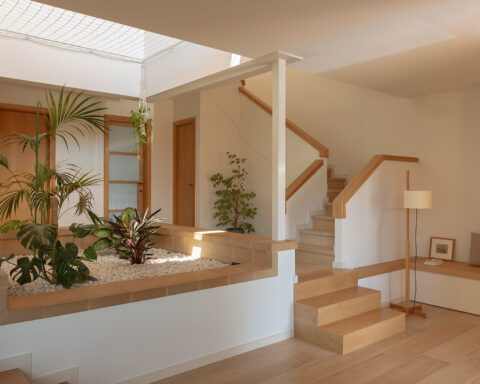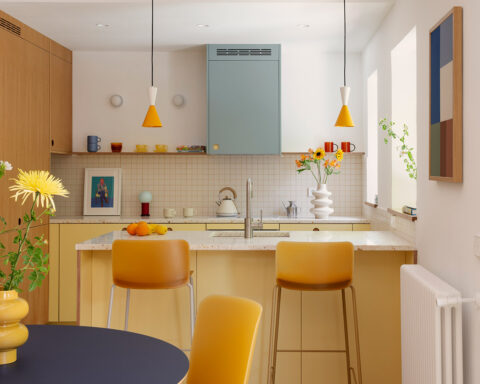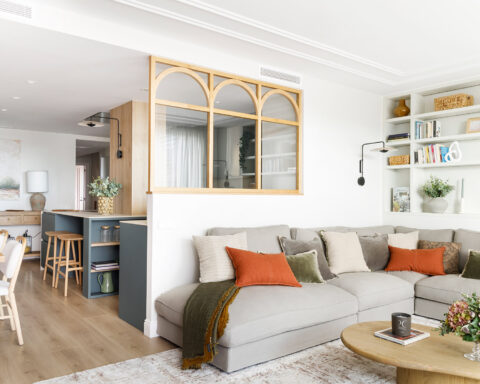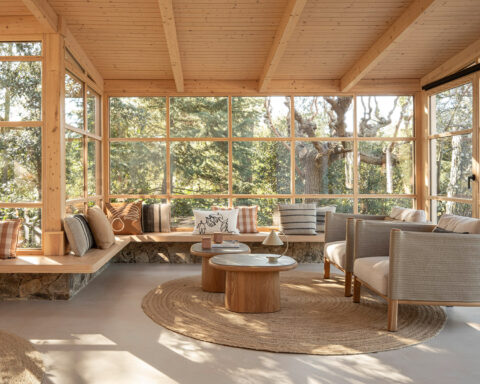


When Manuel first visited the apartment, he felt the strange sensation of having lived there before. He let his imagination drift to an ordinary Sunday afternoon, sitting with his favourite books as sunlight filled the living room through its five large windows. After reading, he pictured himself stepping out to take in Plaza Mayor and the Madrid of the Habsburgs he loves so much. After this vision, the decision to make the place his own came quickly. He contacted Gon Architects to adapt the apartment to his needs. Today, his life has changed completely — because the spaces we inhabit hold the power to transform how we live.
Renovating a home in Plaza Mayor means working in a place deeply layered with history and life. Rather than a stylistic operation, Gon Architects’ intervention reads as a domestic reinterpretation: how to reorganise an inherited space so that it becomes fully inhabitable today.
The apartment, just over ninety square metres, presented an ambivalent condition. On one hand, a privileged position and a generous envelope, with balconies and windows connecting the interior to the city. On the other, a fragmented internal structure, shaped by successive alterations lacking spatial coherence. Disconnected rooms, imprecise circulation and a large undefined central space formed a house with potential, but without a clear narrative.


Yet one element stood out: the existing wooden floor, extending across the entire apartment as a continuous surface, marked by tonal variations and traces of use accumulated over time. The architects recognised its value and not only preserved it, but used it as the conceptual starting point of the intervention. The floor becomes a form of material memory, reconnecting lived history with the present. Gon Architects works with the existing plan as if it were a system in unstable equilibrium, reorganising its parts until a new domestic order emerges. The result is a profound shift in how the space is inhabited.
One of the most significant changes is the reconfiguration of the relationship between bedroom and bathroom, now linked through a more logical and fluid sequence. Traces of earlier configurations are not erased but made visible through materials that register the passage of time. The house incorporates its history rather than concealing it.
The kitchen, once relegated to a secondary position, now occupies the centre of the home. This decision reorganises domestic life around an active social space. The house unfolds from encounter — cooking, conversation, sharing — shifting the focus inward.
The narrow, compressed entrance becomes a conscious threshold between public and private. A subtle manipulation of section and colour transforms this fragile point into a transitional element. From there, the home unfolds as a sequence of connected rooms, where boundaries are not always defined by doors but by shifts in texture, colour or depth. The elimination of corridors creates a new domestic topography. Irregularly shaped rooms connect organically, producing a continuous path that alternates between compression and expansion. Movement through the home becomes a spatial experience rather than simple circulation.


Furniture plays an active role in shaping the space. In some cases, it integrates as continuous storage; in others, it appears as a constellation of autonomous objects that define each room’s character. In the living-dining area, for example, elements are arranged without rigid hierarchies, encouraging an open domesticity adaptable to different uses and moments.
Colour introduces a second layer of reading. Red, blue, yellow and green appear at specific points, not as decoration but as spatial tools. Thresholds are emphasised, cores are intensified and certain elements take on an almost architectural presence. The house can thus be read across multiple registers: visual, tactile and atmospheric.
Beyond programmatic reorganisation, the project reflects on how to intervene in the existing. Against the logic of replacement, the proposal explores a practice grounded in displacement and continuity. It is less about adding more than about developing what is already there. This attitude translates into a home that activates relationships: between past and present, inherited structure and contemporary life, memory and everyday use. A dwelling that, rather than reinventing itself, acquires a new life.


Project: Casa Eme.
Location: Madrid.
Completed: 2025.
Area: 108 m2.
Architecture: Gon Architects.
Lead architect: Gonzalo Pardo.
Design team: Carol Linares, María Cecilia Cordero, Sara Mordt, Alvine Ikauniece, Alexandra Marouda, Manuel Domínguez.
Construction: Redo Construcción.
Furniture: Estantería LIESL (Moormann) / Mesa Arch Table (A01)
Photography: Imagen Subliminal (Rocío R. Rivas + Miguel de Guzmán).

Gon Architects
In the shifting landscape of contemporary Spanish architecture, Gon Architects emerges as a workshop of experimentation, sensibility and generosity: a practice based in Madrid, founded and led by Gonzalo Pardo since 2014.
Gonzalo Pardo, who graduated in 2007 from the Escuela Técnica Superior de Arquitectura de Madrid (ETSAM), earned his PhD in Architecture in 2016 with the thesis “Body and Home: Towards the Contemporary Domestic Space through the Transformations of the Kitchen and the Bathroom in the West”, awarded Cum Laude, the Extraordinary Doctoral Thesis Prize 2016–2017, and an Honourable Mention in the Arquia Foundation competition.
This intellectual background—profound and reflective—does not look to the past as an act of reverence, but rather as a platform from which Pardo ventures to reinvent the contemporary habitat with both boldness and delicacy. His studio understands architecture as a complex creative process, where meticulous observation and the care for detail merge with a playful, experimental, critical and optimistic gaze towards our present time.
From the outset, Gon’s practice has unfolded across multiple scales: urban planning, rehabilitation, housing construction, interior transformation, and even ephemeral interventions or furniture design.
Since 2007, Pardo has combined his professional work with teaching. He has been a guest professor at institutions such as the Istituto Europeo di Design (Madrid), the Illinois Institute of Technology (Chicago), Lund University (Sweden), and the Master in Collective Housing (MCH) in Madrid. He has also taught in the Master in Architectural Communication (MaCA) and the Master in Advanced Architectural Projects (MPAA) at ETSAM, where he is currently an associate professor in the Department of Architectural Projects. He is a member of the research group Hypermedia: Workshop for Architectural Communication and Configuration, where he supervises doctoral theses, master’s dissertations and undergraduate projects.
The work of Gon Architects has received and continues to receive well-deserved recognition. Since the year 2000, Pardo has accumulated around forty-one national and international awards. Among them are the first prize for the renovation of the AZCA block in Madrid (2007) and, more recently, the first prize in the competition for the design of the Archaeological Centre of the city of Lancia (2021). Other milestones include awards, mentions and distinctions in competitions such as the international Skyscraper Competition (New York) or the Velux International Contest (Denmark), the Honourable Mention in Europan 14 (Barcelona, 2017), and being shortlisted for the FAD Awards for Architecture and Design 2020.
Beyond awards, what defines Gon Architects today is its determination to transform the world: to conceive architecture as a possible mediation towards a more sustainable, inclusive, dignified and free habitat. An ideal that permeates every project, large or small — every home, every interior space, every urban gesture — with the same poetic intensity and human commitment. This trajectory reveals a steadfast conviction: to place the human being, their spatial experience, their everyday life and their emotion at the heart of architecture as its generating principle.
Gon Architects
Galería Vallehermoso 4
28003 Madrid
info@gon-architects.com
gon-architects.com
@gonarchitects
Project by Gon Architects