

Domestic architecture sometimes finds its inspiration in a quiet gesture: shifting an element, opening a void, rethinking an inherited geometry. In Casa Binôme, Gonzalo Pardo and his team at Gon Architects turn that gesture into a luminous investigation in which the staircase—usually discreet, almost always utilitarian—becomes the protagonist of a home located in Madrid’s Conde Duque district.
The house belongs to Philippe, an investment manager with a deep passion for design, contemporary art and literature. His 80-square-metre interior penthouse, arranged as a duplex within a 1900 building renovated in 2006, no longer responded to his way of inhabiting: social and introspective, intense and delicate at once. The narrow 3.25-metre-wide structural bay, a rigid and overbearing metal staircase, excessive compartmentalisation, anonymous hotel-like bathrooms and the lack of space for books, objects and artworks all created constant frictions.
Philippe, wishing to “move without leaving”, sought to remain in the neighbourhood he loved by reinventing his own space. Thus began a transformation rooted in a desire that was as personal as it was architectural: to shape a home attuned to his life.


The staircase as interior topography
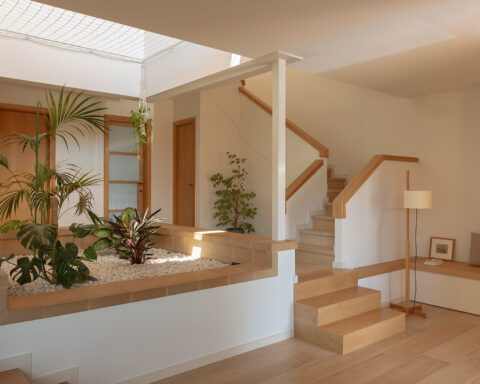
The project arises from the belief that the staircase could cease to be a barrier and become a structure of meaning. Not a mere vertical link, but an element capable of integrating uses, generating fluid paths and enabling new ways of living the house.
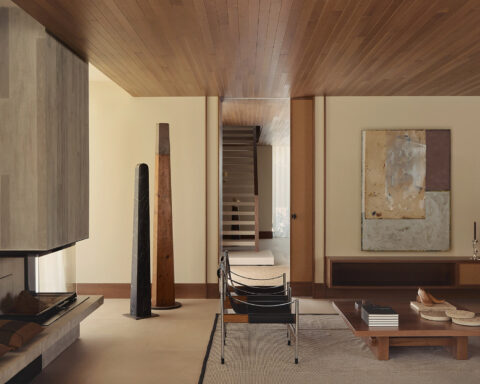
The first decision—bold and structural—was to shift it to the opposite end of its original position, opening a new opening in the slab and emptying the interior to reveal a continuous 181-cubic-metre volume. For months, the duplex became a kind of tabula rasa in which pillars, beams and the orientations of light emerged. Upon this bare stage, the new staircase appears: light, almost imperceptible, conceived to dissolve into the space.
Between the existing metal pillars, 7-centimetre-thick steel shelves are inserted and, at certain points, extend to become cantilevered steps. Below, a denser piece—a platform aligned with the first three steps—grounds the intervention and gives it visual weight, gently subverting Cortázar’s phrase: “the first steps are always the hardest.” The contrast between the solidity of the plinth and the lightness of the treads creates a choreographic effect: the staircase seems to float, becoming shadow, furniture, bench, seat, bookshelf, display surface or a quiet nook for reading or napping. The entire house revolves around it. What once separated and blocked now unifies and liberates.
A spatial binôme: connecting and containing
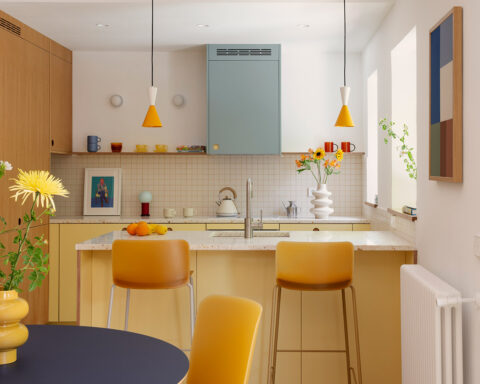
Gon Architects describes the staircase as a “spatial binôme” capable of connecting and containing simultaneously. Indeed, its presence reorganises domestic life: on the ground floor, the social and shared areas—kitchen, living room, dining room, terrace and a small guest toilet—unfold as a continuous indoor-outdoor realm; on the first floor, the private rooms—two bedrooms, a bathroom and a flexible central space—maintain a direct dialogue with the exterior through cross-ventilation and natural light. The home is no longer a traditional duplex but a double topography connected visually and materially. Almost diffuse, the staircase acts as a spine that articulates rhythms, heights and everyday scenes.


Tomette red: a floor that unifies and evokes
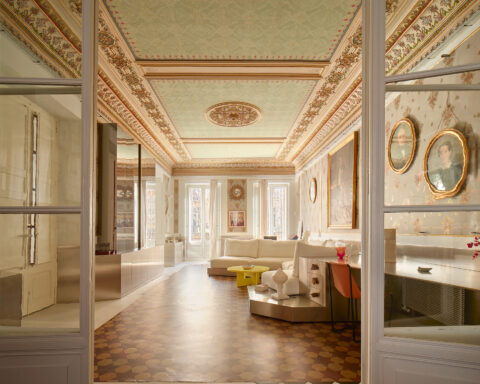
One of the most evocative gestures of the project is the choice of flooring. Philippe is originally from Plateau de Brie, southeast of Paris. Gon reinterprets that French background through the tradition of the tomette—hexagonal or octagonal terracotta tiles—translating it into a contemporary format of 1.20 × 0.60 metres. This deep, continuous and warm red extends seamlessly across interior and exterior, dissolving thresholds and reinforcing the spatial unity of the home.
Upon it, the pale pink staircase—almost a chromatic echo of the floor—unfolds like a stroke that accompanies movement from the library to the terrace facing the Torre de Madrid, whose distant silhouette recalls the Madrid of the 1950s, when it was the tallest building in Spain. In contrast, bathrooms, bedrooms and the kitchen use the same ceramic material in grey and blue tones, introducing subtle variations that organise functions without breaking the overall harmony.
Mirror: density, lightness and optical play
The other major material of the project is mirror, which envelops the volumes of the bathroom and the main bedroom on both levels. These reflective surfaces multiply space, dematerialise boundaries and generate changing scenes depending on daylight and the opening of doors and panels.
They are, as the architects describe, “secret rooms” that reveal and hide, amplify and soften. The mirror acts as a quiet counterpoint to the chromatic presence of the floor, adding layers of depth and visual vibration.
Casa Binôme is, at its core, a home conceived as a large continuous exterior. Without losing intimacy, it redefines it through a strategic transparency: one that allows Philippe to socialise without giving up his refuge, to recognise himself in a place that has evolved with him.
The staircase—an element that threads through the history of domestic architecture—takes on a new role here: it ceases to be an object and becomes a place. From the kitchen to the terrace, among books, lamps, artworks and reflections, it becomes the backdrop to Philippe’s everyday life. A silent yet decisive presence that turns each movement into an experience and every room into an interior landscape.


Project: Casa Binôme.
Location: Madrid.
Completed: 2025.
Area: 80 m².
Architecture: Gon Architects.
Lead architect: Gonzalo Pardo.
Design team: Carol Linares, María Cecilia Cordero, Alvine Ikauniece, Maria Konstantinidou, Nicolas Howden, Sara Mordt, Alexandra Marouda.
Construction: Redo Construcción.
Photography: Imagen Subliminal (Rocío R. Rivas + Miguel de Guzmán).
Source: Gon Architects.

Gon Architects
In the shifting landscape of contemporary Spanish architecture, Gon Architects emerges as a workshop of experimentation, sensibility and generosity: a practice based in Madrid, founded and led by Gonzalo Pardo since 2014.
Gonzalo Pardo, who graduated in 2007 from the Escuela Técnica Superior de Arquitectura de Madrid (ETSAM), earned his PhD in Architecture in 2016 with the thesis “Body and Home: Towards the Contemporary Domestic Space through the Transformations of the Kitchen and the Bathroom in the West”, awarded Cum Laude, the Extraordinary Doctoral Thesis Prize 2016–2017, and an Honourable Mention in the Arquia Foundation competition.
This intellectual background—profound and reflective—does not look to the past as an act of reverence, but rather as a platform from which Pardo ventures to reinvent the contemporary habitat with both boldness and delicacy. His studio understands architecture as a complex creative process, where meticulous observation and the care for detail merge with a playful, experimental, critical and optimistic gaze towards our present time.
From the outset, Gon’s practice has unfolded across multiple scales: urban planning, rehabilitation, housing construction, interior transformation, and even ephemeral interventions or furniture design.
Since 2007, Pardo has combined his professional work with teaching. He has been a guest professor at institutions such as the Istituto Europeo di Design (Madrid), the Illinois Institute of Technology (Chicago), Lund University (Sweden), and the Master in Collective Housing (MCH) in Madrid. He has also taught in the Master in Architectural Communication (MaCA) and the Master in Advanced Architectural Projects (MPAA) at ETSAM, where he is currently an associate professor in the Department of Architectural Projects. He is a member of the research group Hypermedia: Workshop for Architectural Communication and Configuration, where he supervises doctoral theses, master’s dissertations and undergraduate projects.
The work of Gon Architects has received and continues to receive well-deserved recognition. Since the year 2000, Pardo has accumulated around forty-one national and international awards. Among them are the first prize for the renovation of the AZCA block in Madrid (2007) and, more recently, the first prize in the competition for the design of the Archaeological Centre of the city of Lancia (2021). Other milestones include awards, mentions and distinctions in competitions such as the international Skyscraper Competition (New York) or the Velux International Contest (Denmark), the Honourable Mention in Europan 14 (Barcelona, 2017), and being shortlisted for the FAD Awards for Architecture and Design 2020.
Beyond awards, what defines Gon Architects today is its determination to transform the world: to conceive architecture as a possible mediation towards a more sustainable, inclusive, dignified and free habitat. An ideal that permeates every project, large or small — every home, every interior space, every urban gesture — with the same poetic intensity and human commitment. This trajectory reveals a steadfast conviction: to place the human being, their spatial experience, their everyday life and their emotion at the heart of architecture as its generating principle.
Gon Architects
Galería Vallehermoso 4
28003 Madrid
info@gon-architects.com
gon-architects.com
@gonarchitects
Project by Gon Architects