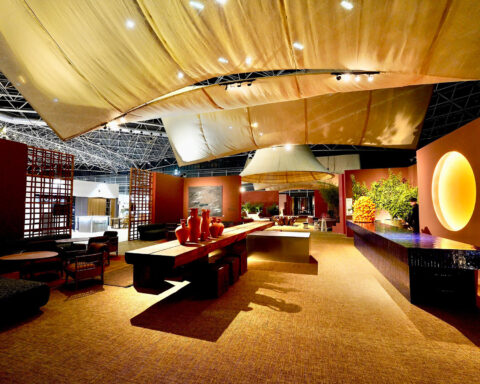


Light is one of the great protagonists of this edition of Madrid Design Festival (MDF25) which presents, for the first time in the history of the festival, a monographic exhibition on the relationship between light and space, with a sensorial experience curated by Javier Riera at the Fernán Gómez theatre. Centro Cultural de la Villa. Plaza de Colón, 4. Madrid.
La Línea Sueña, which can be visited from 6 February to 20 April as part of the Madrid Design Festival programme, shows the work of 45 creators through 70 different pieces that encompass different disciplines: interior lighting, product design and lighting installations. All of them share a sense of design closely linked to architecture and landscape and a particular vision of light in which the technical and the metaphorical run parallel.
With exhibition design by Studio Animal, its title refers to Paul Klee ‘s idea of drawing as an activity that connects the inner world with reality, a metaphor that is transferred to light as a trace in space.
Design, material and concept: the pieces of La Linea Sueña
La línea sueña highlights lighting design as a discipline. The show is organised around different thematic blocks, as perspectives from which to explore the works: Light in the landscape, In praise of penumbra, Light, form and matter, Sustainable light and The passing glow, the latter dedicated to the field of installation. The exhibition focuses both on the effects that light produces and on the elements that generate, emit or diffuse it, creating a coherent unity through design.
From alabaster lamps to luminaires made from urban waste such as polystyrene inspired by the lanterns of Granada, each creation offers a particular vision of light. Sustainability and innovation also play a key role with pieces made through 3D printing or designed with recycled materials, such as the wool lamps from Mallorca or the Tierra, Mar y Aire collection by Héctor Serrano.

The IED Madrid hosts during Madrid Design Festival, in the exhibition hall of the Palacio de Altamira, an immersive installation by Carmen Baselga and Héctor Serrano for Faro Barcelona. A proposal that invites us to reflect in an emotional way on the need to rethink our relationship with the planet. The installation presents the new Earth, Sea and Air collection of luminaires designed by Héctor Serrano.
Some of the most striking proposals in the exhibition La Línea Sueña are the lighting proposals by Draga & Aurel, Davide Groppi and Carlos Coronas. Also the lamp by Álvaro Catalán de Ocón, winner of the National Design Prize in 2023, made from recycled PET bottles by artisans from Ghana; lamps made from 3D printing with cayenne petals and naraja skin by Andreina Reventós; or the wool lamps by María Abando Olarán.
Also of note are proposals by iconic Spanish designers such as André Ricard or Antoni Arola, or creative collaborations such as Candela Cort’s with LZF. Even international figures present interventions such as Tom Dixon, Maximilian Marchesani or Michael Anastassiades.


Andreína Raventós
Andreína Raventós was born in Venezuela in 1986. She moved to Spain as a teenager and graduated from Architecture school in 2014. He has lived in different cities that have enriched his vision of different cultures and ways of life. After working in a studio in Geneva, he returned to Madrid and started his own studio in 2016. Read more.


María Abando Olarán
Born in San Sebastian and resident in Mallorca, she holds a degree in Fine Arts from the University of the Basque Country, a diploma in Industrial Design from the Scuola Politecnica de Design in Milan and a degree in interior design from the Escuela Superior de Diseño in Logroño. Dedicated for more than two decades to training in the culture of design, especially in the generation of forms, in Design for all People and Ergonomics, teaching at the former Escuela Experimental de Diseño, now Arte10 in Madrid and at the Escola d’Art i Superior de Disseny Illes Balears. Read more.


Amarist Studio
Active in collective design and contemporary art, Amarist Studio works within a framework of reflection and development of pieces that are critical of current international social, cultural and economic issues. A series of everyday objects and preconceived symbols are transformed into functional sculptures to stimulate awareness. Changing inherited concepts and highlighting the consequences behind our actions and interests. All the pieces are characterised by their colossal visual power, conveying challenging questions and issues of international current affairs. Read more.


Maximilian Marchesani
Maximilian Marchesani is Italian-German, trained in gastronomy, studied design, is an industrial design consultant, grew up between the banks of the Po River and Berlin, and lives in Milan. He presented his first lighting creations in 2022. Obsessed with the search for harmony between technology and the organic world, his installations invoke a continuous exchange between human interiority and global phenomena, between causes and consequences, between past and future. Read more.


Antoni Arola
Antoni Arola’s artistic research gravitates around an essential and immaterial element: light. He does so both in its absence and in its presence, whether natural or artificial. From this dialogue with light – and its interaction with space – he seeks to appeal to the viewer’s visual perception, inviting them to immerse themselves in a new world: intangible, poetic and always open to new interpretations. Read more.


Massimiliano Moro
Born in Switzerland, 1986, Maximiliano Moro is a sculptor who works with light, colour and movement with shadows as protagonists. He shapes light to give colour to shadow. His research seeks to create new balances that evoke nature in some aspects, but which are always aware of their artificiality and at the same time maintain a familiarity that facilitates contemplation. Read more.


Álvaro Catalán de Ocón
He began his career after studying Industrial Design at the Instituto Europeo di Design in Milan and at Central Saint Martins College of Art and Design in London, and later founded his studio in Barcelona. Catalán de Ocón’s designs are characterised by a strong focus on social and environmental responsibility. Read more.
The exhibition, which invites reflection on perception and creativity, features the participation of important artists and designers, whose works stand out for their innovation and their ability to transform environments through light. Some of them are Antoni Arola, Massimiliano Moro, We+, Maximilian Marchesani, Michael Anastassiades, Andreu Carulla, Mayice, Ábbatte, Marre Moerel, Eliurpi, Davide Groppi, Draga & Aurel, Josep Vila Capdevila, Jana Tothill, Héctor Serrano, Max Enrich, Eduardo Barco, Studio Élémentaires, Carlos Torrijos, María Abando Olarán, Candela Cort/LZF, Marta Pascual, Mario Ruiz, Ezequiel Nobili, Max Milá, Gracias Grecia, Lucas Muñoz, Álvaro Catalán de Ocón, Sergi Pequera/Suru, Carlos Coronas, Elisa Valero, Frank Oehring and Gonzalez Haase.
“All the works gathered together stand out for their innovation and their ability to transform environments through light, based on different ways of feeling and constructing elements designed to illuminate our surroundings. Thus, temperature, saturation and intensity are translated into emotional elements, highlighting the artistic power of light: light as an intangible element that touches us and penetrates our psychology far beyond our skin.” comments the curator of the exhibition Javier Riera.
Berlin, the guest city at this year’s festival, is part of the group exhibition with works by the well-known lighting designers of González Haase AAS that will create a connection with their appearance at Fiesta Design. Also, Frank Oehring will present an installation of his light sculpture of the mythical ICC Berlin. The exhibition gives visibility to Berlin talent throughout the festival and will strengthen the network between the Berlin design world and the festival’s international audience.

Javier Riera
Javier Riera’s work is based on geometric projections of light, made directly on vegetation and landscape. He uses photography as a means of recording and disseminating what has happened, without computer manipulation. He therefore focuses on an experience of real intervention on “the space and time of the landscape”, which brings him closer to the proposals of Land Art.
The relationship between geometry and nature acquires a meditative character in this work, appealing to the public’s coexistence with the suggestive power of the modification of the landscape they are witnessing, which aspires to broaden their perception, building bridges towards the hidden qualities and dimensions of the spaces in which it takes place. Riera understands geometry as a natural language prior to matter, capable of establishing a kind of subtle and revealing resonance with it.
Born in Avilés, Asturias, he studied Fine Arts in Salamanca and completed his training at the Talleres de Arte Actual del Círculo de Bellas Artes in Madrid. He worked as a painter until 2008, when he exhibited photographs of intervened landscapes for the first time at the Reina Sofía Museum.
Javier Riera’s work is based on geometrically shaped light projections, made directly on vegetation and landscape. He uses photography as a means of recording, without computer manipulation. His work is based on an experience of real intervention on “the space and time of the landscape“, which brings him closer to the proposals of Land Art.
The relationship between geometry and nature acquires a meditative character, appealing to the public’s coexistence with the suggestive power of the modification of the landscape they are witnessing, which aspires to broaden their perception, building bridges to hidden qualities and dimensions of the spaces in which it takes place. Riera understands geometry as a natural language prior to matter, capable of establishing a kind of subtle and revealing resonance with it.
His institutional exhibitions include Noche Áurea at the Museo Nacional Centro de Arte Reina Sofía (2008), Secuencias, Museo Barjola (2010); Sincronicidad at the DA2 in Salamanca (2014), Luz Vulnerada Centro Niemeyer (2015), Sector Primario, MUSAC (group exhibition 2015), Luz natural. Un vacío siempre distinto CAB de Burgos (2018) and Bonaval CGAC Santiago de Compostela (2018).
In relation to his work in public spaces, he has carried out specific interventions for Photoespaña, the MUSAC and the CAB in Burgos. Some of his most outstanding interventions include Alameda llum (2012), in which eleven of his installations remained for two months in the Jardines del Turia, or Gráficos Paramétricos (2017) in the Botanical Garden of Madrid, as part of Luna de Octubre, which received more than 6000 visitors. He has made interventions in places such as Annecy, France (2018/ 2019) or the Karlovo Námestí Park in Prague (2016). In 2018 he intervened in the gardens of Bonaval annexed to the CGAC. In 2019 he participates in UMBRA Vitoria-Gasteiz with a work for the Jardines de la Florida.
His work can be found in collections such as the Museo Nacional Centro de Arte Reina Sofía, the Fundación Cajamadrid, Fundación Princesa de Asturias, Colección Banco de España, DA 2 Domus Artium and the New Pilar Citoler Collection. Javier Riera teaches at the Master Photoespaña and at the Francisco de Vitoria University in Madrid.
Fuente: Madrid Design Festival y Lelien Agencia de comunicación.
Project by Javier Riera