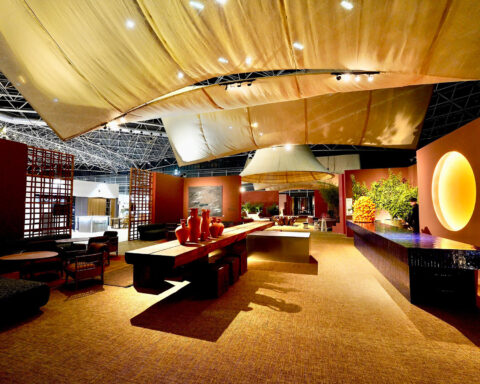


The ninth edition of Madrid Design Festival once again positions Madrid as an open laboratory where design is observed, discussed and tested in direct contact with reality. Organised by La Fábrica, the festival takes place between 5 February and 8 March 2026 under a motto that functions as a declaration of intent: Redesigning the world. An invitation to rethink processes, systems and ways of living through design understood as a transversal tool, capable of operating between industry and craftsmanship, innovation and economy, thought and everyday life.
The MDF26 programme is structured around four conceptual axes —responsibility, transcendence, impact and transmission— which act as a shared framework for very diverse projects, united by a common concern: how to design today with awareness of the consequences that every design decision generates over time, in the territory and in people’s lives. From this perspective, the festival addresses issues such as biodesign and biotechnology, material traceability, the circular economy, mobility, and the role of design in shaping new models of social and community relations. Craft occupies a central place here, as a living space of knowledge where identity, culture and know-how are projected into the future.
Forma Design Fair
Among the main new features of this edition is FORMA Design Fair, the first Spanish fair dedicated to collectible design, which will take place from 5 to 8 March. Conceived as a professional platform, FORMA is born with the aim of strengthening the economic value of design, generating real opportunities for designers, studios, brands and galleries, and consolidating Madrid as a relevant destination within the international contemporary design circuit. Integrated within the framework of the festival and developed with the institutional support of the Madrid City Council, Matadero Madrid and DIMAD, the fair seeks to build a stable economic ecosystem that benefits the city’s entire creative fabric.
Maison Parissienne, Rare, Vandenheede – Furniture Art Design, Mínima, Yukiko Kitahara, Vasco Fragoso Mendes, Regina Dejimenez Estudio, Difusions, Justino del Casar, Marco Calhau Handmade Collectibles, Studio Ejarque, Valuarte, La Ebanistería, Estudio Material, Attipico, Mush Myco Design, Ponce, Lignico, LZL, Grutta, SACo Sociedad Española de Artesanía Contemporánea, Nanimarquina, Arturo Álvarez, Estudio Cerisola, Todomuta Studio, Gärna Gallery, Sancal, among others, will take part in the first edition of FORMA Design Fair Madrid.

Madrid Design Pro
The Madrid Design PRO programme once again stands as one of the pillars of the festival. Over four days, design is explored and debated through masterclasses, round tables, conversations and workshops that bring together some of the most influential voices on the current scene. Professionals such as Patricia Urquiola, Luca Nichetto, Héctor Serrano, Christien Meindertsma, Loumi Le Floc’h and Liza Enebeis share the stage with studios, architects and designers working from social, community-based and experimental approaches. Artificial intelligence applied to design, the circular economy and regenerative leadership appear here as fields of work that demand critical positioning and in-depth knowledge.

Exhibitions and installations
The exhibition programme is once again based at the Fernán Gómez. Centro Cultural de la Villa, which will host three major exhibitions between 5 February and 3 May. André Ricard. Design in use reviews more than six decades of the industrial designer’s career through his most recognisable pieces and a design philosophy consistently linked to everyday life. Mediterranean Manifesto, curated by Mariona Rubio and co-produced with Cosentino, proposes a collective reading of the Mediterranean as a cultural, material and environmental territory through the work of more than thirty creators. Completing the programme is Textile art in Guatemala: design and identity, an exhibition that presents contemporary Guatemalan textile design in Spain for the first time, highlighting textiles as carriers of worldviews and ancestral knowledge reinterpreted through contemporaneity.

Fiesta Design
Fiesta Design, which will take place from 12 to 22 February at the Institución Libre de Enseñanza, reinforces the open and experiential character of the festival. Installations, workshops and presentations bring design closer to diverse audiences and demonstrate its ability to connect research, creativity and everyday life. Projects such as Generational Handover, directed by Kavita Parmar for Amazon; material-focused interventions promoted by Castilla-La Mancha; installations by Enorme Studio, Clínica Studio and Gianluca Pugliese; as well as the broad participation of schools such as IED Madrid, CEU Universities and UDIT, shape a journey in which design is understood as a shared cultural practice.
Madrid Diseña
The urban axis Madrid Diseña expands this perspective and turns the city into an active map of nearly three hundred participating spaces. Exhibitions, open studios, routes, meetings and educational activities unfold across different districts, with Chamberí joining this year the already established Carabanchel, Tetuán and Prosperidad. The aim is to strengthen the local design ecosystem, activate emerging urban economies and facilitate direct encounters between creators, institutions, commerce and citizens.
The programme is completed by initiatives such as the Wool Alliance, which works to protect and project the future of wool in Spain as a natural and cultural heritage, as well as various open calls inviting designers, studios and students to actively participate in the festival, from social design to the reactivation of peripheral industrial environments.
Beyond its scale and diversity, Madrid Design Festival 2026 confirms a coherent line of work: understanding design not as an end in itself, but as an instrument to reflect on the present and to rehearse possible futures. A space where a project is measured by its capacity for use, transmission and real impact on the way we inhabit the world.

LA FÁBRICA
Madrid Design Festival
Verónica 13. 28014 Madrid
+34 913 601 320
info@madriddesignfestival.com
madriddesignfestival.lafabrica.com
@madriddesignf