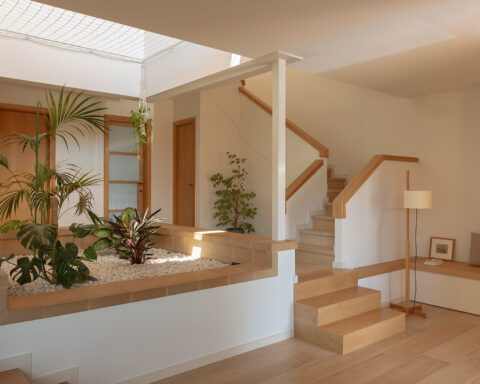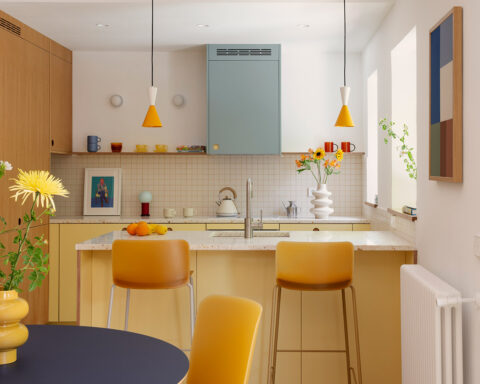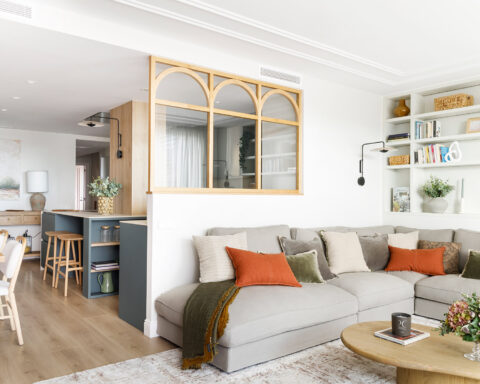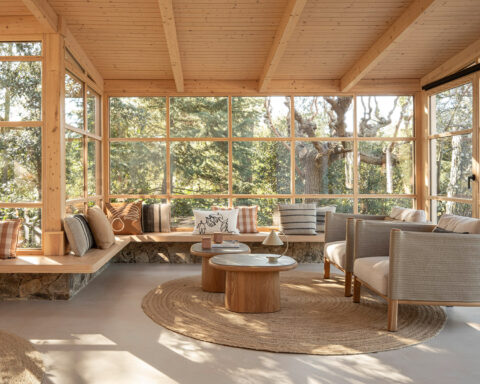


This project, which its authors have named The writer’s house, unfolds within a pre-existing home whose original organisation responded to a fragmented logic: enclosed rooms, interrupted routes, and a dark atmosphere that limited both the entry of natural light and the relationship between spaces. Estudio Boira’s intervention dismantles this compartmentalised legacy to build a new spatial continuity—more open, more legible, and aligned with contemporary forms of inhabitation.
The intervention seeks to reinterpret the character of the home. The studio proposes a reorganisation based on the relationships between rooms, the fluidity of movement, and the creation of visual axes that connect spaces not necessarily adjacent. Natural light becomes another material in the project, capable of traversing the interior and accompanying the domestic sequence throughout the day.
The new scheme rests on an architecture of symmetries and balances, where every gesture is carefully measured. Bespoke wooden joinery articulates the space with precision. Subtle touches of colour, variations in texture, and meticulously integrated details enrich the atmosphere without overwhelming it, allowing the rooms to breathe.


Art and literature: the project’s guiding axes
From the outset, the homeowners’ passions—art and literature—became the axis around which the proposal revolves. Not as added decorative elements, but as a structural part of the project itself. Contemporary artworks occupy central positions within the main spaces, bringing depth and contrast to a serene envelope dominated by white and wood. The house is thus conceived as a framework that accompanies and gives meaning to these contents.
The relationship between kitchen and dining room exemplifies this desire for continuity. Both spaces are separated by a folding screen in wood and mirror which, when fully opened, blurs physical boundaries and amplifies the perception of space. Reflections extend sightlines, prolong light, and reinforce a sense of depth, integrating uses without dissolving their individual identities.
In The writer’s house, balance and harmony are not pursued as abstract values, but as direct consequences of spatial composition. Vertical and horizontal planes engage in dialogue through patterns and rhythms that employ natural and noble materials—wood and stone—worked in different textures, formats, and tones. Every decision responds to a constructive and domestic logic, conceived to accompany everyday use.
The project thus proposes an integrated vision of architecture, interior design, and decoration, understood as inseparable parts of a single process. The container remains quiet, allowing life, books, and artworks to take their place. A home conceived to be lived through its spaces, its paths, and its pauses.


Project: The writer’s house.
Project type: Full renovation.
Location: Madrid.
Area: 800 m2.
Completed: 2025.
Interior architecture: Estudio Boira.
Architects: Berta Otero y Rocío Anós.
Photography: Javier Bravo.
Styling: Bea Torelló.
Source: Boira Estudio.


Estudio Boira
Estudio Boira was founded in Madrid in 2019 from the friendship and intellectual affinity between Berta Otero Pérez and Rocío Anós Población, architects trained at the Escuela Técnica Superior de Arquitectura de Madrid (ETSAM). Coming from different professional paths, both shared a common understanding of architecture as a balance between space, use and restrained emotion.
Before establishing the studio, Berta Otero developed her professional career in Madrid, working in studios specialised in retail projects, while Rocío Anós worked in London within a practice focused on cultural architecture. Two different contexts that, rather than setting them apart, helped to consolidate a shared language rooted in attention to detail, compositional clarity and an idea of beauty linked to harmony.
Boira is thus shaped as a studio focused on residential projects—comprehensive refurbishments and new-build homes—mainly in Madrid and Cantabria. Their work is based on a precise architectural approach, where each project is conceived as the construction of a serene and balanced spatial framework, capable of accommodating the life that unfolds within. “Building the void and then dressing it” is not a formal statement, but a way of understanding space as a structure that precedes inhabitation.
Symmetry, balance and warmth articulate an architecture that rethinks domestic space from a contemporary perspective, rooted in tradition yet attentive to new ways of living. Each project is developed from a deep understanding of those who inhabit it, to the extent that the works take their names: The writer’s house, The diplomat’s house, The pianist’s house. People are always the starting point and the final destination of the project.
Boira’s work offers an integrated vision of architecture, interior design and decoration, understood as inseparable parts of the same process. The container—serene and harmonious—is placed at the service of the content, avoiding unnecessary protagonism and prioritising overall coherence.
Berta Otero Pérez and Rocío Anós Población
Within the studio, Berta Otero and Rocío Anós share the conceptual development of each project and the reflection on new ways of living, although an unwritten internal dynamic places Rocío at the origin of the creative concept and Berta in charge of overseeing and managing the construction process. This complementarity reinforces an architectural practice that is equally attentive to the idea and to its material execution.
Both architects understand the project as a continuous process, in which design and construction form part of the same line of thought. Their architecture is built through listening, dialogue and careful attention to the real conditions of place, client and time.
Projects by Estudio Boira have been featured in publications such as Arquitectura y Diseño, El Mueble, Telva and La Vanguardia, consolidating a trajectory defined by coherence, restraint and an architecture conceived to be lived in.
Estudio Boira
+34 691 687 843
+34 606 020 301
info@estudioboira.com
www.estudioboira.com
@estudioboira
Project by Estudio Boira