
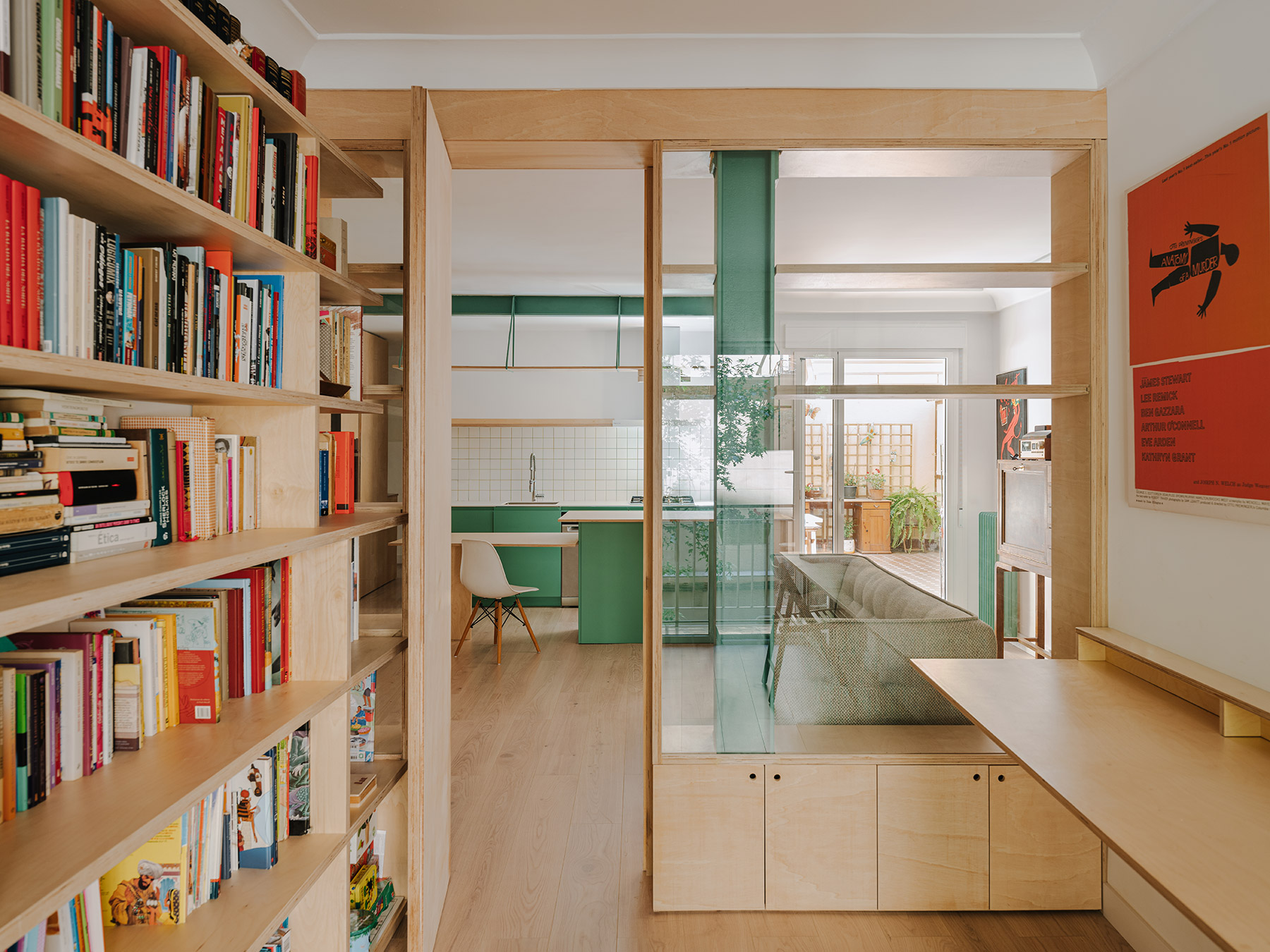
In the historic centre of Madrid, a few blocks from the Teatro Real, Idearch Studio — the practice founded by Syra Abella and Joaquín Mosquera — intervenes in a home that had accumulated decades of compartmentalisation. The starting point is twofold: to modernise without erasing, and to open without emptying. The first decision is also the most radical. The initial demolition responds to a kind of listening: the original floor plan held a potential that its layout refused to reveal. The apartment has façades on two orientations — an interior courtyard and the street — and the renovation works to connect them. Kitchen, living room and study are arranged in a longitudinal sequence that runs through the apartment from east to west, allowing for cross ventilation and natural light throughout the day. The shared spaces occupy the centre; the more private ones are distributed at either end.


Furniture that divides and connects, instead of walls
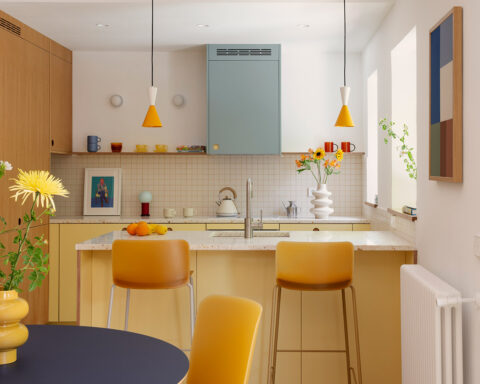
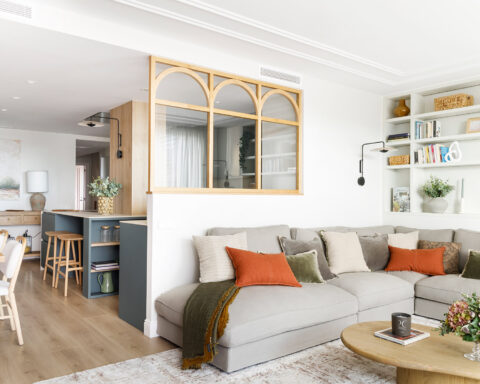
What elevates this project beyond a functional renovation is the way it resolves the boundaries between spaces. Instead of conventional walls or doors, Idearch proposes filters: pieces of furniture that separate and connect at the same time, with two sides of use and varying degrees of transparency. The kitchen opens onto the living room, but the two-height peninsula works simultaneously as a bar and a breakfast counter, while the upper shelving unit acts as a divider accessible from both sides. In the study, the enclosure is a piece of furniture: a timber and glass front with integrated shelving that also houses the doors leading to the study and the main bedroom. The joinery does the work that partition walls would conventionally do, with greater spatial and functional richness.
The material palette is deliberately concise. The existing metal structure is painted green — the same tone that runs through the kitchen furniture — turning a technical element into the project’s most visible chromatic gesture. Against that dense, matte green, the shelving, worktops and birch plywood work table bring warmth and continuity. The bathroom introduces a second scene: white tiles in the shower, relief terracotta ceramic cladding, and light wood on the vanity unit. Three materials that, in combination, generate a recognisable atmosphere, distinct from the rest of the home.


The result is a home that has gained in openness without losing in character. Light travels the full length of the plan, spaces communicate naturally, and the furniture functions as minor architecture: it organises, filters, stores and gives scale. Casa Espejo is a project that demonstrates that versatility does not require vagueness, and that the opening of a space can be built with the same precision as its enclosure.


Project: Casa Espejo.
Location: Madrid.
Completed: 2023.
Interior design: Idearch Studio.
Team: Syra Abella y Joaquín Mosquera.
Photography: Marta Vidal.
Source: Idearch Studio.

Idearch Studio
Idearch is an architecture studio founded in Madrid in 2009 by Syra Abella and Joaquín Mosquera. Since then it has developed projects across multiple scales and programmes — housing, retail, offices, public spaces — guided by a principle that runs through every commission: to give each built work its own singularity, from simplicity and honesty, attending to the essential values of architecture. Its clients include both private entities and public institutions.
The studio’s trajectory has received national and international recognition. The COAM 2019 Award for new construction, for the Casa-Estudio for an artist in Hoyo de Manzanares, was followed by selections in the Bigmat International Architecture Award 2021, the FAD Awards for Architecture and Interior Design 2021 and the Awards of the Council of Architects of Spain 2022. Competition work has also accumulated numerous prizes and mentions — among them first prize in the competition for the new headquarters of the COEM and a finalist position in the competition for the Central Library of Helsinki, from among 550 proposals. Their work has been published in outlets such as Tectónica, AV, ConArquitectura, Arquitectura Viva, Metalocus and Archello.
Abella and Mosquera regard practice and theory as inseparable parts of the same work. Both have taught at the ETSAM and at the Universidad Francisco de Vitoria, have published in specialist journals and books, and take part in university research groups. That dual presence — in the project and in reflection on it — is a constitutive part of the studio’s identity.
Joaquín Mosquera
Joaquín Mosquera holds a doctorate in architecture from the Universidad Politécnica de Madrid and is a professor of Architectural Design at the Universidad Francisco de Vitoria. Before founding idearch, he was part of the team at Dominique Perrault Architecture, where he served as architect in charge of works on the Caja Mágica Olympic Tennis Centre in Madrid — a large-scale project of singular importance for the city.
Awarded a postgraduate grant by the Fundación Caja Madrid to study at Columbia University in New York, he completed the Master of Science in Advanced Architectural Design and the Master in Advanced Architectural Research, rounding out that period with a sustained interest in photography alongside photographers of recognised standing. Back in Madrid, he co-founded idearch with Syra Abella in 2009. His work within the studio spans projects of different scales and typologies, with competition prizes and publications in numerous specialist media. Teaching and research are, for him, natural dimensions of architectural practice.
Syra Abella
Syra Abella graduated in architecture from the Escuela Técnica Superior de Arquitectura de Madrid and went on to develop her professional career over eight years at Espegel-Fisac Arquitectos, where she worked as architect in charge of works and projects. That extended and formative period gave her a thorough command of built practice in the field of contemporary architecture and urban planning.
In parallel, she deepened her interests in architectural visualisation and digital representation during a two-year stay in New York — disciplines she incorporated as fundamental tools in her way of working. In 2009 she co-founded idearch with Joaquín Mosquera, a studio from which she has developed architecture and interior design projects across a wide range of scales and programmes, recognised with national and international awards and published across a broad spectrum of specialist media.
Idearch Studio
Galileo, 69
28015 Madrid
studio@idearch-studio.com
+34 91 293 51 18
www.idearch-studio.com
@idearchstudio
Project by Idearch Studio