

In Madrid’s Salamanca district, a two-storey house —opening onto a garden patio and a terrace— has become something more than a family home. For Ana Arana and Enrique Ventosa, founders of the studio Plutarco, this project is also a statement of principles. The house functions as a domestic laboratory where the ideas guiding their practice unfold with complete freedom .“It has been a project where we were not afraid; we were able to design every last detail, and that is always a pleasure,” explain the interior designers. “It is precisely the manifesto of Plutarco: bringing together all the things we like in the same space.”
The starting point was a building constructed in 1934 that had remained abandoned for years. The house was in critical condition: deformed slabs, weakened structures and a layout completely altered by later interventions. Yet the designers chose to look beyond the physical deterioration in order to understand the original spirit of the place. “What was most interesting was paying attention to when it was built, in 1934, and researching what other modern movement villas were being built at that time in different parts of the world,” they explain.
This exercise in historical research became the guiding thread of the project. Rather than reconstructing a lost past, the designers sought to reconnect the house with the architectural culture of its time, establishing resonances with some of the most sophisticated European villas of the interwar period.
The glossy vaulted ceilings evoke the geometric elegance of Robert Mallet-Stevens; the mixture of marbles on the staircase recalls the Milanese villas of Piero Portaluppi. These are cultivated references, yet reinterpreted with an almost playful freedom.


An exuberant and domestic interior
In contrast to the minimalism that dominates much of contemporary Spanish interior design, this house embraces material density, colour and the deliberate mixture of references.
The living room is organised around the sofa designed by Cini Boeri for Arflex, a very welcoming piece that sets the domestic tone of the space. Beside it coexist a lamp by Ingo Maurer and a work by the artist Iván Franco, whose hyperrealist drawing appears, at first glance, to be a photograph.
The dining room continues this dialogue between architecture and everyday life. Here two references that the designers explicitly acknowledge appear: the moulded vault inspired by the villas of Mallet-Stevens and the mixture of marbles —particularly visible on the staircase— that recalls Portaluppi.
The furniture, designed bespoke by the studio, with the Escote chair as protagonist, seeks to reinforce the social character of the room.
“We love to think of dining rooms as spaces where the conversation after the meal can stretch on,” they explain. “That is why it is important for the dining room to be connected to the living room, to give continuity to those long conversations.”


The kitchen, the heart of the house
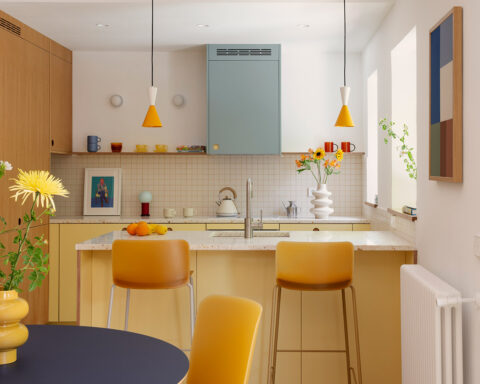
If there is one space where the philosophy of Plutarco becomes most evident, it is the kitchen. Here the mixture of materials becomes a compositional strategy. Two types of wood —cherry and pine stained in dark blue— coexist with terrazzo poured in situ on the island, a flooring that evokes Milanese entrance halls, and pale blue tiles with red joints. The result is a vibrant kitchen, where each material dialogues with the next. “We wanted to move away from the oak we use so often and try new combinations,” they explain.
Another recurring idea in the studio’s work also appears here: the so-called unexpected red, small red accents that interrupt a more restrained palette in order to generate visual tension.
Spaces that transform
The house is conceived as a flexible organism. In the dining room, a tiled folding screen functions during the day as part of the living room wall, yet when rotated it reveals a mirror that transforms the atmosphere of the space. A cinema room can open or close through perimeter curtains, creating an intimate environment or integrating with the living room.
Even the furniture responds to this shifting logic. The STV sofa, designed by Plutarco for Rabadán, is conceived as a family refuge capable of adopting multiple configurations. “The premise was to design a sofa for watching television: very soft, where the whole family can climb inside.”


A bedroom that embraces
On the upper floor the house adopts a more introspective tone. The main bedroom is covered with a night-blue vault dotted with small lights that evoke a constellation. On the ceiling, Jesús Colmenero painted a star map that symbolically refers to different views of the house. Here the atmosphere becomes deliberately enveloping. “Dark colours embrace you,” says Ana Arana.
The bathroom continues this language through soft curves, circular glass blocks and a mixture of materials including Chinese marble, elm burl and terrazzo.


The garden patio, an urban refuge
The garden patio, with its swimming pool and barbecue area, extends the experimental spirit of the interior. The striped paving dialogues with the green mosaic tiles of the pool and with blue tiles in the outdoor area. The vegetation —combining evergreen and deciduous species— has been designed to change with the seasons. A Virginia creeper climbs along the side wall, forming a vegetal screen that transforms the garden throughout the year.


Finding harmony by taking risks
Ultimately, what this house demonstrates is a particular way of understanding interior design as an art of combination. The designers themselves summarise it with a mixture of surprise and satisfaction: “Many times when people come in they say: ‘these are things I would never have used’. But even so, everything still feels harmonious.” Perhaps therein lies the true lesson of this project: demonstrating that it is possible to take risks with colours, materials and historical references without losing spatial coherence.
This is a house that not only accommodates family life but also clearly reveals the creative universe of those who designed it. More than a simple dwelling, the house is a silent manifesto —a place where interior design ceases to be an exercise in style and becomes a way of thinking about domestic life.
Project: PDLL70.
Location: Barrio de Salamanca (Madrid).
Area: 376 m2 + 112 m2 exterior.
Completed: 2025.
Interior architecture: Plutarco. Ana Arana y Enrique Ventosa.
Photography: Germán Saiz.
Source: Plutarco.

Plutarco
Within the recent landscape of Spanish interior design, the studio Plutarco has gradually built a distinctive trajectory that combines architectural research, material experimentation and a profound attention to domestic life. Founded in Madrid by Ana Arana and Enrique Ventosa, the studio works across interior architecture, furniture design and art direction, developing a language where history, colour and materiality coexist with notable creative freedom.
Plutarco’s work begins with a cultural reading of space. Some projects —such as the one presented on this page— start with a careful interpretation of the architectural context and the historical moment in which buildings were conceived. This approach, closer to architectural research than to conventional decoration, allows the studio to construct interiors where references to European modernism, Italian design or twentieth-century domestic architecture are reinterpreted through a contemporary sensibility.
One of the most recognisable traits of their work is the deliberate mixture of materials, colours and formal references. Marble, terrazzo, stained woods, ceramics and textiles are combined in their projects through a compositional logic that seeks to generate rich and complex atmospheres, far removed from the minimalism that dominates much of contemporary interior design. Yet this material diversity never translates into excess: the spaces always maintain a surprising sense of balance and harmony.
The domestic dimension occupies a central place in their understanding of design. For Plutarco, interiors are not conceived as scenographies but as settings for everyday life, where spaces develop around the real dynamics of those who inhabit them: long conversations after meals, family gatherings, reading corners or informal meeting places.
This sensitivity also appears in their furniture design, where pieces are conceived specifically for each project. Sofas, tables or luminaires designed bespoke become integrated into the interior architecture as part of a single spatial strategy.
Throughout their trajectory, the studio has developed residential projects, commercial spaces and collaborations with design brands, consolidating a practice that moves between interior architecture and product design.
Among their most representative works is the project described on this page. In it appear many of the ideas that define their work: historical research, freedom in the combination of materials and an interior architecture deeply connected to domestic experience.
With a sensibility that dialogues with some of the most interesting European studios of their generation, Plutarco represents one of the most singular voices in contemporary Spanish interior design. Their work suggests a way of understanding design in which interior architecture once again occupies the intersection between culture, materiality and everyday life.
Plutarco
Quesada 2
28010 Madrid
hola@plutarco.design
plutarco.design
@hola.plutarco
Project by Plutarco